Skip to the main content.

THE AI THAT ACTUALLY UNDERSTANDS YOU.

Hey Compono helps you understand your personality and how to turn it into your superpower.

First 1,000 users get 10 minutes free.

Just $15 a month after that — cancel anytime.

Hey Compono!

The AI coach that actually gets you.

First 1000 users get 10 minutes free.

Get Started ≫

4 min read

She sends candidates the interview questions in advance. Here's why it works.

She sends candidates the interview questions in advance. Here's why it works.

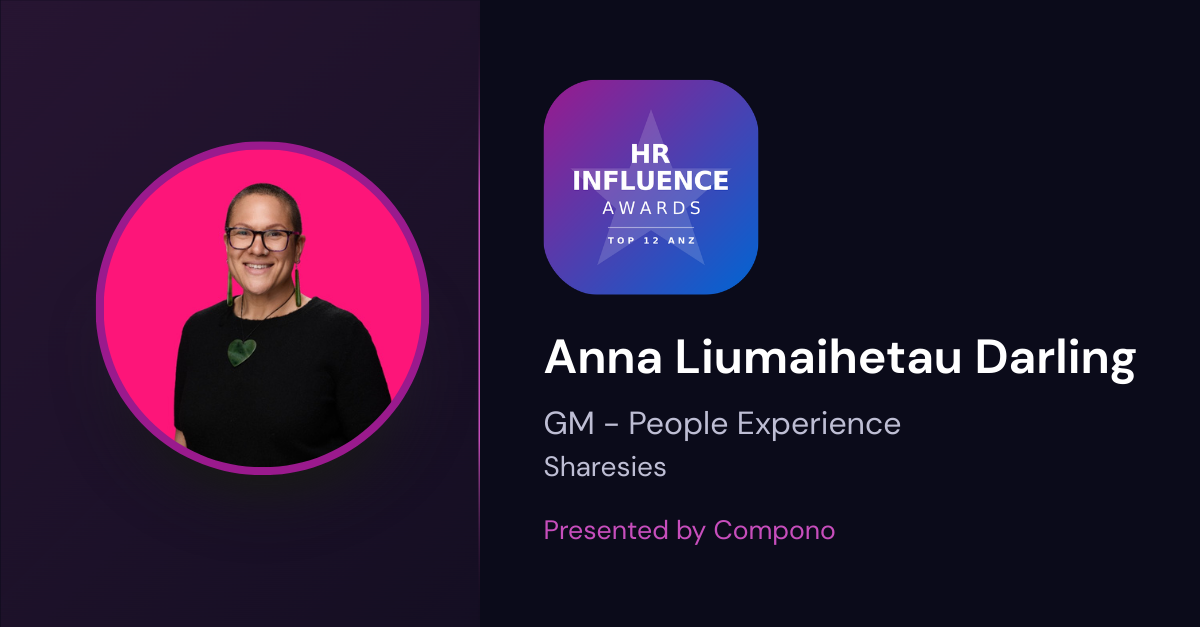
Anna Liumaihetau Darling, GM of People Experience at Sharesies, gives every candidate the interview questions before they walk in the door. Not a rough outline. Not a "here's what to expect." The actual questions. And the results have changed how her entire company thinks about hiring.

In this article:

  • Sharesies sends all interview questions to candidates in advance, along with interviewer bios and dress guidance, and candidates consistently rate it as a standout hiring experience.
  • Anna Liumaihetau Darling's career path, from call centre worker to NZ Rugby to GM of People Experience at one of New Zealand's most watched fintechs, shaped her conviction that people practices should be built with employees, not imposed on them.
  • Her approach to "culture add" over "culture fit" challenges the common hiring assumption that finding people who match your existing team is the same as finding people who'll make it better.
  • Anna is one of the 2026 HR Influence Awards Top 12 ANZ, recognised for her work in Pasifika representation and indigenous financial empowerment, and for building a people function that operates as an enabling team rather than a support function.

I sat down with Anna for the HR Influence Awards earlier this year. She's one of the 2026 Top 12 ANZ, and the conversation stuck with me. Not because she said anything designed to be provocative. Because she said things that were obviously right, and made you wonder why more people aren't doing them.

The case for sharing interview questions

Most hiring processes are built around surprise. You walk in, you get asked something you didn't expect, and the interviewer watches how you handle it. The assumption is that pressure reveals the real person.

Anna doesn't buy it.

"Some scary boss is not going to come up to you at your desk and go, 'tell me about a time when...'" she told me. "That's just not how we work."

Her point is simple. Springing questions on someone in a high-pressure, artificial setting doesn't tell you who's best for the job. It tells you who's best at performing under artificial pressure. Those are different skills. For most roles, they're completely different skills.

At Sharesies, candidates get the questions beforehand. They get a brief bio of who they'll be meeting. They even get guidance on what to wear. The goal isn't to make the process easy. It's to make it fair. And to get better information about who the person actually is when they're not in fight-or-flight mode.

The feedback from new hires consistently backs it up. People call out the questions-in-advance approach as the moment they knew Sharesies was different.

Culture add, not culture fit

The other thing Anna said that I keep coming back to is her distinction between culture fit and culture add.

Culture fit sounds reasonable on the surface. You want people who work well with your existing team. But Anna points out that in practice, it tends to produce teams where everyone thinks and looks the same. Even when nobody intended that.

"You look at your own family and you can tell that every single person has their own personality," she said. "We can't treat every single employee the same."

Culture add flips the question. Instead of asking "does this person match what we already have?" you ask "does this person bring something we're missing?" It's a subtle shift in language that changes who gets hired.

This is something we think about a lot at Compono. Our Hire platform uses behavioural profiling alongside traditional recruitment to surface whether a candidate will genuinely add to a team's culture, not just mirror it. It's the kind of shift Anna is describing, built into the process rather than left to gut feel.

From support function to enabling team

One more thing worth pulling out. Anna renamed her team at Sharesies. They used to be a "support team." Now they're the "enabling team."

It sounds like a small word change. But internally, it shifted how the rest of the company interacted with them. Support means you're there to catch people when they fall. Enabling means you're there to help them run faster.

That reframe is something every HR leader should sit with. The language you use to describe your own function shapes how the business treats you. If you call yourself support, you'll be treated as support. If you position yourself as the team that helps the business move, you get invited into different rooms.

Anna's team now includes a business partner embedded across teams and a capability manager who doubles as an executive coach. That's not a support function. That's a strategic one.

The full story

There's a lot more in the full feature, from Anna's time developing women's rugby in New Zealand, to her work on the Rautaki Working Group helping build financial empowerment for Māori communities, to the advice she'd give her younger self about HR.

She's a Pasifika leader in a space that doesn't have many, and her perspective on belonging and what it means to actually build for the people in the room is worth your time.

Read the full feature on the HR Influence Awards site, or watch our conversation on YouTube.

See how culture-fit hiring actually works

Anna's approach at Sharesies shows what happens when you design hiring around people rather than process. If you're curious how behavioural profiling can surface culture add (not just culture fit) in your own hiring, we can show you.

See how it works – take a look at Compono Hire and see what your current ATS isn't telling you about your candidates.


Anna Liumaihetau Darling is GM of People Experience at Sharesies, Auckland. She is a 2026 HR Influence Awards Top 12 ANZ, HRNZ People's Choice nominee, and NZ HR Summit 2025 speaker. Connect with her on LinkedIn.

The HR Influence Awards is presented by Compono. The 2026 program recognises the top 12 HR and people leaders across Australia and New Zealand.


Frequently asked questions

Should you send interview questions to candidates in advance? Sharing interview questions beforehand gives candidates time to prepare thoughtful answers, which produces better signal about their actual capabilities. Sharesies has used this approach successfully, with new hires consistently rating it as a standout part of the hiring experience. It doesn't make the interview easier. It makes it fairer.

What is the difference between culture fit and culture add? Culture fit asks whether a candidate matches the existing team. Culture add asks whether they bring something the team is missing. HR leaders like Anna Liumaihetau Darling at Sharesies advocate for culture add because culture fit, in practice, tends to produce homogeneous teams even when diversity is the stated goal.

What are the HR Influence Awards? The HR Influence Awards is an annual program presented by Compono that recognises the top 12 HR and people leaders across Australia and New Zealand. The 2026 cohort was selected by an independent judging panel based on influence and impact in the people and culture space.


Related

OzHarvest's one hiring rule that protects culture

OzHarvest's one hiring rule that protects culture

OzHarvest protects its culture with a single hiring rule: "if it's not a hell yes, it's a hell no." Sharon Gray, the charity's Chief People Officer...

Read More
Unlocking the Power of HR: What 52 Companies Taught Us About Culture, Leadership and Impact

Unlocking the Power of HR: What 52 Companies Taught Us About Culture, Leadership and Impact

A white paper by Compono - August 2025 Why HR Still Feels Stuck and How to Change It In boardrooms across Australia and New Zealand, something...

Read More
How Safety Culture can be Operationalised for the Workforce

How Safety Culture can be Operationalised for the Workforce

As CEO of Compono, I’m a firm believer that it’s simply not enough for me and my team to focus only on building intelligent software. It is also...

Read More