


 Gigi Curley

Solving the AI slop problem in recruitment software
 Mathan Allington
AI-written applications are clogging hiring pipelines. Why keyword filters miss them, and how matching on work personality surfaces real candidates.

Inclusive hiring improves when you redesign the hiring process so every candidate is measured against the same criteria, not when you add another commitment to the careers page. That's the core finding of a new World Economic Forum (WEF) article on workplace inclusion. For HR leaders, it's a useful prompt to look at how screening really works in your team, not just how it's meant to.
In short
- The WEF argues that organisations making real progress on inclusion treat it as an organisational design challenge, building fairness into the systems behind everyday decisions.
- A WEF Executive Opinion Survey of more than 10,000 business leaders across 110 economies found no underrepresented group is perceived to have fully equal access to workplace opportunities.
- Structured hiring criteria and standardised evaluation are two of the levers the WEF names for making fair outcomes the default.
- In hiring, that means setting criteria before applications arrive, assessing every candidate the same way and keeping a person accountable for the final decision.
Most HR leaders don't need convincing that inclusion matters. The harder question is why outcomes still lag behind the intent.
The WEF's article, How leading organizations are redesigning workplace inclusion by Karolina Anda Juodpusytė, Manager of Economic Inclusion at the WEF, puts it bluntly. Across more than 10,000 business leaders in 110 economies, no underrepresented group is seen to have fully equal access to workplace opportunities.
That gap sits alongside problems every employer recognises: labour shortages, ageing workforces, persistent skills gaps and fierce competition for talent. Overlooking capable people isn't just unfair. It's a cost few organisations can afford.
The WEF's answer is to stop relying on individual intentions. The organisations pulling ahead aren't spending more or making louder promises. They're building what the article calls "fairness that works" into how decisions actually get made.

Picture your busiest hiring manager with 200 applications and an afternoon to get through them. A diversity statement won't change what they do next. A process that sets the criteria in advance will.
The WEF points to four practical levers:
The aim is consistency and accountability, so the same standard applies no matter who's reviewing.
For hiring, that translates into a few habits. You define what good looks like before the role goes live. You assess every candidate against those same measures. You can explain why someone progressed, and someone owns the process well enough to check it's working.
Most hiring tools handle the process side of this well. They post jobs, track candidates through stages and keep the paperwork in order. That matters, and it's a solid foundation.
What's often missing is the people side. If the first real filter is a CV, the process is consistent, but it's consistently rewarding the most familiar career paths. Steps that run the same way every time aren't the same as criteria that judge people fairly.
Consistent screening starts before the job ad goes live. The hiring team agrees on the skills, experience and behaviours that matter for the role, and writes them down. Every applicant is then assessed against that same set of measures, in the same order, before anyone forms a gut feel from a CV.

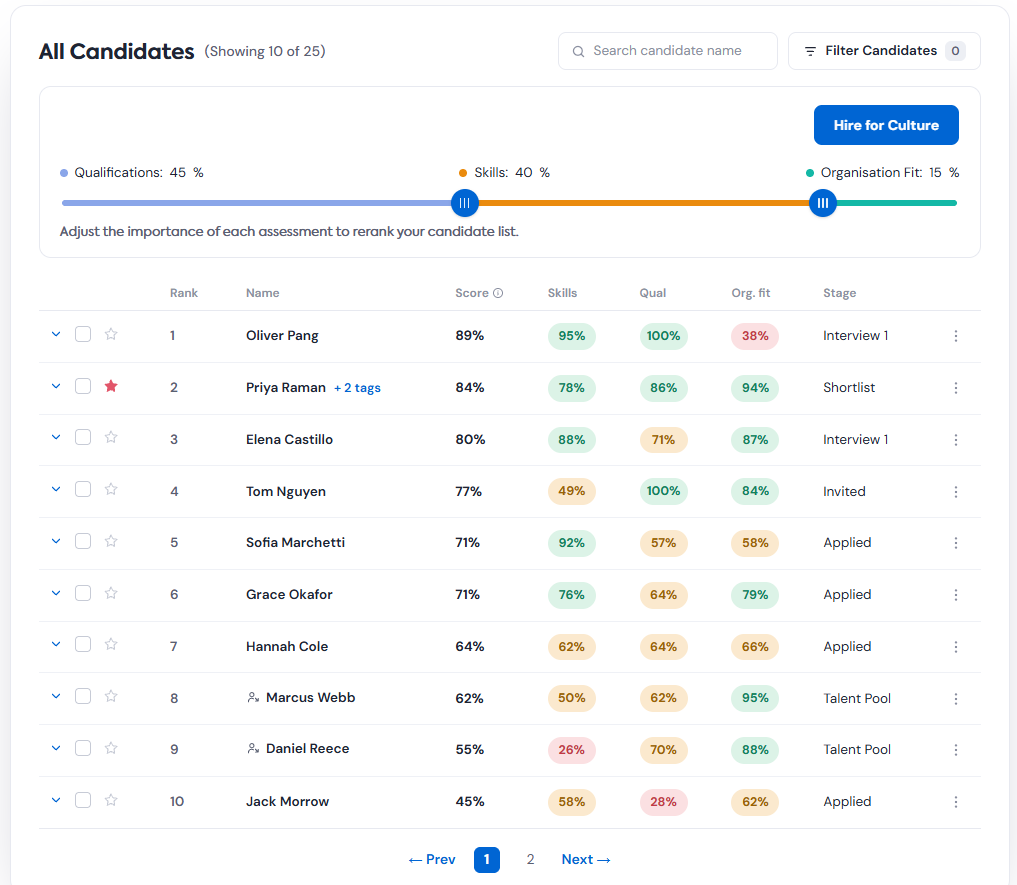
Behavioural assessment can help here, because it gives every candidate the same opportunity to show how they work, regardless of where they've worked before. It also gives reviewers something consistent to compare, rather than reading between the lines of very different CVs.
This is the approach we've taken with Compono Hire, where each applicant completes the same validated Work Personality assessment as part of applying. Teams that hire at pace tell us the repeatability matters most. Lyre's Spirits Co. credited consistent screening criteria with keeping its teams aligned while it grew from 4 to over 70 people across five continents.
Consistency alone isn't inclusion. But inclusion rarely holds up without it.
The WEF highlights organisations building new pathways for people returning from career breaks, people from lower socioeconomic backgrounds, people with disability, neurodivergent talent and experienced workers later in their careers. The article frames this as a business decision as much as a social one, because wider access builds stronger, more resilient pipelines.
Changing what you screen for first changes who gets noticed. When a shortlist weighs how someone works alongside their qualifications, a candidate with a non-linear career has a better chance of being seen. Someone returning after five years of caring for family may bring exactly the judgement and resilience the role needs, even if their CV has a gap.
It also helps to keep strong past applicants in view. A good candidate for one role is often a good candidate for the next, if you have a way to find them again.
There's a limit worth being clear about. No screening method replaces the conversation about workplace adjustments for candidates with disability or neurodivergence. That responsibility stays with your team, and it deserves its own plan. What a consistent screen gives you is a fairer starting point.
The WEF notes that leading organisations are moving beyond broad diversity metrics to granular data that shows where barriers appear across hiring, promotion, pay, retention and employee experience. It's equally clear on AI: it can improve consistency and fairness at scale, but only with high-quality data, strong governance and meaningful human oversight.
A practical place to start is the data you already have. Look at who applies for your roles and where candidates stall in your pipeline. If one group consistently drops out at the same stage, that stage is worth a closer look.
Whatever tools you use, rankings and scores should inform a decision, not make it. Your team reviews the shortlist, runs the interviews and owns the outcome.
Barriers don't disappear after the offer letter either. How people experience your culture once they're in matters just as much, and it's far easier to act on early signals than on exit interview feedback.
Governance applies to your tech stack as much as your policies. Before you trust a tool with your shortlist, ask:
They're fair questions for any vendor, including us. The answers will tell you a lot about whether a tool supports your inclusion goals or simply sits alongside them.
Fairer hiring doesn't come from trying harder. It comes from deciding what good looks like, applying it to everyone and checking the results. That's the shift the WEF describes, and most HR teams can start on it with the process they already have.
If you'd like to see what consistent, behaviour-informed screening looks like in a real hiring process, we're happy to show you. No pressure, just a look at how it works.
See how it works. Talk to us and we'll walk through how Compono Hire approaches screening, using your own roles as the example.
Inclusive hiring is a recruitment approach designed so candidates from different backgrounds have a fair chance of being assessed on what matters for the role. It relies on consistent criteria, standardised evaluation and clear accountability rather than goodwill alone.
Set structured criteria before you review applicants, assess every candidate against the same measures and track who applies and who progresses. The WEF also recommends stronger governance, so someone owns the process and reviews whether it's working.
According to the WEF, transparent systems with clear, consistently applied criteria support better decisions and make fair outcomes the default. Structure doesn't remove human judgement. It gives that judgement a consistent starting point.
An applicant tracking system (ATS) can apply the same criteria to every candidate and show you where people drop out of your pipeline. It can't replace governance or individual adjustments, so it works best as one part of a well-designed process.
Gigi Curley is the COO at Compono, an Australian people and culture platform that combines hiring, culture, and learning with people insight.

AI-written applications are clogging hiring pipelines. Why keyword filters miss them, and how matching on work personality surfaces real candidates.
Every HR Influence Awards 2026 winner admitted to making a bad hire. Here's what six of Australia and New Zealand's top people leaders learned about...

Team communication breaks down because people process information differently. How to spot the mismatch and what to change in meetings and handovers.