

 Mathan Allington

You generally cannot ask about religion in a job interview in Australia, as religious belief is a protected attribute under federal and state anti-discrimination laws.
Last reviewed November 2026
Key takeaways
- Federal and state laws prohibit employers from asking interview questions that could lead to discrimination based on religious beliefs.
- Faith-based organisations and religious schools have specific legal exemptions, provided the religion is a genuine occupational requirement of the role.
- Hiring managers should ask about the underlying job requirement, such as weekend availability or shift work, rather than asking about religious observance.
- Structured interviewing tools help businesses assess candidates on skills and behavioural fit while removing non-compliant conversational bias.
The line between building rapport and breaking the law
Most hiring managers do not enter an interview intending to break employment law. They start with a desire to build rapport. They want to get to know the person sitting across the desk. They ask about weekend plans, public holidays, or community involvement. Yet this unstructured, conversational approach is exactly where process risk enters the hiring cycle.
When an interview feels like a casual chat, managers often stumble into protected territory. A question about what a candidate does on Sundays might seem harmless, but it can force the applicant to disclose their religious practices. If that candidate does not get the job, they may legitimately claim they were discriminated against because of their faith.
Traditional recruitment software tracks resumes and approvals, but it rarely stops a hiring manager from going off-script. To protect your organisation and ensure fair hiring, you need to understand the legal boundaries. You must train your team to separate the inherent requirements of the job from their personal curiosity about the candidate.
The legal framework protecting religious belief
Australian employment law provides reliable protections for job seekers. Religion is a protected attribute in Australian employment law, and questions about religious belief can create discrimination risk during recruitment, according to the Fair Work Centre. These protections exist at both the federal and the state level.
The Fair Work Act 2009 prohibits adverse action against prospective employees for protected reasons, including religion, as highlighted by The Recruitment Alternative. Refusing to hire someone because of their faith is a clear example of adverse action. Asking questions about religion during the recruitment process implies that the answer will influence your hiring decision.
State and territory anti-discrimination laws add another layer of compliance. While the specific wording changes across borders, the core principle remains identical. You cannot use a person's religious affiliation to disadvantage them in the job market.
Jurisdictional differences across Australia
The federal framework applies broadly, but state tribunals often handle individual complaints. HR leaders managing national workforces need to understand these local nuances.
In Victoria, the Equal Opportunity Act 2010 explicitly lists religious belief or activity as a protected attribute. The Queensland Anti-Discrimination Act 1991 offers similar explicit protections. In New South Wales, the Anti-Discrimination Act 1977 does not list religion as a standalone category. Instead, tribunals in New South Wales commonly apply protections through the category of ethno-religious origin.
Regardless of which state your office is in, the safest approach is universal compliance. You should treat religious belief as strictly off-limits during the screening and interview phases.
When faith-based organisations can ask about religion
The law recognises that some organisations have a legitimate need to consider religious affiliation when hiring. Section 351 of the Fair Work Act contains specific exemptions for religious institutions. These exemptions allow certain employers to ask about faith and make hiring decisions based on religious belief, provided they meet strict legal criteria.
This exception typically applies to faith-based schools, religious charities, and religious hospitals. However, the exemption is not a blanket pass. The action must be taken in good faith and must be necessary to avoid injury to the religious susceptibilities of the followers of that religion.
According to Walsh Legal Group, religious-belief questions may be permissible only where they are directly relevant to the role's genuine requirements; hiring decisions should otherwise focus on skills, qualifications and experience. For example, a Catholic school can likely require its religious education teachers to be practising Catholics. The same school would have a much harder time justifying why its groundskeeper or payroll officer must share the same faith.
How to assess availability without asking about religion
Managers often ask inappropriate questions because they are trying to solve a real business problem. They need to know if the candidate can work the Saturday morning shift. They need to know if the candidate requires a month of leave during the busy season. The error lies in how they frame the question.
According to Your HR Toolkit, questions such as "What religion do you practise?" or "Do you attend church or a place of worship?" should generally be avoided in Australian interviews. When a manager asks these questions, they assume the answer will tell them about the candidate's availability. This is poor interviewing technique.
You must teach your hiring managers to ask directly about the inherent requirements of the role. If the job requires weekend work, ask about weekend work. If the job requires specific uniform compliance for safety reasons, ask if they can meet the safety requirements.
Scripts for legitimate interview inquiries
Replacing flawed questions with precise, job-related questions removes the legal risk while giving you the exact information you need. Legal experts at Sprintlaw suggest a safer interview formulation: "This role requires availability on Saturdays. Are you able to commit to that schedule?" rather than asking about religion or religious observance.
Here are practical examples of how to shift the conversation away from protected attributes:
| High-risk question (Do not ask) | Compliant question (Ask this instead) |
|---|---|
| What religion do you follow? | Are there any working conditions or arrangements we should discuss to help you perform this role? |
| Do you need time off for religious holidays? | This role requires full-time availability during our peak season in December. Can you meet this requirement? |
| Will your faith prevent you from working on weekends? | Our standard roster includes Saturday and Sunday shifts. Are you available to work on weekends? |
| Does your religion require you to wear specific clothing? | This role requires you to wear personal protective equipment (PPE) including a hard hat. Can you comply with this safety requirement? |
By focusing entirely on the roster, the physical environment, and the tasks, you evaluate the candidate strictly on their capacity to perform the work. If you are unsure whether your current interview scripts are compliant, you can check them against the standard rules for interview questions you can't ask in Australia.
What to do when a candidate volunteers the information
Even with perfectly compliant questions, candidates will sometimes volunteer information about their religious beliefs. A candidate might explain a gap in their resume by mentioning missionary work. They might answer an availability question by saying they cannot work Friday afternoons because they attend a mosque.
When this happens, the hiring manager must not panic, but they also must not probe. Acknowledge the information politely, confirm the availability requirement, and move on to the next job-related topic.
The manager should note down the candidate's actual availability limit rather than the reason for it. The interview notes should reflect that the candidate is unavailable on Friday afternoons, not that the candidate attends religious services. Keeping your records strictly focused on the business requirement protects your organisation if the hiring decision is ever challenged.
Handling reasonable adjustments
Australian employers have a legal obligation to make reasonable adjustments for their employees. This obligation extends to accommodating religious practices where doing so does not cause unjustifiable hardship to the business.
These adjustments belong in the onboarding phase, not the screening phase. You evaluate the candidate on their skills and their alignment with the role. Once you make an offer, you can have a collaborative conversation about how the business can support their needs. This might involve flexible break times for prayer, adjustments to uniform policies to accommodate religious dress, or approving annual leave for cultural holidays.
When you handle these requests after the hiring decision is made, you prove that the candidate's faith played no part in your evaluation. You protect the business from process risk while demonstrating that you value diverse people.
The consequences of getting it wrong
When a candidate believes they have been discriminated against during an interview, they have several avenues for recourse. They can lodge a complaint with the Fair Work Ombudsman, the Australian Human Rights Commission, or their relevant state tribunal (such as VCAT in Victoria or NCAT in New South Wales).
These complaints trigger a conciliation process. If conciliation fails, the matter can escalate to a formal hearing. The financial penalties for adverse action and discrimination are severe, but the reputational damage is often worse. In a tight labour market, candidates talk. An organisation known for asking inappropriate or discriminatory interview questions will quickly find its talent pipeline drying up.
Why unstructured interviews invite bias
The root cause of most discriminatory questions is the unstructured interview. When managers rely on a "getting to know you" chat, they naturally gravitate toward people who look, think, and sound like them. This unstructured approach fails to manage process risk (because managers ask illegal questions) and fails to manage people insight risk (because the conversation yields no valid data about job performance).
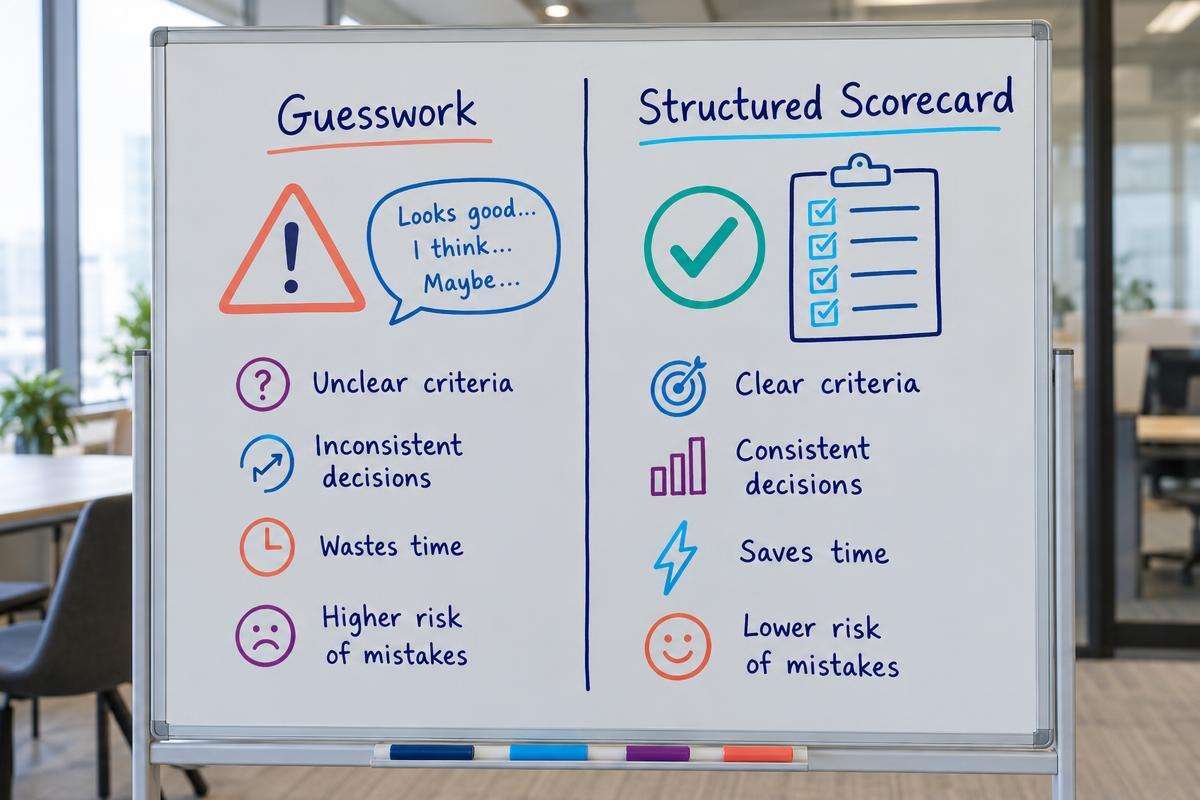
You cannot fix this by simply telling managers to be careful. You fix it by changing the system. You need to start structured interviews across your organisation. In a structured interview, every candidate is asked the exact same set of predefined, job-related questions. Responses are evaluated against a standardised scoring rubric.
Structured interviewing removes the guesswork. It forces the hiring manager to focus on good interview questions that measure actual capability. When a manager follows a structured process, they have no opportunity to ask about religion, marital status, or age.
Moving from gut feel to objective data
Many managers resist structured interviews because they believe the casual chat helps them assess "culture fit". This is a misunderstanding of what culture actually is. Culture is not about shared hobbies or similar backgrounds. Culture is about how people behave, how they make decisions, and what they value in a work environment.
If you want to know if culture fit hiring is legal in Australia, the answer is yes, provided you measure actual work behaviours rather than demographics. You evaluate culture fit by measuring a candidate's preferred work style against the realities of your team. Do they prefer highly structured environments, or do they thrive in ambiguity? Do they communicate directly, or do they prefer consensus?
You measure these traits through behavioural science, not by asking them what they do on a Sunday. When you deploy psychometric profiling and behavioural assessments at the front end of your recruitment process, you equip your managers with objective data. They walk into the interview already knowing how the candidate aligns with the role and the culture.
This is where incomplete HR tech falls short. Traditional systems track the workflow but offer no insight into the human being. Compono Hire changes this. Compono Hire is an applicant tracking system that matches candidates to culture, not just keywords. It evaluates candidates across organisation fit, skills, and qualifications before the interview stage. For example, The Coffee Club delivered consistent hiring across 400 outlets by standardising their assessment process with Compono, ensuring every manager had the objective data they needed to make fair, defensible decisions.
By pairing objective pre-employment data with structured interview scorecards, you completely remove the need for managers to dig into a candidate's personal life. You run a faster, fairer process, and you hire better people.
Evaluating hiring software in Australia requires looking past simple process tracking. You need a platform that helps your managers ask the right questions and make decisions backed by evidence.
How Compono can help with compliant hiring
Unstructured interviews invite bias and legal risk into your recruitment process. Compono Hire gives your team the tools to run consistent, compliant, and highly predictive interviews based on behavioural science, ensuring you evaluate candidates on capability rather than personal background.
Frequently asked questions
Can you ask about religion in a job interview in Australia?
No, you generally cannot ask about a candidate's religion during a job interview. Religious belief is a protected attribute under the Fair Work Act and state anti-discrimination laws. Asking this question can lead to claims of discrimination or adverse action.
What happens if a candidate volunteers their religion during an interview?
If a candidate mentions their religion without being asked, the hiring manager should acknowledge it politely and move the conversation back to the inherent requirements of the role. You should not ask follow-up questions about their faith, and interview notes should only record job-relevant information, such as specific availability restrictions.
Can a religious school ask about my faith in an interview?
Yes, in specific circumstances. Section 351 of the Fair Work Act provides exemptions for religious institutions, such as faith-based schools or charities. They can ask about your religion and make hiring decisions based on it, provided the requirement is genuine and necessary to avoid injuring the religious susceptibilities of their followers.
How do you ask about weekend availability legally?
You should state the specific requirement of the role and ask if the candidate can meet it. You should say, "This position requires you to work a standard roster that includes Saturday and Sunday shifts. Are you available to commit to this schedule?" This addresses the business need without probing into the candidate's personal or religious reasons for their availability.
Is culture fit hiring legal in Australia?
Yes, hiring for culture fit is legal in Australia as long as you define culture in terms of work behaviours, values, and communication styles. It becomes illegal if you use "culture fit" as a proxy to hire people of a similar age, race, or religion. Using objective behavioural assessments helps ensure your culture fit evaluation remains compliant.