1 min read
Team effectiveness assessment tools for high performance
Team effectiveness assessment tools measure how well a team's mix of work personalities, culture, and engagement supports performance. The best ones...
Voice or text coaching built on psychology. For you, your team, or the candidates you place.
A coach that actually gets you.
Get 10 minutes free, then $15 a month. Cancel anytime.
Get Started ≫5 min read
Mathan Allington
Updated on July 7, 2026
The best free personality tests for employees are the Compono Work Personality assessment, Big Five tests, DiSC-style quizzes, 16-type (MBTI-style) tests, the Enneagram and the Keirsey Temperament Sorter. CliftonStrengths is widely used but has no free version. Here is how the seven compare, and which one fits which job.
Last reviewed July 2026.
One honesty note before the list. Several famous assessments are commercial products: the official versions of DiSC, MBTI and CliftonStrengths are paid. What most teams actually use for engagement work are free tests built on the same models, and for most team conversations they do the job. The comparison below tells you where the genuinely free access is.
| Test | What it measures | Free access | Best for |
|---|---|---|---|
| Compono Work Personality | How people prefer to work, across 8 work personality types | Free, 4 questions, about 2 minutes; enter details to get results | Team design and engagement conversations |
| Big Five (OCEAN) | Five research-backed trait dimensions | Free research-based versions widely available | Scientific grounding, management tailoring |
| DiSC | Four communication and behaviour styles | Official version paid; free DiSC-style quizzes common | Communication and conflict conversations |
| 16-type (MBTI-style) | 16 types across four preference pairs | Official MBTI paid; free 16-type tests widely available | Self-awareness and development chats |
| CliftonStrengths | Top talents from 34 strength themes | No free version; access is paid | Strengths-based development, if budget allows |
| Enneagram | Nine types built on core motivations and fears | Free versions widely available; paid reports add depth | Understanding motivation and stress responses |
| Keirsey Temperament Sorter | Four temperaments: Artisan, Guardian, Idealist, Rational | Free to take with a basic result; full reports paid | Matching roles to natural preferences |
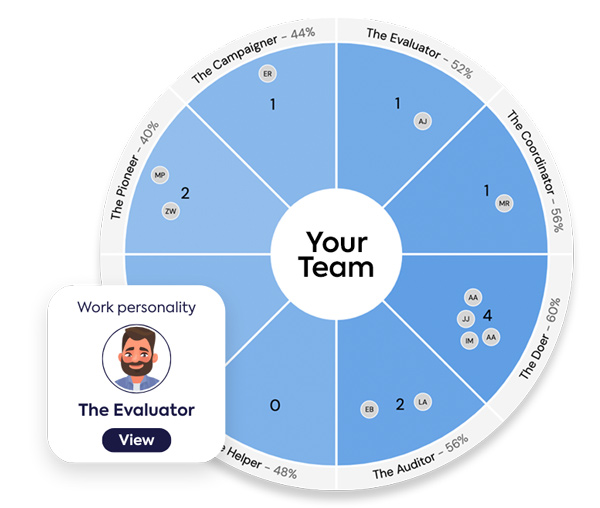
The Work Personality assessment is Compono's free test, built specifically for the workplace rather than adapted from general personality theory. It maps people to eight work personality types (Doer, Auditor, Helper, Advisor, Pioneer, Campaigner, Evaluator, Coordinator) based on the eight core work activities that effective teams cover between them.
It takes 4 questions and about 2 minutes, and you enter your details to receive your results. The short format is deliberate: it is designed to get a whole team profiled quickly so the conversation can move quickly to what the mix means. It was never meant to replace an in-depth psychometric battery.
The honest boundary: this is a work-behaviour lens, not a clinical instrument, and on its own it is not a hiring tool. Where it earns its place is team design. Because the types map to work activities, you can see which kinds of work your team gravitates to and which are nobody's preference, which is where delivery quietly breaks. Paired with Compono Engage, those insights connect to culture and engagement data rather than sitting in a drawer.
The Big Five measures Openness, Conscientiousness, Extraversion, Agreeableness and Neuroticism. It is the most scientifically validated personality model available, and free research-based versions are widely accessible online.
For managers, the value is in tailoring. High-conscientiousness people deliver reliably and want clear ownership. High-openness people generate ideas and handle change well. People higher in neuroticism may need more support under pressure. Knowing the mix helps you assign work and manage stress points before they become conflicts. Our guide to conscientiousness in the workplace covers the trait employers care about most.
The trade-off: trait scores are less immediately "shareable" than type-based tests. Teams tend to find types easier to talk about, even if traits are more precise.
DiSC sorts people into four styles: Dominance, Influence, Steadiness and Conscientiousness. Its strength is communication. Once a team knows who wants the short direct version and who wants time to process, meetings genuinely improve and misunderstandings drop.
The official Everything DiSC assessment is a paid product. Free DiSC-style quizzes are common and fine for a team conversation, though they lack the official version's depth and facilitation materials. DiSC describes style, not ability or values, so treat it as a communication aid rather than a full picture of a person.
The Myers-Briggs Type Indicator categorises people into 16 types across four preference pairs, such as introversion versus extraversion. The official MBTI is administered commercially, but free 16-type tests built on the same model are among the most-taken personality tests in the world.
The format is popular for a reason: people recognise themselves in their type, and it gives teams a shared language for differences in how they take in information and make decisions. The criticism is also fair: type boundaries are blunt and results can shift between sittings. It was never designed for workplace team composition either. Use it for self-awareness and development conversations, not for decisions about people.
CliftonStrengths (formerly StrengthsFinder) identifies a person's leading talents from 34 themes, and its strengths-based development philosophy has a strong following: build on what people are naturally good at rather than sanding down weaknesses.
It appears on this list with an asterisk because there is no genuinely free version; access is paid. If your budget covers it, it pairs well with development planning. If not, a free Big Five test plus a strengths-focused conversation gets you a useful way down the same path.
The Enneagram organises personality into nine interconnected types, each defined by core motivations and fears rather than surface behaviour. That makes it distinctive: it explains why people do what they do, including how they behave under stress.
Free versions are widely available, with paid reports adding depth. It suits teams willing to have deeper conversations about motivation and how people respond under pressure. It is less corporate-standard than DiSC or the Big Five, and its motivational focus is more abstract than a workplace-specific tool, so results need a good facilitator to become actionable.
Keirsey groups people into four temperaments: Artisans, Guardians, Idealists and Rationals. It is free to take with a basic result, with fuller reports paid.
Its practical use is role alignment. A Guardian who values structure and dependability tends to thrive in operations; an Idealist often suits people-focused roles. As with all broad-type models, it describes tendencies rather than destiny, so use it to inform conversations about fit rather than to box anyone in.
Three other names come up constantly: the Hogan Personality Inventory, the Occupational Personality Questionnaire (OPQ32) and the 16 Personality Factor Questionnaire (16PF). All three are validated, well-regarded instruments, and none is free. They are employer-purchased selection and development tools, administered under licence, usually in recruitment or leadership contexts.
That is a different job to the free tests above. If you are making hiring decisions, use a properly validated selection assessment. Free personality tests belong in engagement and development work, where the stakes are conversation quality rather than someone's livelihood.
Start with the problem, not the test. Communication friction points to DiSC-style tools, while development conversations suit 16-type tests or the Enneagram. If you want scientific rigour, use the Big Five. If the question is about how your team covers the work itself, a workplace-specific tool like Work Personality answers it directly, and at 4 questions per person you can profile the whole team in one meeting.
The free Compono Work Personality assessment takes 4 questions and shows how each person prefers to work, so your next team conversation starts with evidence.
Take the Free AssessmentSome are. The Compono Work Personality assessment, Big Five research versions, most Enneagram tests and the basic Keirsey Temperament Sorter are free to take. The official versions of DiSC, MBTI and CliftonStrengths are paid products, though free tests built on the DiSC and 16-type models are widely available.
It depends on the problem. DiSC-style tests suit communication issues and the Big Five offers the strongest scientific validity. For team design, workplace-specific tools like Compono's Work Personality assessment work best because they map results to the eight core work activities teams need covered.
No. Free personality tests are built for engagement and development conversations, not selection decisions. If you are hiring, use a properly validated selection assessment administered as part of a structured process, and treat personality data as one input rather than a verdict.
Four questions and about 2 minutes. It is free, you enter your details to receive your results, and it maps you to one of eight work personality types: Doer, Auditor, Helper, Advisor, Pioneer, Campaigner, Evaluator or Coordinator.

Compono Hire helps you predict job-fit and team-fit using behavioural science, so you can shortlist with confidence.
Request a demoBuilt for mid-market hiring teams.

Voice-first coaching that adapts to your personality. Get actionable steps you can take this week.
Start freeBuilt by Compono. Not therapy — practical behaviour change.
1 min read
Team effectiveness assessment tools measure how well a team's mix of work personalities, culture, and engagement supports performance. The best ones...
1 min read
To fix a dysfunctional team, find the cause before you treat the symptoms. Most dysfunction traces back to one of four sources: broken trust, avoided...
1 min read
Ever wondered why some teams just click and others seem to struggle, even if every individual is talented? The secret often lies in understanding...