


 Mathan Allington


Moodle Workplace pricing: the real costs in 2026
 Compono
The true cost of Moodle Workplace in 2026: hidden fees, partner pricing, hosting costs and total cost of ownership for mid-market teams.
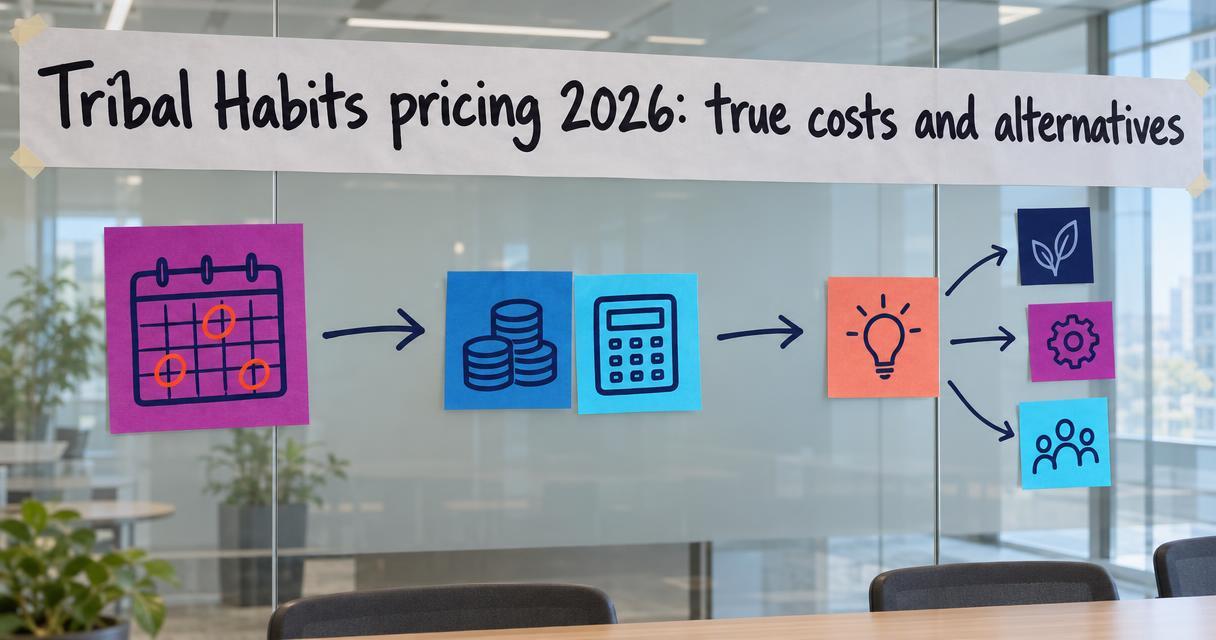
Tribal Habits pricing in 2026 starts with an AUD $1,200 annual base fee on the Lite plan, or scales to volume-discounted monthly active user rates on Business plans.
Last reviewed October 2026
Quick answer
- Price: The Lite plan requires a base fee plus usage charges, while Business tiers range from AUD $5,100 to over $36,000 annually based on active user commitments.
- Best for: Mid-sized Australian companies seeking an active-user billing model and basic internal authoring capabilities.
- Verdict: The monthly active user model works well when training is sporadic, but costs escalate rapidly if your organisation requires continuous, company-wide compliance training.
Buying a learning management system requires clarity on how the vendor counts your staff. Many platforms charge a flat fee for every employee in your database. Tribal Habits takes a different approach by billing for usage. This active-user model appeals to organisations with fluctuating training schedules.
Pricing structures in HR technology often obscure the total cost of ownership. A low sticker price usually hides premium support tiers, data storage limits, or content creation add-ons. We have mapped exactly how Tribal Habits charges in 2026 so you can forecast your actual annual spend.
Tribal Habits bills based on Monthly Active Users. The platform defines a monthly active user as someone who logs in at least once during a calendar month. Repeated logins by the same person in that same month do not increase your bill. You only pay for the individuals who actively access the system in a given billing period.
This model creates predictability if your training calendar is static. According to a Tribal Habits guide for mid-sized businesses, organisations typically see 30 to 70 percent of their total headcount active in a given month. This ratio depends heavily on your industry and training intensity.
The risk of the MAU model is the compliance spike. If your business rolls out a mandatory policy update in July, every employee must log in to acknowledge it. Your active user count hits 100 percent of your headcount for that month. You then incur overage fees or face pressure to upgrade your permanent tier commitment.
Tribal Habits divides its pricing into two main categories. The Lite plan suits small teams testing the waters, while the Business plans serve established organisations ready to commit to minimum usage levels.
The Lite plan costs AUD $1,200 per year as a flat base fee, plus a pay-as-you-go charge for each monthly active user, according to research by SuperPath. This entry-level option offers flexibility but carries a higher per-user cost for active learners.
Business plans waive the annual platform fee in exchange for a minimum monthly active user commitment. The per-user rate drops as your commitment grows. SuperPath reports that the Business 50 plan costs AUD $8.50 per monthly active user. This equates to a minimum annual spend of AUD $5,100 for 50 guaranteed active users.
Volume discounts apply as you scale up the Business tiers:
Registered not-for-profit organisations receive a 20 percent discount on these published rates.
Total cost of ownership extends far beyond the software licence. Most learning management systems charge extra for implementation, premium technical support, and external content authoring tools.
Setup fees are often a major hurdle when comparing HR platform pricing models. However, Tribal Habits states that its pricing includes no setup fees. Implementation support is built directly into the subscription. The platform also includes native authoring tools, eliminating the need to buy third-party software like Articulate 360 or Adobe Captivate for basic module creation.
The true hidden cost in the Tribal Habits set of tools is administrative bandwidth. Because the platform relies heavily on internal subject matter experts to build training content, your hidden cost is the wage of the employee spending hours writing modules instead of doing their primary job. If your managers lack instructional design experience, the resulting training often falls flat.
Forecasting your spend requires looking at actual business scenarios. Imagine a logistics company with 300 employees. If they choose an active-user model, they must predict their monthly engagement accurately.
In a standard month, 100 employees might complete routine safety refreshers. The company falls into the Business 100 tier at AUD $7.97 per user. The monthly cost is approximately AUD $797. Over a quiet year, the annual software cost hovers around AUD $9,500.
Now consider a high-growth retail business with 300 employees. They hire 20 new staff every month and roll out mandatory product updates to the entire floor staff quarterly. Their active user count frequently spikes to 250 or 300 users. To cover these spikes without massive overage penalties, they must commit to the Business 200 or Business 500 tier. At the Business 200 tier, the minimum annual commitment jumps to over AUD $18,000. For organisations with continuous learning cultures, a flat per-employee pricing model is often more economical.
When evaluating a new learning platform, it pays to compare different billing structures. Here is a ranking summary of the top options for Australian and New Zealand teams.
Each platform serves a different use case and budget. If you are seeking a direct Tribal Habits alternative, evaluate how these vendors align with your training volume.
Compono Develop focuses on capability rather than simple content delivery. Large organisations use our architecture to scale compliance safely. The Department of Transport Victoria saved $34M in operational costs over two years using our digital licensing capability. We look at learning through the lens of behavioural science to ensure your team actually understands the material.
Comparing active-user billing against registered-user billing reveals a deeper truth about HR technology. Most systems are built solely to manage process risk. They track who logged in, who clicked 'next', and who watched a video until the end.
Process management is necessary but not sufficient. When you buy an LMS based purely on how cheap the user licences are, you ignore people insight risk. People insight risk is the danger of assuming an employee is capable just because a system marked them as compliant.
A smart learning platform does more than track attendance. It assesses real understanding. It aligns the training delivery with how your team naturally processes information. Before you commit to a long-term software contract, ensure the tool actually measures capability improvements.
The table below outlines the billing models for the major platforms in the mid-market space. You can also view our Absorb LMS pricing analysis for enterprise-level comparisons.
| Platform | Pricing model | Best for |
|---|---|---|
| Compono Develop | Registered user | Building measurable capability |
| Tribal Habits | Monthly active user (MAU) | Fluctuating internal training |
| TalentLMS | Registered user or active user | Small business compliance |
Compono makes Compono Develop. We've included it and kept every entry's strengths and limits honest.
Compono Develop is a learning management system that tracks compliance and builds verifiable capability across your entire workforce.
Tribal Habits costs AUD $1,200 annually on the Lite plan, plus per-user fees. The Business tiers start at AUD $5,100 per year for 50 active users. Volume discounts apply as your user base grows.
A monthly active user is any employee who logs into the platform at least once during a calendar month. Repeated logins by that same person during the month do not incur extra charges.
No. Tribal Habits does not charge setup fees or implementation costs. Support and onboarding are included in the standard subscription price.
Yes. Registered not-for-profit organisations receive a 20 percent discount on the standard published pricing tiers.

The true cost of Moodle Workplace in 2026: hidden fees, partner pricing, hosting costs and total cost of ownership for mid-market teams.
The true cost of EdApp in 2026. Compare per-user pricing plans, hidden fees and learning management alternatives to make the right budget choice.

Discover the true cost of Rippling pricing in Australia for 2026. We break down the $12 AUD starting price, modular add-ons, and hidden fees for HR...
 Mathan Allington