

.webp)

 Mathan Allington


1 min read
Best recruitment CRM software for 2026: a complete guide
 Mathan Allington
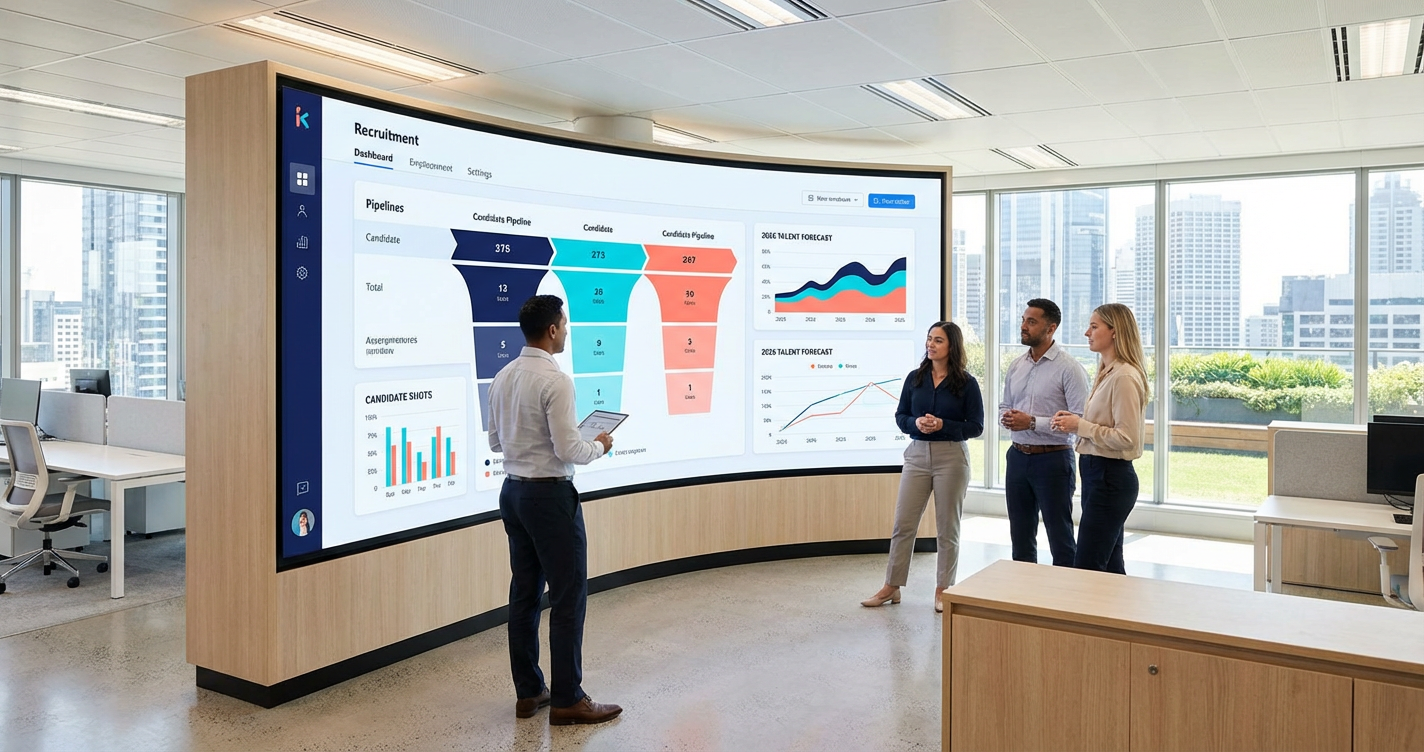
The best recruitment CRM software in 2026 depends on who you are. Agencies placing candidates at volume need pipeline and client tools like Bullhorn...

Candidate evaluation software scores every applicant against the same defined criteria, so your shortlist rests on evidence rather than on who wrote the better CV. The tools worth paying for measure skills and qualifications alongside organisation fit, because fit is the part that predicts whether someone will do the job well inside your particular team. Choosing between platforms comes down to what a tool actually measures, whether the vendor can show that measure works, and how much of your candidates' time it spends.
Last reviewed September 2026
This guide covers what sits inside the category, how the main types of assessment tool differ, what assessment services give you that software cannot, what the pricing models look like, and the questions to put to a vendor before you sign.
Candidate evaluation software sits between the job ad and the interview. It gathers applications, puts the same tests or questionnaires in front of everyone, scores the results against the requirements you set for the role, and ranks people so the hiring manager opens a shortlist instead of a stack. Some tools handle one narrow slice of that. Others live inside an applicant tracking system and carry the whole path from application through to offer.
The category exists because a CV tells you what someone has done, not how they work. Two candidates with identical job titles can behave completely differently under a deadline, inside a team that argues, or in a role with almost no supervision. Evaluation software puts a measure on that second half, and it applies the measure to every applicant in the same way, at the same point in the process.
That consistency is the quiet benefit. A structured score you can explain six months later is worth more than a gut read that was right nine times and catastrophically wrong on the tenth.

Vendors all describe themselves as assessment platforms, and they are not solving the same problem. Sorting them by what they measure makes a shortlist much easier to build.
| Type of tool | What it measures | Best suited to | Worth checking |
|---|---|---|---|
| Skills and knowledge tests | Whether someone can do the technical work today | Roles with a clear testable skill, such as coding, spreadsheets or trade knowledge | Tells you nothing about how the person works with other people |
| Psychometric and behavioural assessments | Work preferences, reasoning, and how someone behaves under pressure | Roles where team fit, judgement and consistency matter | Quality varies enormously, so ask for validity evidence in writing |
| Video and asynchronous interviewing | Communication and answers to a set list of questions, at volume | High-volume shortlisting across time zones | Can reintroduce appearance and accent bias unless scoring is structured |
| Assessment built into an applicant tracking system | Screening, scoring and ranking inside the same workflow as the application | Teams that want one process, one candidate record and one audit trail | The depth of the assessment matters more than the convenience of the bundle |
| Assessment services and assessment centres | Exercises designed and run by occupational psychologists | Senior, safety critical or low-volume high-stakes hires | Cost per candidate is high and turnaround is slower |
Most mid-sized organisations end up combining two of these. A behavioural assessment early, when the applicant pool is large and the decision is which twenty people to look at properly, then a skills test or a structured interview later, when the pool is small and the decision is which one person gets the offer. The comparison between assessments and video interviewing is worth reading if you are choosing between those two for the early stage.
People searching for candidate assessment services usually want something different from software. Services are run by people: an occupational psychologist designs exercises around your roles, facilitates an assessment centre or a structured day, and writes up a report on each candidate. The judgement is expert and the output is tailored.
The trade is cost and speed. A service priced per candidate stops making sense once you are hiring dozens of people a year, and it rarely fits a retail or hospitality funnel where hundreds of applications arrive for one opening. Software carries the volume, runs overnight and costs the same whether you assess five candidates or five hundred.
Plenty of organisations run both. Software handles the top of the funnel for every role, and a service is brought in for executive appointments or for roles where a wrong decision creates a safety or licensing problem. If you go that way, check the two measure compatible things, because two reports built on different models will argue with each other in front of the hiring panel.
Feature lists all read the same. These are the points where platforms genuinely separate.
A psychometric assessment that has never been validated against job performance is a personality quiz with an invoice attached. The question to keep asking is what the score predicts, not what it describes.

Pricing in this category takes a few shapes. Per-assessment pricing charges for each candidate who completes a test, which suits low or unpredictable volume. Subscription pricing charges by user, by employee count or by hiring volume band, and suits steady hiring because the marginal assessment is free. Assessment built into a hiring platform is usually part of the platform licence. Services are quoted per candidate or per assessment day.
The comparison that matters is cost per hire, not cost per assessment. Here is an illustrative example with made-up round numbers: if you assess 40 applicants to fill one role and each assessment costs $30, the assessment line on that hire is $1,200. Set that against what one wrong appointment costs you in recruitment, onboarding, lost output and the disruption to the team. Our cost of a bad hire calculator lets you put your own salary and tenure figures in rather than taking an industry average on faith.
Ask about the things that are not on the price list, too. Implementation fees, the cost of building role profiles, charges for extra assessment types, and what happens to your data and your historical scores if you leave.
Skills and qualifications answer whether a person can do the job. Organisation fit answers whether they will do it well in your environment, with your managers, at your pace. A capable developer who does their best thinking alone will struggle on a team built around constant pairing, whatever the technical test said.
Fit becomes measurable once you know what a person's natural way of working is. Compono uses eight work personalities: Doer, Auditor, Helper, Advisor, Pioneer, Campaigner, Evaluator and Coordinator. Each one describes a way of approaching work rather than a type of person, and strong teams carry a spread of them. A group weighted entirely towards Pioneers and Campaigners generates ideas and finishes very little. A group weighted entirely towards Auditors and Evaluators ships carefully and rarely starts anything. Seeing the spread you already have tells you what the next hire needs to bring, which is a more useful brief than "someone like the person who left". There is more on how those combinations play out in our guide to work personality types in high-performing teams.
Compono Hire assesses candidates on skills, qualifications and organisation fit in one workflow and ranks them on those measures, so the shortlist arrives with the reasoning attached. The fit boundary is worth stating plainly: this suits organisations hiring regularly into defined roles where team dynamics matter. For a single executive appointment once every three years, a specialist assessment service will serve you better. Compono holds a 4.8 out of 5 rating on Capterra across its platform.
Any vendor who answers those six clearly is worth a trial. Run the trial on a live role, not a demo dataset, and check whether the hiring managers actually read the scores. A tool nobody opens has a return of exactly zero.
Compono Hire assesses skills, qualifications and organisation fit in one workflow, and ranks candidates on what it finds.
Talk to usAn applicant tracking system manages the process: applications, stages, communication and records. Candidate evaluation software produces the judgement: it measures skills, reasoning or work preferences and turns those into a score. Several platforms now do both, which removes the step of moving results between systems by hand.
Assessments used at the application stage generally sit between 10 and 20 minutes and work on a phone, because anything longer costs you applicants who abandon partway. Deeper assessments used later in the process, when candidates are already invested, can reasonably run longer.
Assessments are widely used in Australian hiring, and the general expectation is that any selection tool must be job-related and must not discriminate on a protected attribute under anti-discrimination law. This article is educational rather than legal advice, so check your specific process with an employment lawyer or your industry body before you roll it out.
Yes, and many organisations get more value there than in hiring. The same data supports internal moves, team design, development planning and succession conversations. Be clear with staff about what is being measured and how the results will be used.
A validated assessment applied identically to everyone reduces the influence of a reviewer's personal preferences, which is where most hiring bias lives. An unvalidated assessment, or one scored inconsistently, can add bias while looking objective. The safeguard is evidence of validity plus reporting on outcomes by group.
1 min read
The best recruitment CRM software in 2026 depends on who you are. Agencies placing candidates at volume need pipeline and client tools like Bullhorn...

1 min read
Talent acquisition software earns its place when it does four things a resume database cannot: score every candidate against the job and the...
 Read More