


 Mathan Allington

Best engagement survey for hospitality staff in 2026
 Mathan Allington
The best engagement survey for hospitality staff in 2026. Compare top platforms to measure frontline sentiment and reduce hotel and restaurant...
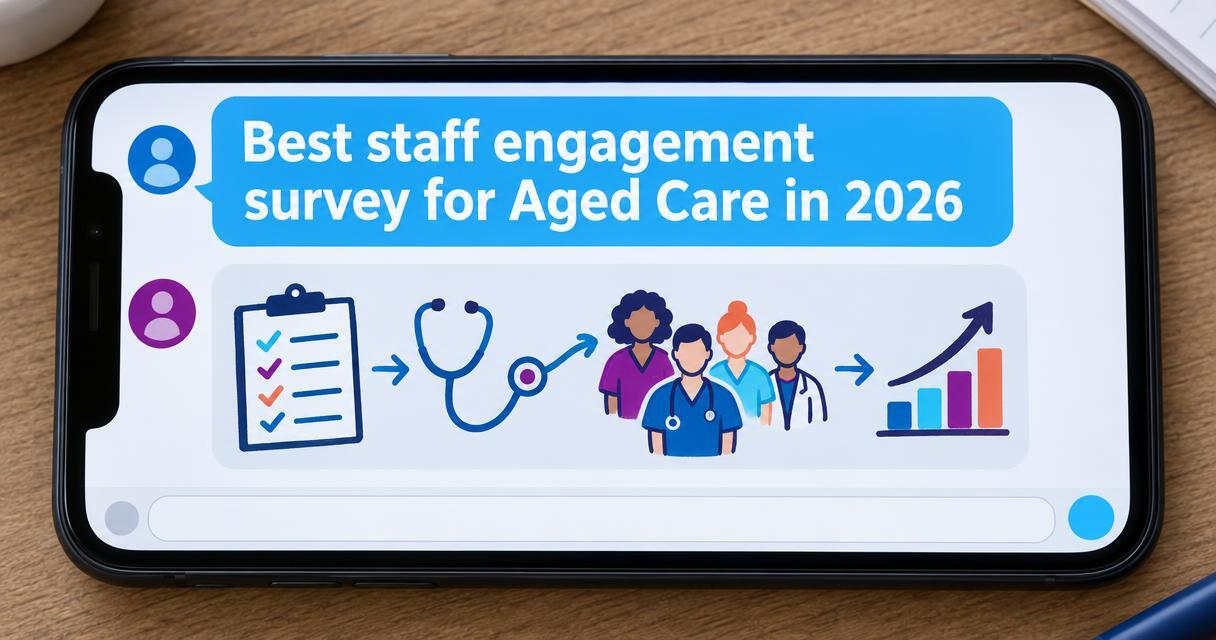
A staff engagement survey for aged care measures how connected and supported your frontline workers feel, revealing the direct link between their workplace experience and the quality of resident care.
Last reviewed November 2026
Quick answer
- Price: From $4 to $12 per user per month based on industry averages, with enterprise pricing for larger providers.
- Best for: Identifying the root causes of clinical burnout and staff turnover, rather than just measuring general workplace sentiment.
- Verdict: The best staff engagement survey for aged care goes beyond a basic pulse check to measure validated dimensions of culture, translating raw carer feedback into immediate operational improvements on the floor.
Aged care providers face a unique set of operational pressures. Your frontline carers work irregular shifts, manage high physical and emotional demands, and frequently speak English as a second language. Traditional human resources technology manages process risk effectively. It tracks payroll, monitors compliance training, and schedules rosters. However, it completely misses people insight risk.
A standard corporate engagement survey fails in an aged care setting. It asks generic questions about office perks or software tools instead of addressing the realities of clinical support, rostering fatigue, and compliance with the Aged Care Quality Standards. When you use the wrong survey approach, you risk widespread survey fatigue. Carers stop answering because they see no tangible changes on the floor. To retain great staff, you need a survey designed to uncover the operational realities of their daily work.
The Australian aged care workforce operates under intense pressure, yet the dedication of carers remains strong. A recent 2024–25 workforce study shows that 64% of aged-care workers reported enjoying their industry, which is a 10-percentage-point increase since 2020. People choose this work because they care about residents.
However, the daily toll of the job requires active management. A nationwide Australian study by npj Mental Health Research found that 56.4% of residential aged-care workers reported improved burnout, while 36.2% had low wellbeing. This directly impacts retention. Furthermore, research from Monash University notes that among aged-care workers considering leaving in 2024, 48% cited burnout, 46% lack of support, 45% excessive stress, and 43% low pay.
To combat these trends, providers are rethinking their technology stacks. If you are evaluating options to improve retention, reading a best aged care recruitment software Australia buyer's guide helps you attract talent, but you need an engagement strategy to keep them.
Choosing the right platform determines whether you get actionable behavioural data or just another spreadsheet to ignore. Here are the top platforms available in 2026.
| Platform | Best for | Culture mapping |
|---|---|---|
| Compono Engage | Mapping engagement to specific culture dimensions | Yes |
| Culture Amp | Enterprise corporate environments | Partial |
| Employment Hero | Single HR for small providers | No |
Compono makes Compono Engage. We've included it and kept every entry's strengths and limits honest.
Most HR tech only manages process risk. Compono handles both process and people insight risk. By using Compono Engage, aged care leaders get clear data on how team changing and work environments actually function. The platform provides pre-designed evidence-based surveys to standardise the assessment process. This helps you identify exactly where culture gaps lead to high turnover or compromised resident care.
Culture Amp offers a comprehensive suite of survey tools with strong analytics capabilities. It works exceptionally well for desk-based corporate staff and executive teams. However, aged care providers often find they must heavily customise the templates to make them relevant for floor staff, nurses, and allied health professionals.
Employment Hero combines payroll, rostering, and basic HR functions in one place. Their engagement surveys are convenient for basic temperature checks and general sentiment tracking. They lack the scientific depth needed to diagnose complex team culture issues in high-stress clinical care environments.
High engagement in a corporate office means faster project delivery. In aged care, it means better clinical outcomes and safer environments for residents. Engaged carers are more observant, communicate better during shift handovers, and build stronger relationships with families. When staff feel supported, they have the emotional capacity to provide person-centred care.
If you want to read more about building resilient care teams, see our aged care HR software guide. The reality is that disengaged staff are more likely to miss critical compliance steps under the Aged Care Quality Standards. When you measure engagement effectively, you are actively managing your clinical and compliance risk across the entire facility.
Do not ask carers if they have a best friend at work. Ask them if they have the resources, equipment, and support to perform their jobs safely. Your survey must cover workload manageability, physical safety, emotional support from leadership, and communication clarity between shifts.
You can use an employee engagement survey questions template to establish a solid baseline. However, aged care surveys should also include highly specific questions. Ask how well management responds to clinical incidents. Ask whether current rostering practices allow for adequate rest between physically demanding shifts. Measure psychological safety by asking if staff feel comfortable reporting a near-miss medication error without fear of punishment.
A massive barrier to accurate survey data is the delivery format. You cannot email a 40-question survey to a personal care assistant who rarely sits at a computer. You need mobile-friendly, brief assessments that respect their time and fit seamlessly into their existing routines.
Many aged care teams include culturally and linguistically diverse staff. Ensure your survey language is plain, direct, and accessible in multiple languages if necessary. You must also guarantee absolute anonymity. Frontline workers will not report toxic behaviour or unsafe rostering practices if they fear retribution from facility managers.
When you get this right, the results are powerful. As shared by aged care provider Warrigal, they achieved a 98% staff survey participation rate, alongside engagement, wellbeing, and career-progress score increases of 6.2%, 8.6%, and 9.5% respectively.
Collecting feedback is only the first step. You damage trust when you ask carers for their opinions and do nothing with the data. You need a transparent framework for action. Staff want to see their feedback turned into visible changes on the facility floor.
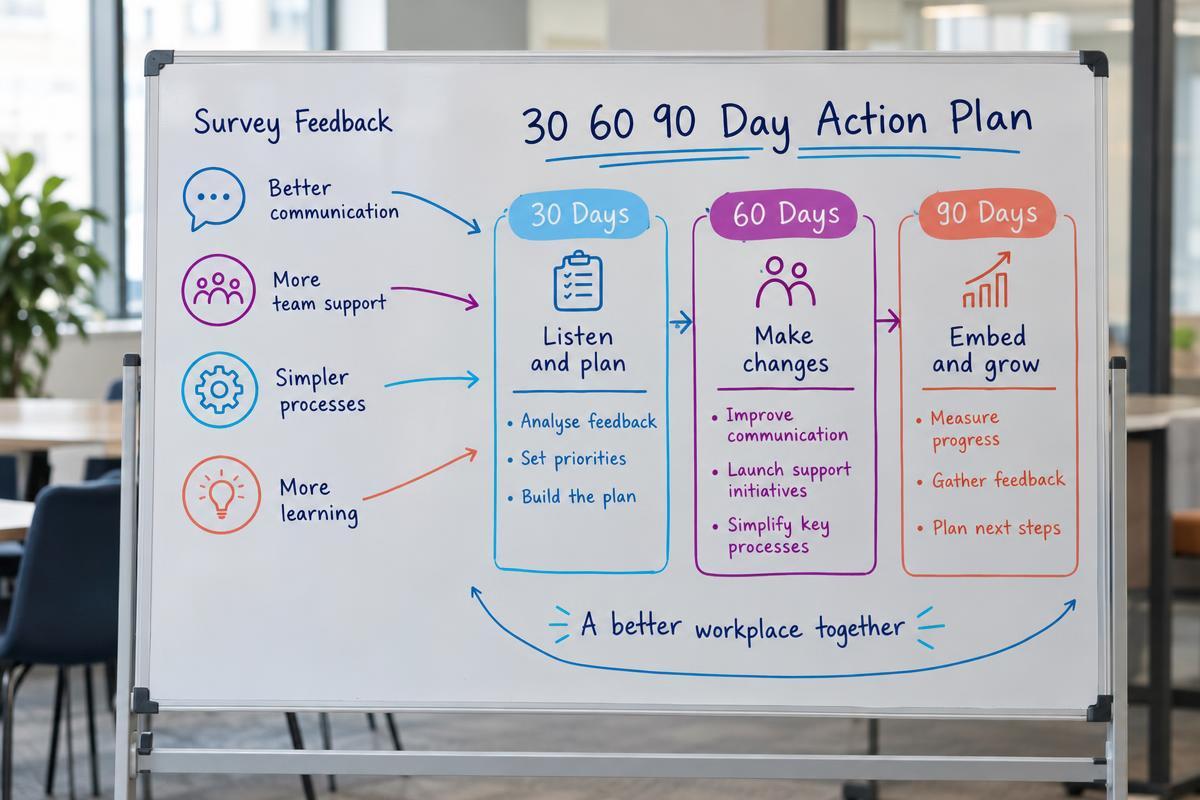
If you struggle to make sense of your data, you are not alone. It is common to find that your engagement survey says fine but people still leave. To fix this, build a 30-60-90 day action plan. In the first 30 days, share the raw results openly with the team. By 60 days, start quick wins like better break room facilities or clearer shift handover protocols. By 90 days, begin addressing systemic issues like flawed rostering models or clinical training gaps.
Regulators expect aged care providers to demonstrate a culture of continuous improvement and staff capability. Your engagement survey data acts as evidence that you actively monitor and respond to workforce pressures. It proves you understand the environment your staff operate within.
When assessors review your facility, showing a structured approach to measuring and improving staff wellbeing proves you take governance seriously. A supported workforce directly correlates with the safe, effective personal and clinical care required by national standards. Your engagement metrics are ultimately risk management metrics.
Compono gives you the tools to move beyond simple pulse checks and genuinely understand the culture driving your care teams. When you map engagement against validated behavioural data, you can stop guessing and start building a more resilient, compliant workforce.
Annual surveys are too slow for the fast-moving aged care sector. Use short pulse surveys every quarter to check on immediate concerns like workload and safety, while reserving a comprehensive culture and engagement assessment for once a year.
Make the survey accessible on mobile devices and keep it under five minutes. Provide dedicated paid time during handovers or in-service training for staff to complete it. Most importantly, show them that their previous feedback led to tangible workplace improvements.
Engagement measures how employees feel about their work right now, such as their current energy levels and job satisfaction. Culture defines how they actually behave and work together, including how they communicate during stressful shifts and approach clinical compliance.
Use a third-party platform that aggregates data and prevents managers from seeing individual responses. When filtering results by role or shift, ensure the system requires a minimum group size before displaying data, protecting the identities of isolated workers.
Yes. There is a direct link between supported, engaged carers and improved clinical outcomes. When staff feel heard and have manageable workloads, they are more observant, make fewer medication errors, and build stronger, more empathetic relationships with residents.
The best engagement survey for hospitality staff in 2026. Compare top platforms to measure frontline sentiment and reduce hotel and restaurant...

What culture survey software measures that engagement tools miss, how Culture Amp and Compono Engage compare, and how to act on the results.

Where Culture Amp surveys and benchmarking are strong, which teams it suits, and the gaps to plan for if you need culture and hiring data together.