

.webp)

 Mathan Allington


Best recruitment CRM software for 2026: a complete guide
 Mathan Allington
The best recruitment CRM software for 2026 by use case: agency, enterprise and in-house. An honest comparison, including where Compono does not fit.

The best hiring platform for a small or growing business is the one that covers job advertising, applicant tracking and candidate assessment in a single workflow, posts to the job boards you actually use, works properly on a phone, and keeps the records your obligations require. For Australian buyers that means deep SEEK integration, record keeping that supports the Fair Work Act, and assessment that predicts fit rather than filtering resumes by keyword.
Last reviewed September 2026.
This guide covers the categories of hiring tools that matter, how they differ by company size, and what to check before you sign. If you hire on both sides of the Tasman, we have a separate guide to hiring tools for Australia and New Zealand with SEEK and LinkedIn integration. This one stays focused on choosing for Australia.
Hiring tools get sold under several names: recruitment platform, hiring platform, talent acquisition suite, applicant tracking system. Underneath, they are assembled from the same parts.
Almost every product covers the first two competently. The third is where they separate, and the third is the one that decides whether your hire is still performing in a year. Tracking tells you where a candidate sits in your process. It says nothing about whether that candidate belongs in your team.
Five shapes of product dominate the Australian market. Matching the shape to your size and hiring volume removes most of the shortlist before you sit through a single demo.
| Type of platform | What it handles well | Best suited to | Watch for |
|---|---|---|---|
| Entry-level ATS | Basic pipeline, one or two job board connections, simple templates | Businesses hiring a handful of roles a year and replacing a shared inbox | Reporting and compliance records are often thin, and you outgrow it quickly once hiring picks up |
| HR and payroll suite with hiring included | Hiring attached to employment records, onboarding and payroll in one subscription | Small teams who want one vendor for admin and compliance | The hiring module is usually the lightest part of the suite, particularly on assessment |
| Agency-grade recruitment platform run in-house | High-volume pipeline management, candidate databases, recruiter productivity | In-house teams hiring continuously or running their own talent pools | Workflow built for recruiters can feel heavy for hiring managers who use it twice a year |
| Enterprise talent acquisition suite | Multi-site, multi-brand and high-volume recruitment with deep configuration | Large organisations with dedicated talent acquisition teams | Configuration depth needs internal ownership, and candidate experience can feel impersonal at volume |
| ATS with built-in assessment | Tracking plus evidence on fit, so shortlists are ranked rather than just ordered by date | Teams where a wrong hire is expensive and culture is the thing they are protecting | You still need core HR and payroll elsewhere, so check the integrations on day one |
If you are unsure whether you need a hiring platform at all or core HR first, the split between an applicant tracking system and an HRIS is the distinction to settle before you shortlist anything.
For a business hiring between roughly 5 and 40 people a year, the honest answer is the simplest platform that still gives you two things: a direct SEEK connection, and some form of structured assessment. Everything else on a feature list is secondary at that size.
The SEEK connection matters because it is where the volume is. Without two-way integration (instant posting out, applicants pulled back automatically) you add manual steps to every role, and the cost compounds with every vacancy.
Assessment matters because the maths of a mis-hire is brutal for a small team. Recruitment fees, lost productivity, the drag on the people who cover the gap and then do it again for the replacement. Run your own numbers through the cost of a bad hire calculator before you decide that assessment is a nice-to-have. For most small businesses it is the single feature with the clearest payback, because one avoided mis-hire usually covers the subscription.
Skip, for now: AI sourcing, complex approval chains, recruitment marketing modules, anything requiring an administrator. Those are problems you want to have later.

For businesses in the roughly 60 to 1,000 employee range, the priority is automating the administrative heavy lifting without adding complexity your team will not use. Several local players have earned their reputations here. JobAdder, founded in New South Wales, brings recruitment-agency-grade workflow to in-house teams and does pipeline management very well. Employment Hero pairs hiring with an HR and payroll suite rooted in Australian compliance, which suits teams who want one vendor for the admin layer.
The gap in most growing stacks is not workflow. It is evidence. An applicant tracking system moves candidates through stages efficiently, and it still cannot tell you which candidate will be performing and engaged a year in. That takes assessment. Compono Hire combines the tracking layer with work personality and culture fit assessment, so the shortlist is ranked on fit rather than resume polish. The Coffee Club uses this approach to keep hiring consistent across 400 outlets, which is the repeatability most multi-site Australian businesses are chasing. The fit boundary is worth stating plainly: if your real problem is payroll, leave and employment records, start with an HR suite and integrate hiring into it.
Growth is also the stage where hiring volume becomes unpredictable, and our guide to choosing a recruitment platform for the mid-market covers how to size a contract you will not regret in 18 months.
Large organisations face high-volume recruitment across multiple locations, where candidate experience and processing speed both matter at scale. PageUp offers extensive talent management modules, while LiveHire focuses on building talent communities that reduce reliance on job boards over time. The risk to manage at this end is the application black hole: high-volume systems that feel impersonal push good candidates away quietly, and you only find out from your offer acceptance rate.
Enterprise buyers should also check integration with local background checking services and VEVO right-to-work checks. Automating those steps protects you from breaches of migration and safety requirements as volume grows, and it removes a manual bottleneck that slows offers at exactly the wrong moment.
Four local requirements separate tools built for this market from generic international platforms.
Compliance. Any tool you implement must support compliance with the Fair Work Act: proper record keeping, plus consistent and privacy-safe handling of candidate data in line with the Privacy Act 1988 and the Australian Privacy Principles. Ask vendors directly where candidate data is stored and how it is protected. This is general information rather than legal advice, so confirm your own obligations with a qualified adviser before you rely on a vendor's answer.
SEEK integration. SEEK is the heavyweight of Australian job boards. A hiring tool without deep two-way SEEK integration adds manual steps to every single role you advertise.
Mobile-first application. Australia has a large deskless workforce across retail, hospitality, healthcare and trades. These candidates apply from their phones, often on a break. If your application process fights the small screen, your best frontline applicants drop out before you ever see them.
Local support hours. A critical system error at 9am Monday in Sydney is mid-Sunday in San Francisco. If your vendor's support team wakes up when your workday ends, every incident costs you a day of recruitment momentum. Australian-based support also understands local context, from public holidays through to regulatory change. It is an unglamorous selection criterion that buyers consistently rank higher after 12 months of ownership than before purchase.

Start by auditing your current process for bottlenecks. Are you losing candidates to a long application form? Is time to hire blowing out at the scheduling stage? Choose the tool that fixes your specific failure points, not the one with the longest feature list.
During implementation, prioritise the day-one integrations: SEEK and your payroll provider. Clean data flow between those systems from the start prevents months of manual re-entry errors. Resist the urge to migrate every historical record, too. A fresh start with clean workflows usually beats forcing old, messy data into a new system, and it gives you a reporting baseline you can trust.
Then measure two things for the first six months: how many applicants finish your application on a phone, and how your new hires are performing at six months. The first tells you whether the platform works. The second tells you whether your assessment does.
Compono Hire pairs SEEK-integrated workflow with culture-fit prediction, backed by an Australian team on Australian hours.
Talk to usThe simplest platform that still gives you a direct SEEK connection and structured candidate assessment. For small teams, Australian-based support and assessment that reduces mis-hires matter most, because a single wrong hire hurts a small business disproportionately.
At 60 to 1,000 employees the shortlist usually comes down to an agency-grade platform run in-house, an HR suite with hiring attached, or an applicant tracking system with built-in assessment. Choose on your weakest stage. Pipeline chaos points to workflow depth, while repeated mis-hires point to assessment.
In practice the terms are used interchangeably. An applicant tracking system is the pipeline layer, while hiring platform usually implies more around it: job distribution, assessment, interview scheduling and onboarding handover.
Yes. SEEK is the primary job board in the Australian market, so direct integration for posting roles and retrieving applicants meaningfully reduces time to hire compared with manual posting.
It can be. Australian businesses must comply with the Privacy Act 1988, so confirm your provider follows the Australian Privacy Principles, especially around where candidate data is stored and how it is protected. Treat this as general guidance and take professional advice on your own obligations.
A mobile-responsive, low-friction application process. Deskless candidates in retail, hospitality, healthcare and trades apply from smartphones, so a quick apply option is the difference between a full pipeline and silent drop-offs.
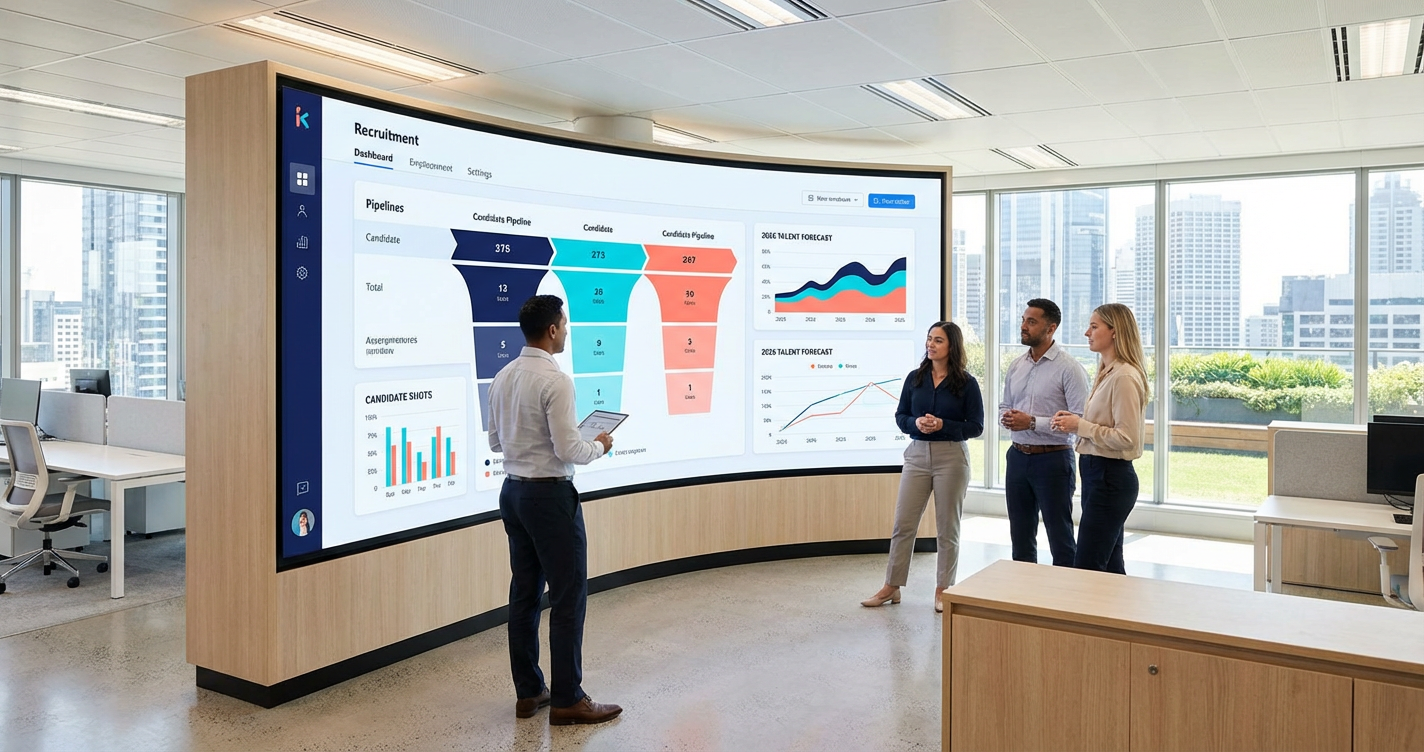
The best recruitment CRM software for 2026 by use case: agency, enterprise and in-house. An honest comparison, including where Compono does not fit.

What candidate management software does, how it differs from a full ATS, and the features that matter most when you compare systems.

The five categories of recruitment software, what each one actually automates, and how to tell which fits the hiring problem you have.