

.webp)

 Mathan Allington


How to choose the best ATS for charities in Australia
 Compono
Discover how to choose the best ATS for charities in Australia. Learn why values alignment matters more than resumes to build a mission-driven team.

The best candidate tracking system for 2026 does more than store applications. It matches candidates to your team on behavioural fit and automates compliance in the background, feeding engagement data back into your hiring criteria. Compono leads for mid-market Australian teams, with Lever suiting outbound-heavy recruiters and Workday suiting global enterprises.
Last reviewed July 2026
For decades, the standard candidate tracking system was little more than a digital filing cabinet. Its job was to account for every applicant and keep the hiring process legally tidy, and HR was often cast as the "no" department. That era is over.

Talent acquisition is now recognised as a core driver of competitive advantage. Recruiters and HR leaders are expected to advise on workforce planning, skills gaps, retention risk and hiring priorities before a job ad is even posted. That requires treating every hire as a long-term investment rather than a seat to fill.
The right technology makes this shift possible by automating the policing side of the job. Compliance checks and basic screening should run in the background, freeing you for the high-value work of relationship building and strategic talent mapping.

Traditional systems overlook strong candidates because their CVs lack the exact buzzwords. Skills can be taught; values and cognitive fit are much harder to change. That is why the most effective candidate tracking strategies have moved from keyword filtering to intelligent matching.
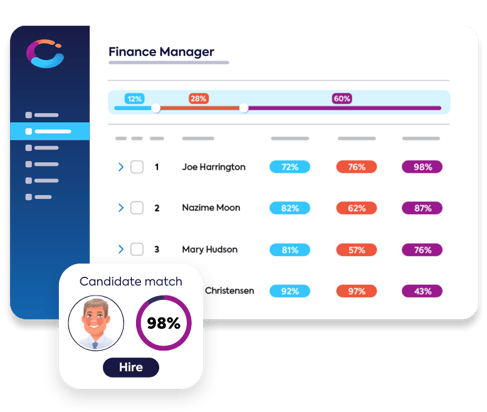
Compono Hire builds psychometric and behavioural science directly into the recruitment workflow, identifying candidates who are not just qualified on paper but genuinely likely to thrive in your environment. Its culture-fit predictions are validated against real hiring outcomes, and instead of manually reviewing hundreds of near-identical CVs, you receive a ranked list based on predicted fit for the role and your culture.
Screening on evidence early also reduces the risk of bad hires, which cost Australian businesses billions each year. That is strategic recruitment: using data to make better, faster human decisions.
Modern HR leaders are buying outcomes, not feature lists. The best candidate tracking system supports the whole talent lifecycle, and a few capabilities separate the leaders from the filing cabinets:

Compono is the strongest choice for mid-market Australian businesses because it combines recruitment workflow with deep behavioural insight. The platform is intuitive, built around the long-term success of the hire, and rated 4.8/5 on Capterra.
Lever suits companies that prioritise talent relationship management. Its strength is candidate experience and long-term pipeline building, with a CRM-style approach that works well for teams doing high volumes of outbound sourcing.
For very large global organisations, Workday connects recruitment data with broader financial and operational goals. It can be complex and expensive to implement, and for mid-sized Australian firms it often feels like more system than the job requires.
A quality candidate tracking system is a value driver, not a cost. The return shows up in faster time-to-hire and lower turnover, plus your own job satisfaction as tedious data entry disappears.
The analytics matter just as much. When you can show the board how hiring decisions affect the bottom line, you stop being a processor of applications and become a consultant to the leadership team, advising on how to build a workforce that is ready for what comes next.
An ATS with behavioural science built in, so every shortlist is ranked on real fit for your team.
Talk to usA candidate tracking system, often called an applicant tracking system or ATS, manages job applications through each stage of recruitment. Modern systems also score candidates on behavioural fit and culture alignment rather than just storing resumes.
Look for intelligent matching based on behavioural science, automated compliance, integration between hiring and engagement data, and an interface your hiring managers will actually use. Avoid enterprise systems that add complexity without adding insight.
Keyword filtering rewards candidates who use the right buzzwords. Behavioural matching assesses how a person naturally works and whether that complements your team, which improves quality of hire and reduces turnover.
It depends on your context. Lever excels at outbound talent relationship management and Workday suits large global enterprises. Compono is built for mid-market teams that want behavioural science and culture matching inside the recruitment workflow.

Discover how to choose the best ATS for charities in Australia. Learn why values alignment matters more than resumes to build a mission-driven team.

Why hiring software matters for modern HR teams, and how it reduces bias, improves candidate experience and supports data-driven decisions.

How to choose recruit CRM software: the features that matter, ATS vs CRM, AI in practice, and how to measure recruitment ROI beyond time-to-hire.
 Mathan Allington