
.webp?width=559&height=292&name=2026.07.21%20Fireside%20KV%20-%201200x627%20(event%20featured).webp)
.png?width=383&height=200&name=team%20(1).png)
 Claire Fernando


1 min read
Beyond 360 degree feedback: Why HR leaders need system intelligence
 Mathan Allington
If you're researching 360 degree feedback software, you already know the basics. Multiple raters assess an individual. Anonymous surveys collect...
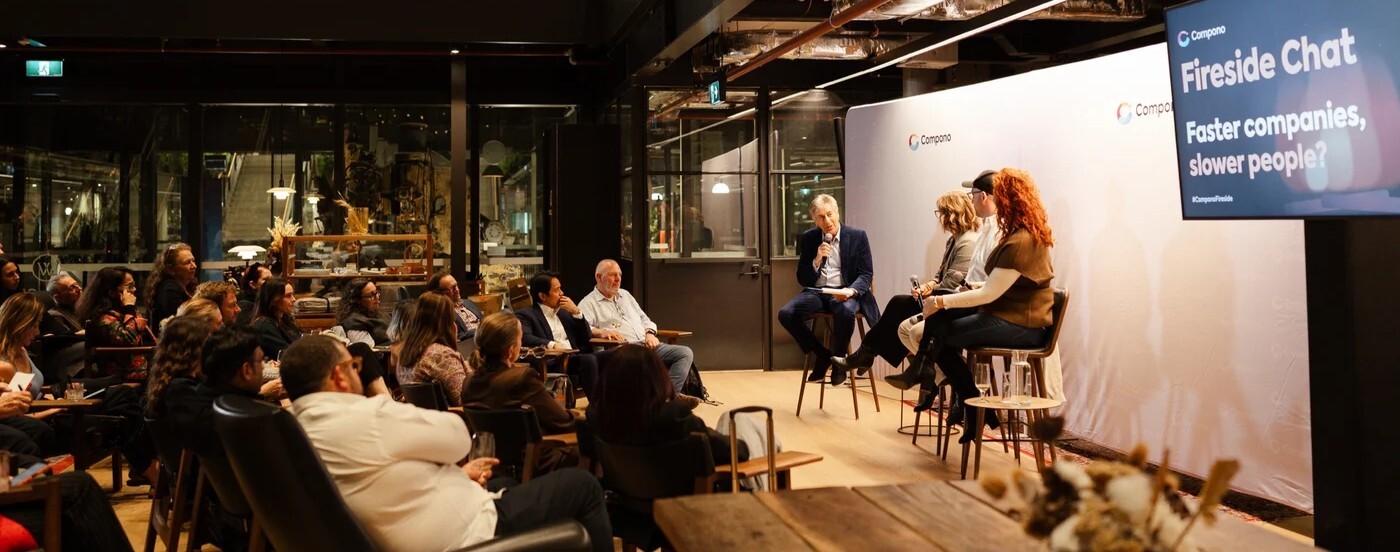
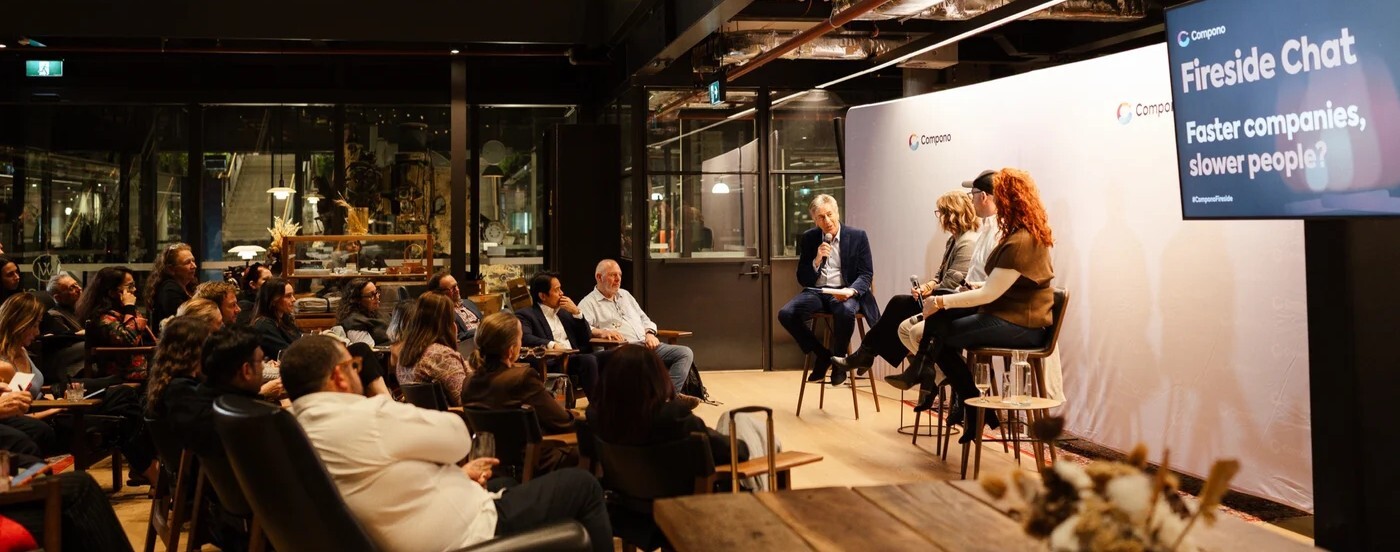
A workforce capability gap opens when a business changes faster than its people systems can keep up, and the fix is visibility, not more hiring. That was the through line at Compono's Sydney Fireside Chat, ‘Faster companies, slower people?’, hosted by Andrew Banks. Three people leaders, one uncomfortable question: where are your people versus where the business needs them?
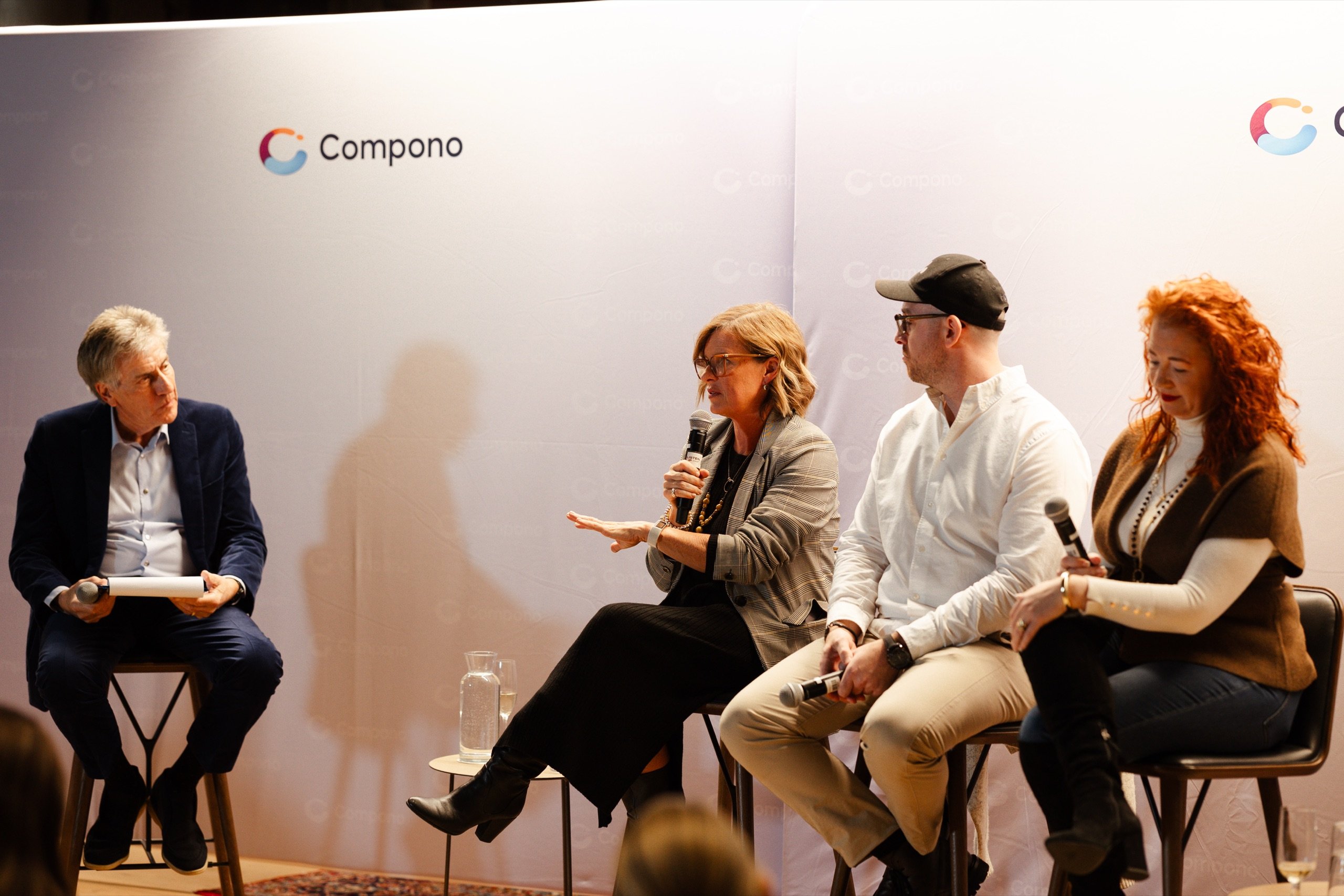
Banks, who co-founded Morgan & Banks and Talent2, put the question to three people leaders on stage in Sydney. Matt McFarlane, director of compensation consultancy FNDN and founder of the Startup People Summit. Hassanah Rudd, Head of People at Preacta and previously a talent leader at Canva. Sharon Gray, Head of People and Culture at food rescue charity OzHarvest. Here is what they agreed on, what they differed on, and what a people and culture platform actually needs to show you.
The gap rarely starts with skills. It starts with a structure that stops matching the strategy.
"Change is inevitably happening because of outside pressures in the business," Rudd said. "What's not happening internally is that the org chart doesn't change fast enough to support that, and you get friction."
She watched Canva grow from 3,000 to 5,300 people in two and a half years. The reflex in that environment is always the same: we are behind, so we need to hire. Her job was to ask a harder question first.
"You've got quite a few hundred engineers on this already," she said. "When you look down on it, they were delivering on this already. That means you're running on the red line, so you're going to have a problem going forward. But as a structure, you're doing it."
McFarlane framed the same problem as a communication failure dressed up as a capability failure. Being clear about the goal and telling people how they are tracking against it are old fundamentals, and they are the first things dropped when the pressure comes on.
Asked at her first OzHarvest board meeting to describe the culture, Gray picked one word: ‘slippery’.
"I'd just come from a really old not-for-profit where things took months to get approved," she said. "Ninety-nine per cent of our people know how their job is connected to our purpose. When that happens, that's an accelerator. That's an accelerating culture that can keep up with the pace of the business, if the pace is realistic."
Rudd drew a line under what culture is not. "I am not cupcakes HR," she said. "You can have a lovely, lovely culture and the performance is in the toilet. That's not going to work as a company long term."
McFarlane offered the definition most of the room nodded at: culture is the way things are done around here. Compono CEO Rudy Crous extended it in his closing remarks, and the extension is the useful part: “The way things are done around here in the pursuit of our objectives”. Culture never happens in a vacuum. It happens while you are chasing something.
Which exposes the measurement problem. Most organisations can describe the culture they have. Very few have written down the culture their strategy requires, and almost none can show the distance between the two. That distance is where the capability gap lives. Compono Engage is a culture assessment platform that measures the culture you have against the culture you need, so the gap becomes a number rather than a debate.
If you want one place to look for lost capability, look at your managers.
"I'm seeing the total erosion of the leadership level," McFarlane said. "We're hearing terms like ‘player-coach’ being thrown around where actually it's just a label to give someone 30 direct reports and expect them to still be an individual contributor."
The numbers back him up. Global employee engagement fell to 20% in 2025, the lowest level since 2020, and manager engagement dropped from 31% in 2022 to 22% in 2025, according to Gallup's State of the Global Workplace: 2026 Report. Gallup puts the cost of low engagement at roughly US$10 trillion in lost productivity, or 9% of global GDP.
Rudd's read on why is blunt.
"Most leadership training is on the job, sink and swim," she said. "Nobody in this room who stepped into a leadership role was told, right, here's a massive training course before you get in there. You therefore learn from what you've seen. You learn from good leaders and bad leaders, and it gets propagated like that."
She also pointed to the question nobody asks in CEO surveys. Leadership capability comes back as a top concern every year. The follow-up, how much are you investing in leadership development, tends to be met with silence.
McFarlane's fix was practical. Run a time and motion study on the leadership role itself. Define what a leader here is expected to do, then work out how much time is genuinely left for individual contributor work. Then decide whether the job you have written is a job a human can succeed at.
Convincing an executive team that a performance problem is a leadership problem rather than an employee problem is the hardest conversation in HR. Rudd has a rule for it.
"You've got to go for the data," she said. "You can't turn up and go, look at all the feelings, people. Take what that company is trying to achieve, break it back down and go, here is where you have a gap, and the reason is X, Y and Z. That gets you over the trust hump, because nobody wants to be told you're a bit rubbish as a leader."
Her list of what to pull together is refreshingly ordinary: attrition, engagement hotspots, how long each leader has been in role, operational efficiency, revenue per head, and where the business says it wants to go. There will be holes. The story still shows up.
Banks pushed further, arguing the most valuable people data is behavioural rather than transactional. He told the room about British chemist chain Boots, which found the teenagers working weekends drove a significant share of sales, profiled what those staff did differently, then screened for those behaviours nationally. Gross sales moved by about one and a half per cent.
Raw HR data tells you what happened. Behavioural data tells you why, and what to do next time.
McFarlane gave the panel its best phrase of the night.
"There's this tooling now, AI, that allows candidates to mass apply to roles, and it can tailor the CV perfectly to the position," he said. "Companies are on the receiving end of these huge volumes of CVs and are responding in kind. There's AI interviewers, there's all of these things, which I characterise as this arms race of technology that just seems to be dehumanising the process more and more."
Rudd sees the receiving end of it. "You put a role up, you come back the next day and you've got 400 applications." Add AI-generated applications, AI-generated screening, AI feeding answers to candidates mid-interview, and a growing volume of fake candidates, and Gray's question lands hard: where is the person in that at all?
Banks argued the arms race is unwinnable on volume and winnable on context. Feed an AI a resume with no context and it will tell you the candidate is excellent. Feed it behavioural data on what already works in your business, and the question changes from who looks qualified to who resembles the people already succeeding here. He described an English teacher whose resume looked wrong on paper, who he could never get an interview for, and who became a standout hire the moment a client agreed to meet her. As AI absorbs more task work, more of the workforce will look wrong and be right.
That is what behavioural profiling is for. Compono Hire is an applicant tracking system (ATS) that scores culture and behavioural fit alongside the resume. When Lyre's Spirits Co. scaled from 4 to 70 people across 5 continents in two years, that was the difference between hiring fast and hiring fast without losing the thing that made the company work.
Rudd closed the topic with the best story of the night. A consultant called into the BBC, which could not attract engineers, filmed those engineers honestly and rebuilt the careers site. Click apply and a message appeared: are you sure? Watch this. Then it played the unflattering clips: ‘Deployment is slow’. ‘Code review takes ages’. ‘You will not ship much’.
Applications went through the roof, from exactly the people the BBC had never been able to attract. Engineers out of ship-ship-ship cultures liked the idea of being allowed to take their time. Honesty was the filter.
"LinkedIn sadly still knows more about our people than we do," Rudd said. "You want to know what the skills are? You're on LinkedIn. A CV that brought the person in is moot six months after they started. If you looked at it against the job description, that's also moot six months after they started."
The data agrees with her. Only 36% of Australian organisations have reliable employee skills data in their HR system, and 28% have no formal method of capturing and updating skills at all, according to Mercer's 2023 Skills Snapshot Survey of 1,400 HR and reward leaders. Internal mobility gets remembered at exactly the wrong moment, usually the week a restructure is announced.
The cost of getting it wrong outlasts the quarter. Research from the University of Manchester tracking around 7,000 British adults found that people displaced from a job were measurably less willing to trust others nearly a decade later, even after they found new work. The people who stay are watching too.
There are better plays. IKEA retrained roughly 8,500 call centre staff into remote design advisors after introducing an AI chatbot, and those remote sales centres generated €1.25 billion last financial year, according to Fortune. Klarna went the other way, cut customer service hard on the promise of AI, then began rehiring humans when quality slipped.
McFarlane's warning about AI-branded redundancies was sharp. When employees believe AI is the reason their colleagues left, they stop using AI, and the organisation forfeits the productivity it was chasing.
Gray offered the counter-example. OzHarvest's new CEO committed publicly, in an open forum, to no redundancies driven by the changes ahead. She tested it the week of the panel, when a route change threatened one person's day. "The CEO heard and said, no, no, no, carry that person, find another role," she said. "That sounds like nothing, but to me that's big."
The panel disagreed on plenty, but not on this: you cannot close a capability gap you cannot see. Most organisations can describe their current culture, almost none can quantify the culture their strategy needs, and that turns every hiring and restructure call into a guess.
Compono Engage measures your culture and the behaviours driving it, then shows you the distance from where your strategy needs them to be. No guesswork, no gut feel.
See how it works. Fifteen minutes with our team and you will know what your current tools are not telling you about your people.
What is a workforce capability gap?
A workforce capability gap is the distance between the capability a business needs to deliver its strategy and the capability it currently has. It shows up as slipping delivery dates and rising headcount requests that do not improve output.
How do you measure company culture?
You measure culture by assessing the behaviours and values people actually demonstrate, then comparing that profile against the culture your strategy requires. Engagement surveys tell you how people feel. Culture assessment tells you how people work, which is the part that predicts performance.
Does hiring for culture fit reduce diversity?
It can, if culture fit means hiring people who feel familiar. Behavioural assessment screens for how someone thinks and works rather than where they went to school or who they remind you of, which widens the pool by surfacing candidates whose resumes would have been screened out.
How do I convince my CEO to invest in leadership development?
Lead with commercial data rather than sentiment. Connect attrition, leader tenure, engagement hotspots, and revenue per head to the business goal the executive team has already committed to, then show where the gap sits and what it is costing.
1 min read
If you're researching 360 degree feedback software, you already know the basics. Multiple raters assess an individual. Anonymous surveys collect...
1 min read
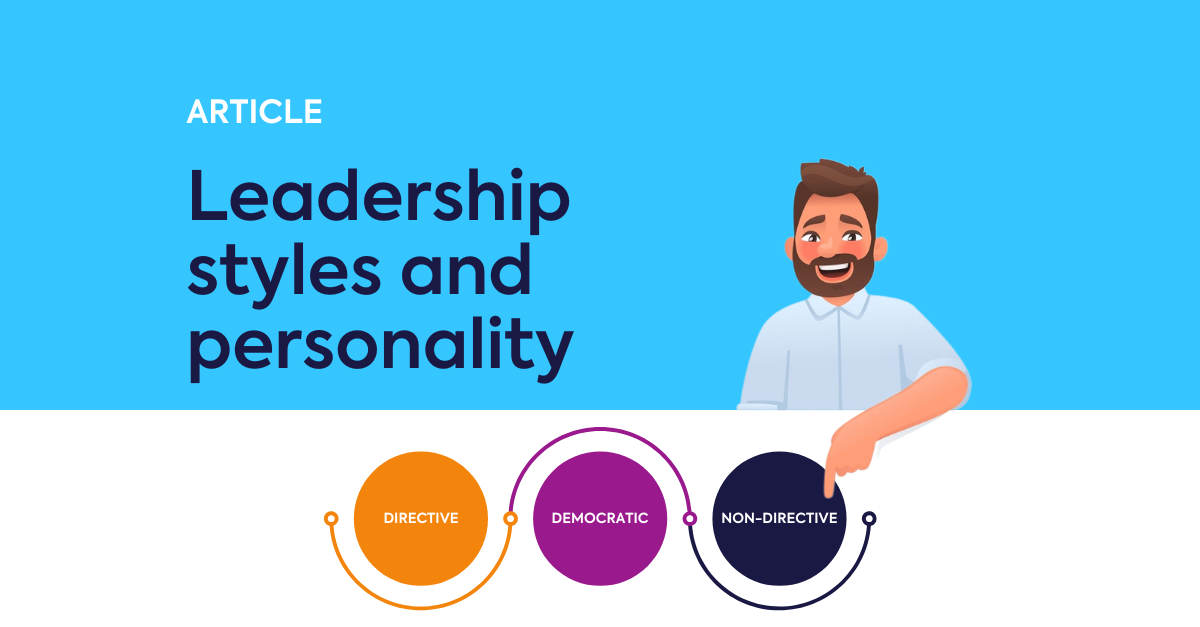
Your work personality shapes your default leadership style. Evaluators, Coordinators and Doers tend toward directive leadership, Campaigners, Helpers...

1 min read
C-level executives in 2026 are judged less on distant authority and more on how well they steward culture through constant change. The modern C-suite...