

.webp)

 Rudy Crous
Most people think assessment design starts with the question.
What should we ask?
What response scale should we use?
Should it be multiple choice, Likert, forced choice, scenario based, or something else?
How do we make sure the assessment is valid and reliable?
All of those questions matter. A lot.
But they are only one side of the coin.
The other side, which is often completely overlooked, is this:
What do we need to understand once the data comes back?
That question sounds simple, but it changes everything.
Because too often, organisations build assessments that look good on the surface. The questions are well written. The response format makes sense. The assessment may even have good psychometric properties. But then the results come in and the organisation quickly discovers a problem.
They cannot cut the data properly.
They cannot compare groups.
They cannot tell whether results differ by department, region, role level, gender, age group, tenure, leadership cohort, or business unit.
They cannot answer the questions they actually care about because they did not design the assessment with the analysis in mind.
And by then, it is too late.
Assessment design is not just question design
When people create assessments, they often move too quickly into item writing.
They want to create the questions. They want to define the scale. They want to build the assessment experience. That is understandable because it feels like the “real” work.
But assessment design is not just about creating the assessment instrument.
It is also about designing the data model behind the assessment.
That means thinking carefully about:
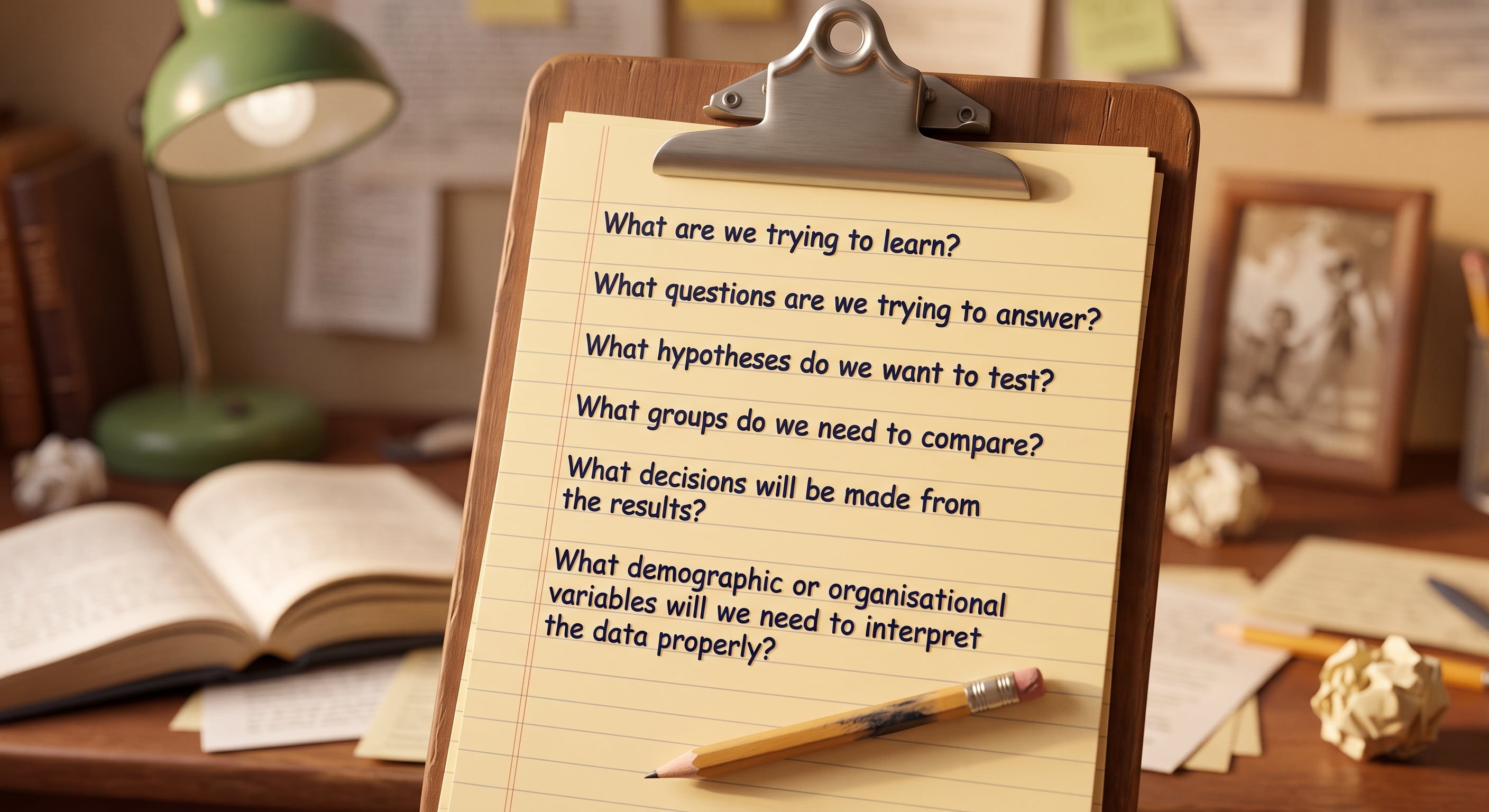
What are we trying to learn?
What questions are we trying to answer?
What hypotheses do we want to test?
What groups do we need to compare?
What decisions will be made from the results?
What demographic or organisational variables will we need to interpret the data properly?
Without this thinking, you can end up with a technically decent assessment that produces strategically weak insights.
The assessment may measure something validly, but the organisation cannot do much with it.
The missing step: research questions and hypotheses
Before any assessment is designed, there should be a clear view of the research questions.
For example:
Are engagement drivers different for frontline employees compared with leaders?
Do younger employees experience culture differently from older employees?
Are new starters less confident in their role expectations than longer-tenured employees?

Are there differences between national teams and global teams?
Do certain departments have stronger alignment between capability, culture, and performance?
Are managers scoring differently to individual contributors?
Are high performers responding differently to the broader workforce?
These are not small details.
They determine what data needs to be collected.
If you want to compare leaders and non-leaders, you need a clean leadership variable. If you want to compare regions, you need a consistent region field. If you want to compare tenure bands, you need tenure captured in a usable way. If you want to understand whether gender differences exist, you need to ask about gender in a responsible, respectful, and analytically useful way.
The point is not to collect demographics for the sake of it.
The point is to collect the right contextual data so the results can actually be interpreted.
Why demographics matter so much
In assessment design, demographics are often treated as an afterthought.
A few fields are added at the start or end of the assessment, usually because someone thinks they might be useful later. But this is not good enough.
Demographics are not just administrative details. They are analytical variables.
They allow you to understand whether assessment results are general across the whole population or whether they differ meaningfully between groups.
That matters because organisations are rarely uniform.
A company may have one overall engagement score, but very different realities across departments. A workforce may have one average capability score, but significant gaps between sites. A leadership program may look effective overall, but only because one cohort is pulling up the average. A culture assessment may suggest strong alignment, but hide major differences between head office and frontline employees.
Without the right demographic and organisational cuts, averages can become misleading.
They smooth out the very differences leaders need to see.
The danger of asking too little
If you ask too few demographic questions, you limit what can be analysed.
You might be able to report an overall score, but not explain what is driving it. You might see a pattern, but not know where it is coming from. You might suspect differences across groups, but have no way to test them.
This creates a major problem: the assessment becomes descriptive, not diagnostic.
It tells you what the overall result is, but not where to act.
For organisational assessments especially, this is a serious limitation. Leaders do not just need to know that something is happening. They need to know where, with whom, and under what conditions.
That is where demographic design becomes critical.
The danger of asking too much
Of course, the answer is not to ask every demographic question imaginable.
That creates a different problem.
If the demographic section becomes too long, people get frustrated before they even reach the assessment. Completion rates drop. Response quality can suffer. Participants may become suspicious about why so much personal information is being collected. In some cases, the data may also create privacy, confidentiality, or ethical concerns.
So the goal is not to create a shopping list.
The goal is to be intentional.
Every demographic question should earn its place.
A good test designer should be able to explain why each demographic variable is being collected, how it will be used, and what decision it will support.
If there is no clear use case, do not ask it.
A better way to design assessments
Good assessment design should begin with the end in mind.
Before writing the questions, the organisation should work through a few practical questions.
First, what are we trying to measure?
This is the core construct question. Are we measuring engagement, capability, culture, personality, safety confidence, leadership behaviour, learning transfer, job readiness, or something else?
Second, what decisions will be made from the data?
Will the results inform hiring, development, workforce planning, team design, leadership intervention, compliance, training investment, or organisational strategy?
Third, what comparisons will matter?
This is where demographics and organisational variables come in. Do we need to compare by gender, age, role level, location, tenure, business unit, department, employment type, manager status, cohort, or region?
Fourth, what hypotheses do we want to test?
For example, we may hypothesise that newer employees feel less clear about performance expectations, or that frontline employees experience culture differently from corporate employees, or that middle managers report higher pressure and lower support than senior leaders.
Fifth, what is the minimum demographic data we need to answer those questions responsibly?
This forces discipline. It prevents both under-collection and over-collection.
Demographics should be designed, not dumped in
A well-designed demographic section should feel purposeful.
It should not feel like a generic HR form attached to the front of an assessment.
The variables should reflect the research purpose.
For example, in an organisational culture assessment, useful variables may include business unit, team, location, role level, tenure, and manager status. In a recruitment validation study, useful variables may include role family, selection outcome, performance rating, tenure, hiring source, and assessment score. In a leadership development assessment, useful variables may include leadership level, cohort, function, span of control, and prior leadership experience.
The right demographics depend on the assessment purpose.
That is why there is no universal list.
There is only a better design process.
The quality of the insight depends on the quality of the data structure
This is where many assessment projects fall over.
The assessment itself might be strong, but the data structure is weak.
For example, department names may be entered inconsistently. One person writes “Sales”, another writes “Sales Team”, another writes “Revenue”, and another writes “Business Development”. Suddenly, the data is messy and hard to analyse.
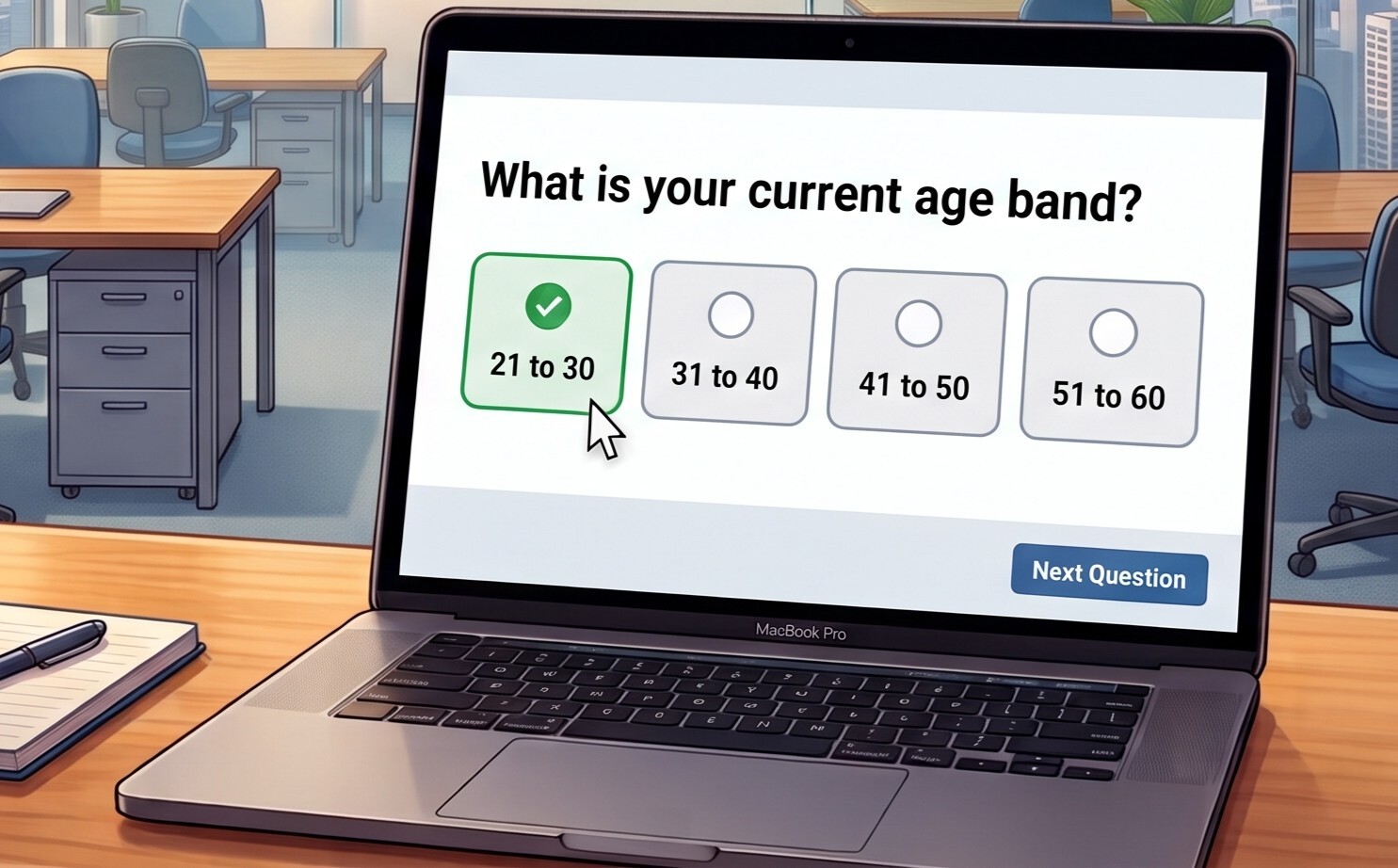
Or age is captured as a free-text field when age bands would have been more appropriate.
Or role level is not defined properly, so “manager” means different things in different parts of the organisation.
Or country, region, and site are confused, making it impossible to distinguish between local and global patterns.
These sound like technical details, but they are not.
They determine whether the data can be trusted.
Bad demographic design creates bad segmentation. Bad segmentation creates weak analysis. Weak analysis leads to poor decisions.
Privacy and confidentiality still matter
There is also an important ethical point.
Just because you can collect a demographic variable does not mean you should.
Demographic data can be sensitive. It can also increase the risk of identifying individuals, especially in smaller teams or niche cohorts.
For example, if you cut results by gender, age, department, location, and role level, you may quickly reduce a group to one or two people. That creates a confidentiality issue.
So demographic design needs to balance insight with protection.
In practice, that means:
Only collect what is genuinely needed.
Use categories rather than overly specific fields where appropriate.
Set minimum reporting thresholds for small groups.
Be transparent about why the data is being collected.
Avoid cuts that could identify individuals.
Make sure the analysis is used to improve decisions, not to target people unfairly.
Good assessment design is not just psychometric. It is also ethical.
The best assessments are built backwards
The simplest way to improve assessment design is to build backwards.
Start with the decision.
What decision does this assessment need to support?
Then define the insight.
What do we need to understand to make that decision well?
Then define the analysis.
What comparisons, cuts, and groupings will we need?
Then define the data.
What demographic, organisational, and outcome variables must be captured?
Only then should we finalise the assessment items and response format.
This sequence matters.
If you start with the questions first, you may end up with a good assessment but poor insight.
If you start with the decision first, you are far more likely to build an assessment that is not only valid and reliable, but useful.
The real test of an assessment is what you can do with the results
Validity and reliability matter. They are non-negotiable.
But they are not the whole story.
An assessment also needs to produce data that can be analysed, interpreted, segmented, compared, and acted on.
That means demographic design is not a side issue. It is part of the assessment design itself.
Because the real value of an assessment is not just in the score.
It is in what the score helps you understand.
It is in the patterns you can detect.
The differences you can explain.
The risks you can identify.
The interventions you can target.
The decisions you can improve.
And none of that happens by accident.
It happens when assessment designers think beyond the questions and design for the data they will need later.
That is the forgotten half of assessment design.
Rudy Crous is a corporate psychologist and the co-founder and CEO of Compono, a people and culture platform that brings hiring, engagement, learning and credentialling together in one place, adding behavioural science to the processes most HR tools only track.

