

.webp)

 Mathan Allington


Why training doesn't work for modern teams
 Compono
Discover why traditional staff training often fails and how to build a high-performing team culture that actually sticks. Learn more with Compono.
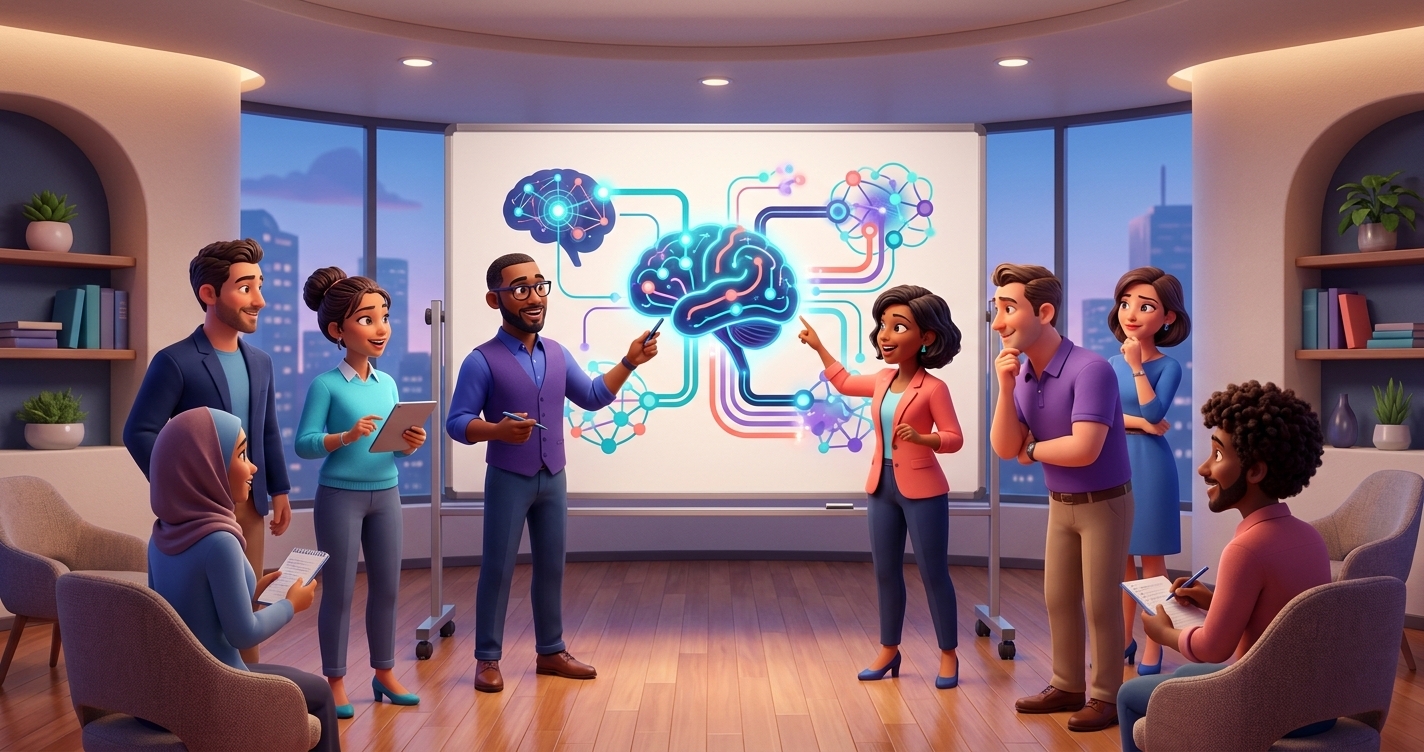
Learning science principles are evidence-based strategies derived from cognitive psychology and neuroscience that explain how the human brain acquires, retains, and applies new information.
Key takeaways
- Learning science principles shift the focus from passive information consumption to active cognitive engagement and retrieval.
- Introducing desirable difficulties like spaced repetition and retrieval practice significantly improves long-term knowledge retention.
- Effective learning is deeply tied to social and emotional dimensions, requiring high trust and active collaboration to succeed.
- Many traditional training methods rely on debunked myths, making evidence-based learning science essential for modern workforce development.
For decades, corporate training has relied heavily on the "click next to continue" model of e-learning. We place employees in front of screens, ask them to watch videos or read dense compliance documents, and then test their short-term memory with a multiple-choice quiz.
This approach might tick a compliance box, but it fundamentally ignores how the human brain actually works. The result is a massive waste of organisational time and resources, with employees forgetting the vast majority of what they have "learned" within a matter of days.
The issue is not just a lack of engagement; it is a lack of scientific rigour. According to recent research, faculty assessments reveal significant gaps in teachers’ knowledge of well-established learning principles. Many cannot reliably distinguish proven methods like retrieval practice and spacing from debunked misconceptions like "learning styles" or pure discovery learning.
If traditional educators struggle to separate fact from fiction, it is no surprise that corporate Learning and Development (L&D) teams often fall into the same traps. To build high-performing teams, we need to look past the myths and embrace the cognitive realities of how adults actually build capability.
Understanding the evolving learning management system environment means recognising that technology alone cannot save bad instructional design. We must build our programs on a foundation of proven learning science principles.

Consider the metaphor of the gulping goose. When a goose eats, it often swallows its food whole, bypassing the vital process of chewing and breaking down the nutrients. In many ways, traditional corporate training treats employees like gulping geese.
We feed them massive amounts of information in marathon onboarding sessions or day-long workshops, expecting them to swallow it all whole. But cognitive science tells us that true learning requires digestion. Information must be broken down, processed, and synthesised before it can become long-term knowledge.
Learning is not a spectator sport. The National Academy of Science’s STEM education report identifies seven principles, noting specifically that students need opportunities to actively engage in disciplinary learning. Passive listening simply does not create the neural pathways required for mastery.
When we design training, we must move away from information dumping. Instead, we should create environments where learners are forced to actively process the material. This means asking them to solve problems, categorise information, or explain concepts back to their peers.
Recent NAEP data shows students reported fewer opportunities to design investigations, use evidence to support claims, or construct explanations, core practices that are at the absolute heart of learning science. When we remove these active elements, we are no longer teaching; we are merely broadcasting.
Continuing with our avian metaphor, consider how geese fly in a V-formation. They do not fly in silence; they honk loudly to encourage the birds in front to keep up their speed. This noise is a critical part of their collective success.
Similarly, learning is an inherently social and emotional process. We do not learn in a vacuum. The environment in which we learn, the people we learn with, and the psychological safety we feel all play a massive role in our ability to acquire new skills.
A 2025 meta-analysis of 40 studies found comprehensive social and emotional programs improve overall academic achievement by 8.4 percentile points. This reinforces the principle that trust, combined with high standards, propels classroom and workplace performance.
When employees feel safe to ask questions, admit mistakes, and challenge ideas, their cognitive load is freed up to focus on the actual material. Conversely, in high-stress or low-trust environments, the brain's threat response hinders its ability to form new memories.
This is why modern L&D programs must incorporate peer-to-peer learning, mentoring, and collaborative problem-solving. A noisy classroom, or a highly interactive digital learning environment, is often a sign of deep, engaged learning.
How do we ensure that learning actually sticks? While discovery-based learning has been a popular trend, the science points to a more structured approach, especially for novices.
A Global Education Evidence Advisory Panel report synthesising over 120 studies confirms that explicit, structured teaching of core skills is the most effective way to teach worldwide. When introducing new concepts, learners need clear, unambiguous instruction before they can be expected to apply that knowledge creatively.
This structured approach involves breaking complex skills into manageable chunks. By managing the cognitive load, we prevent the learner's working memory from becoming overwhelmed. Once the foundational knowledge is secure, we can then gradually remove the scaffolding.
To make this knowledge sticky, we must also employ spaced repetition. This involves revisiting information at gradually increasing intervals. Instead of a one-off annual compliance module, a learning science approach delivers bite-sized reinforcements over several weeks or months.
When you combine explicit instruction with spaced repetition, you create a solid framework for long-term retention. The brain is repeatedly signalled that this information is important, prompting it to move the data from short-term working memory into long-term storage.
It is a common misconception that if a training session feels easy and smooth, it must be effective. In reality, the opposite is often true. When learning feels too easy, it usually means we are experiencing an illusion of fluency.
Research demonstrates that introductory courses appear to expand students’ sense of expertise faster than their actual knowledge grows. In these studies, inflated self-assessments of knowledge often persisted for years after the initial training.
To combat this overconfidence, learning science advocates for the introduction of "desirable difficulties". These are intentional points of friction designed to make the learner work harder to retrieve information. The harder the brain has to work to recall a fact, the stronger that memory trace becomes.
Retrieval practice, such as low-stakes quizzes, flashcards, or simply asking an employee to summarise what they learned yesterday, is a prime example of a desirable difficulty. It feels harder in the moment, and learners may even perform worse during the training session itself, but the long-term retention is vastly superior.
We must train our workforce to embrace this friction. Learning, when done right, is hard work. By designing programs that challenge our teams to actively recall and apply information, we ensure that the capability is there when they actually need it on the job.
None of these cognitive strategies matter if the learner is not motivated to engage with the material. Motivation is the engine that drives the entire learning process. But motivation in the workplace is rarely as simple as offering a certificate or a digital badge.
Adult learning theory tells us that adults need to know *why* they are learning something. The content must be immediately relevant to their day-to-day challenges. If an employee cannot see the direct line between the training module and their own success, their cognitive engagement will plummet.
This ties back to the affective dimensions of learning. When we design training, we must tap into intrinsic motivation by providing autonomy, building a sense of competence, and building relatedness among the team.
The Compono Develop platform is built with these exact principles in mind. By aligning learning pathways with clear career progression and real-world skills, we ensure that employees are not just completing modules, but actively building capabilities they care about.
When you combine high motivation with evidence-based cognitive strategies like spaced repetition and retrieval practice, you create an unstoppable culture of continuous learning.
Key insights
- True learning requires active cognitive processing and effort, rather than the passive consumption of videos or reading materials.
- Social connection, peer collaboration, and psychological safety are foundational requirements for high-performance learning environments.
- Building desirable friction into training programs prevents the illusion of competence and ensures that knowledge actually sticks long-term.
- Organisations must abandon debunked learning myths and embrace evidence-based cognitive science to see a real return on their development investments.
If you are ready to move away from passive training and start building real capability through evidence-based cognitive strategies, it is time to upgrade your instructional approach.
The main principles focus on how the brain processes and retains information. They include active engagement, spaced repetition, retrieval practice, dual coding, and the integration of social and emotional dimensions into the learning environment.
Spaced repetition combats the natural forgetting curve. By revisiting information at gradually increasing intervals, the brain is forced to recall the data, which strengthens the neural pathways and moves the information into long-term memory.
Desirable difficulties are intentional challenges or friction points built into a learning experience. Examples include low-stakes quizzes or interleaving different topics. While they make the learning process feel harder in the moment, they significantly improve long-term retention.
Cognitive load theory suggests that our working memory has a limited capacity. If training presents too much information at once, or if the presentation is confusing, the learner's working memory becomes overwhelmed, and learning stops. Good instructional design breaks complex topics into manageable chunks.
Extensive cognitive research has shown no evidence that tailoring instruction to a learner's preferred style (such as visual, auditory, or kinaesthetic) improves outcomes. Instead, learning science shows that all learners benefit from a mix of modalities, known as dual coding, depending on the subject matter being taught.
If you'd like to talk through how Compono can support your team, we're happy to walk you through it. No pressure, just a conversation.

Discover why traditional staff training often fails and how to build a high-performing team culture that actually sticks. Learn more with Compono.

How L&D teams use competency framework software to map skills, track gaps, assign training and report compliance without chasing spreadsheets.

How competency framework software helps Wellington HR teams map skills, find the gaps, and build career pathways people can see.