


 Mathan Allington

Recruitee pricing 2026: plans, true costs and how to budget
 Mathan Allington
The true cost of Tellent Recruitee in 2026. Explore pricing tiers, headcount models, hidden fees and smarter HR technology alternatives.
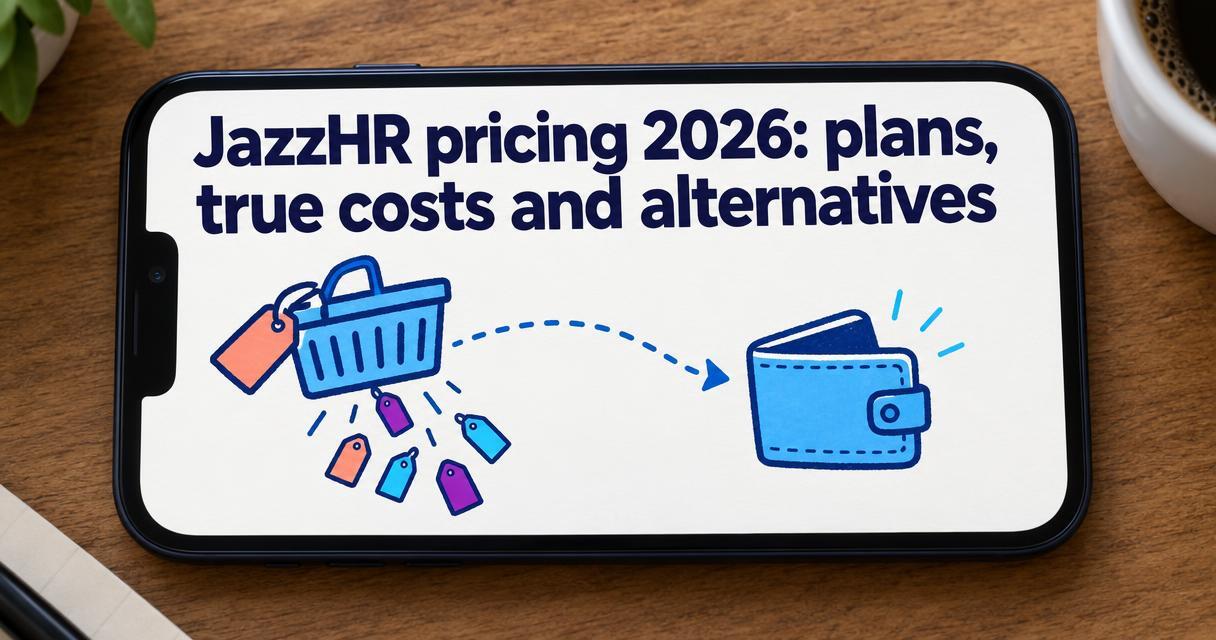
JazzHR pricing starts at US$99 a month for its Hero plan, scaling to US$325 a month for Plus and US$499 a month for Pro when billed on a monthly cycle.
Last reviewed October 2026
Quick answer
- Price: US$99 to US$499 a month on monthly billing, or US$1,000 to US$5,508 paid yearly.
- Best for: Small businesses that need a flat-fee applicant tracking system without per-user charges.
- Verdict: JazzHR controls basic process risk well for small teams, but scaling businesses often hit a ceiling with hidden add-on fees and a lack of behavioural insight into candidate fit.
Buying an applicant tracking system is an exercise in managing compromises. Most platforms charge a fee for every user you add. This punishes growth and forces HR teams to restrict login access to save money, creating bottlenecks when hiring managers need to review applications. JazzHR takes a different approach by removing the per-user penalty.
It sounds like a right solution on the surface. You pay a single flat rate, and your whole company can log in to review candidates. However, the reality of HR software economics is rarely that simple. Vendors that do not charge per user must recover that revenue somewhere else, usually through job slot limits, restricted features, or premium add-ons for essential tools.
The core problem is that systems like JazzHR focus entirely on managing process risk. They track resumes, shift candidates between columns on a digital board, and handle compliance records. This is necessary work, but it is not sufficient for building a high-performing team. These platforms ignore people insight risk. They cannot tell you if a candidate who looks great on paper will clash with your team culture or thrive in your environment. You start with a cheap software subscription, but you pay the true cost in poor hiring decisions.

To understand what you will actually spend, you have to look past the monthly sticker price. JazzHR splits its platform into three distinct tiers, each designed for a different phase of company growth. The real constraints sit inside the job slot limits and the features locked behind the higher plans.
The entry-level Hero plan is built for micro-businesses that only hire occasionally. It includes basic resume tracking, email templates, and standard reporting. The major limitation is that you can only have three active job postings at any one time.
For a small retail shop or a local consultancy, three active jobs might be enough. But if a team suddenly needs to backfill two roles while opening a graduate intake, that limit becomes a hard roadblock. You are forced to pause existing hiring pipelines or upgrade your entire subscription just to post a fourth job.
This is where most mid-market teams land. The Plus plan jumps the active job limit from three up to 200, which is functionally unlimited for a mid-sized organisation. It also introduces automated job board syndication, basic interview scheduling, and custom workflows.
The price jump from Hero to Plus is significant, moving from US$99 up to US$325 on a monthly billing cycle. This tier is essentially the real starting point for any business that runs a continuous recruitment function. It removes the job slot anxiety but leaves several critical features as paid add-ons.
The top tier removes all job limits and bakes in tools that are considered premium on the lower plans. This includes native electronic signatures and advanced reporting features. It is designed for larger corporate teams that need to standardise compliance and contract execution inside the platform.
Across all three of these tiers, the primary selling point remains the same. JazzHR offers unlimited users across all three plans, differentiating its flat-fee model from per-user recruiting software (JazzHR). This means you can invite every department head, team lead, and external consultant to review resumes without paying an extra cent for their seats.
SaaS vendors love annual contracts because they guarantee cash flow. Buyers often prefer monthly billing because it preserves flexibility. If the platform fails to deliver, or if hiring freezes due to economic shifts, a monthly contract lets you walk away. JazzHR prices its software to heavily encourage annual commitment.
Annual billing lowers JazzHR’s published prices to US$1,000 a year for Hero, US$3,480 a year for Plus, and US$5,508 a year for Pro (Front Desk Review). When you run the mathematics on this commitment, the savings appear compelling. JazzHR’s annual pricing page states that customers can save up to 24 percent by paying yearly (Front Desk Review).
For a business confident in its hiring volume, paying upfront makes financial sense. But HR leaders must weigh that discount against the risk of lock-in. If you sign an annual Plus contract for US$3,480 and find out three months later that the system does not integrate well with your new payroll software, you cannot claim a refund for the unused months. You are tied to the platform until the renewal date.
The biggest trap in HR software buying is assuming the subscription fee is the total cost of ownership. Most point solutions offer a clean base price, but the features you actually need to close modern candidates sit behind a paywall. This is a common theme explored in our guide to the hidden costs of HR software.
Email open rates are dropping, and text messaging is now the fastest way to reach candidates, especially for frontline, retail, and hospitality roles. In JazzHR, SMS capabilities are not included in the base subscription. You must pay an additional monthly fee to text candidates from the platform. If you rely on speed to secure talent, this add-on is mandatory, immediately inflating your monthly baseline.
Getting a candidate to say yes is only half the battle. You need to send a contract and get it signed before they take a counter-offer. If you are on the Hero or Plus plans, electronic signatures are a paid add-on. Without it, you are forced to export documents, upload them to a third-party signing tool, and manually track completion. This breaks the candidate experience and adds administrative friction to the exact moment you want to look professional.
Software breaks, integrations fail, and hiring managers forget their passwords. Standard support is included, but if you want priority routing, a dedicated account manager, or tailored training sessions, you will need to pay for a premium support package. For teams with complex hiring workflows, relying on standard email ticket queues during a recruitment crisis is a massive operational risk.
When you map out the add-ons and the true cost of scaling, it pays to look at the broader market. If you are evaluating a switch, you should compare your options carefully. For a deeper breakdown of the market, you can read our full guide to the best JazzHR alternatives. Here is how the top contenders stack up.
To make an informed decision, you must map the financial cost against the capability of the platform. Here is how the leading options compare on core functionality and billing models.
| Platform | Starting price | Billing model | Best use case |
|---|---|---|---|
| Compono Hire | Pricing on request | Custom scaling | Culture and behavioural fit |
| JazzHR | US$99 a month | Flat fee (job limited) | Small business administration |
| BambooHR | From US$10 a user | Per employee | Single HRIS needs |
| Workable | US$149 a month | Job slot limits | Global talent sourcing |
Compono makes Compono Hire. We have included it and kept every entry's strengths and limits honest.
To calculate real ROI, you need to model scenarios based on your hiring volume, not just the software subscription fee. You can run your own figures through a cost per hire calculator to see how much administrative friction actually costs your business. Here are two common scenarios for JazzHR buyers.
A small retail chain needs to hire three casual staff members a year for the summer rush. They choose the JazzHR Hero plan on an annual contract. The cost is US$1,000 upfront. Because their volume is so low, they do not need candidate texting or automated eSignatures. They manage contracts on paper. For this business, JazzHR delivers exactly what it promises. They pay US$1,000 for the year, centralise their resumes, and avoid per-user fees for their store managers.
A marketing and tech agency plans to hire 25 people this year. They start on the Hero plan but immediately hit the three-job limit. They upgrade to the Plus plan. At US$3,480 a year, the base cost is manageable. However, they are competing for top developers and need to move fast, so they add candidate texting and the eSignature module.
Their true software cost pushes past US$5,000 a year. More importantly, they are hiring fast based on resumes alone. Two of their new developers clash with the existing team and resign within four months. The cost of those bad hires dwarfs the software subscription. The agency managed its process risk perfectly through JazzHR, but completely failed to manage its people insight risk.
When you buy a new ATS, the software is empty. You have to fill it with your historical candidate data, job templates, and approval workflows. Many vendors advertise a low subscription cost but charge heavy professional services fees to get the system running.
JazzHR handles basic setup reasonably well for small teams, allowing you to manually upload spreadsheets of old candidates. However, if you are migrating from an enterprise ATS and have tens of thousands of candidate records, parsing that data cleanly requires technical support. If you need custom API endpoints built to connect JazzHR to a proprietary payroll system, you will need developer time. You must factor internal labour and potential vendor integration fees into your first-year budget.
If you decide a flat-fee system is the right choice, you should never accept the first quote blindly. Software margins are high, and sales teams have levers they can pull to close a deal, especially at the end of a financial quarter.
First, model your actual job volume. Do not buy the Pro plan just because it offers unlimited jobs if you only ever hire ten people a year. Start with Plus and force the vendor to prove the value of the upgrade.
Second, negotiate the add-ons, not just the base price. A sales representative might not be able to discount the core Plus subscription, but they often have the authority to bundle candidate texting or eSignatures for free during the first year. Ask for the bundle.
Third, demand a trial that tests your specific workflow. JazzHR provides a 21-day free trial but does not offer a permanent free plan (JazzHR). Use those 21 days to test the exact integration you need with your calendar and email system. If it fails the trial, do not sign the annual contract.
Hiring on skills alone is like buying a house from the floor plan. You know how many rooms it has, but you are completely missing the neighbourhood. Process-driven tools like JazzHR organise the floor plan brilliantly. They ensure every candidate has submitted a resume, passed a compliance check, and received an interview invitation.
But they tell you nothing about the human being. Will they communicate well with your existing project managers? Are they driven by steady, methodical work, or do they thrive in chaos? When you buy an ATS that only manages applications, you are accepting a massive blind spot. The highest cost in recruitment is not the US$300 monthly software fee. The highest cost is paying an US$80,000 salary to a person who quits after three months because their work personality clashed with the team culture.
If you are reviewing Compono pricing alongside other platforms, the difference in philosophy is clear. An ATS must do the administrative heavy lifting, but it must also add a layer of behavioural science. When you understand who people are, rather than just what they can do, you stop replacing bad hires and start building high-performing teams.
Your ATS tracks applications, but ours tells you who will thrive in your culture before you make an offer. We combine process automation with behavioural science to ensure every hire is a true fit.
No. While JazzHR offers a 21-day free trial to test the platform, there is no permanent free tier. Once the trial expires, you must upgrade to a paid subscription to continue managing candidates and posting jobs.
The main difference is the limit on active job postings. The Hero plan restricts you to three active jobs at any given time, making it suitable only for very small businesses. The Plus plan expands this limit to 200 active jobs and adds features like automated job board syndication and custom reporting.
No, JazzHR operates on a flat-fee model for users. You can invite an unlimited number of hiring managers, department heads, and interviewers to the platform on any tier without increasing your monthly subscription cost.
Yes, JazzHR offers monthly billing options for its plans. However, the company heavily incentivises annual contracts by offering discounts of up to 24 percent if you choose to pay for the full year upfront.
Electronic signatures are only included in the top-tier Pro plan. If you are on the Hero or Plus plans, you will need to pay an additional monthly add-on fee to send and sign offer letters directly within the platform.

The true cost of Tellent Recruitee in 2026. Explore pricing tiers, headcount models, hidden fees and smarter HR technology alternatives.

Looking for Breezy HR alternatives in 2026? Compare top ATS platforms for mid-market teams, from behavioural science tools to all-in-one HRIS suites.

What SmartRecruiters costs in 2026: the $14,995 Essential plan, quote-based enterprise tiers and how the per-employee-per-year model adds up.
 Compono