

.webp)

 Mathan Allington
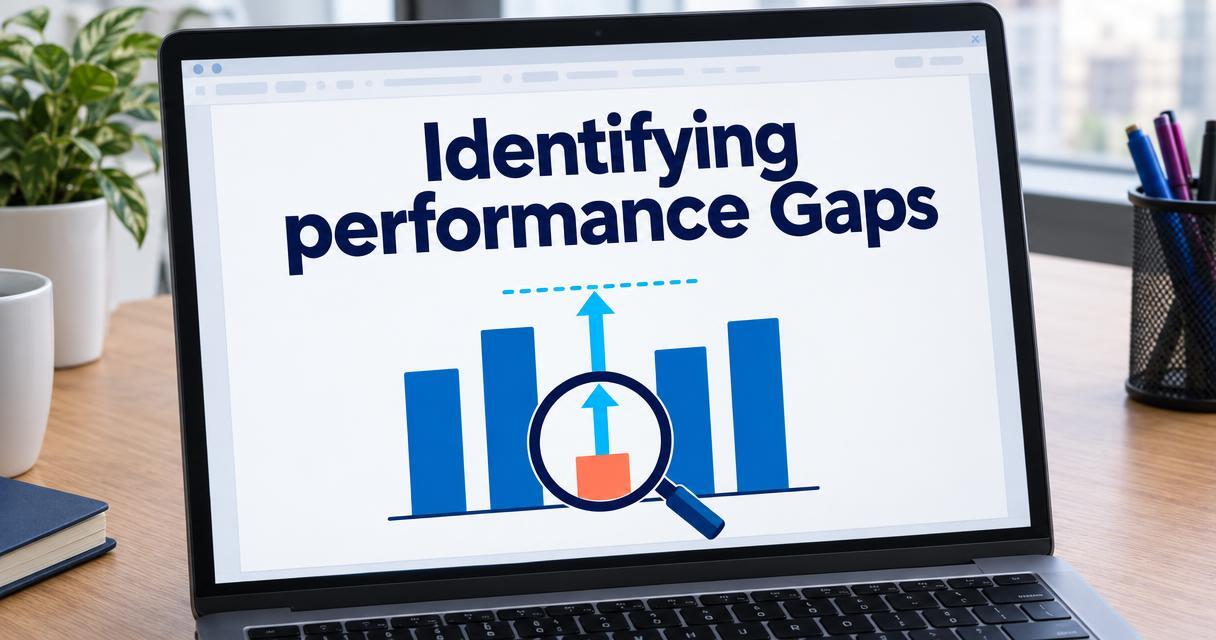
Identifying performance gaps means finding the exact point where your team's actual output falls short of your expected business results and figuring out why.
Last reviewed October 2026
Most leaders assume a performance gap is a people problem. They see missed targets and immediately prescribe more training or harder KPIs. The data usually tells a different story. When good people fail to deliver, the root cause often points to a broken process, misaligned tools, or a fundamental misunderstanding of what the job actually requires.
Key takeaways
- A performance gap is the measurable difference between what a business expects and what an employee actually delivers.
- Most performance issues stem from systemic failures like poor tools or unclear expectations rather than a lack of employee motivation.
- Conducting a proper analysis requires mapping current reality against specific targets and investigating the root cause without bias.
- Closing the gap requires targeted interventions like capability building and culture alignment instead of generic compliance training.
The problem with how we view underperformance
When a team misses its targets, the standard corporate response is highly predictable. Managers schedule extra one-on-one meetings. Human resources rolls out a new training module. Leaders talk about accountability and ownership. None of these actions actually fix the underlying issue.
We treat underperformance as an individual character flaw. We assume the employee simply needs to try harder. This mindset ignores the reality of modern work. Performance is a system. If you put a highly capable person into a broken system, the system will win every time. Identifying performance gaps requires you to look at the entire environment surrounding the employee.
You need to ask whether the business has actually provided the conditions necessary for success. Have you clearly defined what good looks like? Do your people have the right tools? Does the company culture punish the very behaviours you are trying to encourage? Until you answer these questions, any attempt to fix a performance issue is just guesswork.
What exactly is a performance gap?
A performance gap is the space between your current reality and your desired outcome. It is a highly specific, measurable deficit in output. If you expect your customer success team to resolve support tickets within four hours and their average is currently twelve hours, you have an eight-hour performance gap.
Leaders often confuse performance gaps with skills gaps. They are related but distinct concepts. A skills gap means an employee lacks the specific knowledge or technical ability to do a task. A performance gap means the task is not being completed to the required standard. A lack of skill can cause a performance gap. A highly skilled employee can also underperform because they are burnt out, using outdated software, or receiving conflicting instructions from management.
If you want to fix the issue, you first need to know which problem you are solving. Rushing to train an employee who already knows how to do the job is a waste of time and money. This is why identifying skill gaps within a team must be handled as a separate diagnostic step before you start writing performance improvement plans.
The five true causes of performance gaps
When you strip away the excuses and the corporate jargon, almost all performance gaps trace back to one of five root causes. Understanding these causes stops you from treating the symptoms and forces you to fix the actual disease.
1. Unclear expectations and moving goalposts
You cannot hold someone accountable for a standard they do not understand. Many managers believe they have communicated their expectations clearly. In reality, they have offered vague directives like "take more initiative" or "improve customer satisfaction".
Employees cannot execute on vague directives. If the definition of success changes every week based on the manager's mood, the employee will eventually stop trying to hit the target. Clear expectations require specific metrics, defined timelines, and documented standards of quality.
2. Misaligned work personalities
We all have different natural preferences for how we approach work. Some people thrive in structured, detail-oriented environments. Others excel in chaotic, fast-paced situations that require rapid problem-solving. When you force an employee to work consistently against their natural grain, their performance will eventually degrade.
This is not about making excuses for poor work. It is about strategic alignment. If you put a natural pioneer into a role that requires endless auditing of historical data, they will struggle. By assessing work personality, you can identify whether a performance gap is actually a role-fit issue. Sometimes the easiest way to fix a performance problem is to move the person into a seat that matches their strengths.
3. Broken tools and inefficient processes
You can hire the best talent in the market. If you force them to use software from a decade ago and work through six layers of approval to make a basic decision, their output will be mediocre. Process friction is a silent killer of productivity.
Before you blame the employee for failing to hit a deadline, audit their workflow. Look for bottlenecks. Look for manual data entry that should be automated. Look for contradictory policies. If the process is broken, fixing the process is the only way to close the performance gap.
4. The illusion of training completion
Organisations spend millions on learning and development. They track attendance and completion rates obsessively. The problem is that watching a video and clicking "next" does not equal competence.
A major cause of performance gaps is the false assumption that training fixed a capability issue. Managers see a 100% completion rate on a compliance module and assume the team knows what to do. The gap between training completion rates and actual capability is massive. If your training does not verify that the employee can actually apply the knowledge in a real-world scenario, the performance gap will remain wide open.
5. Culture and environment friction
Company culture dictates how people actually behave when the manager leaves the room. If your stated goal is cross-functional collaboration, but your bonus structure only rewards individual sales metrics, your people will not collaborate. The culture is actively working against your performance goals.
Employees are rational. They adapt to the environment they are in. If the environment rewards speed over quality, you will get fast, low-quality work. Identifying performance gaps requires you to look at what your culture actually rewards.
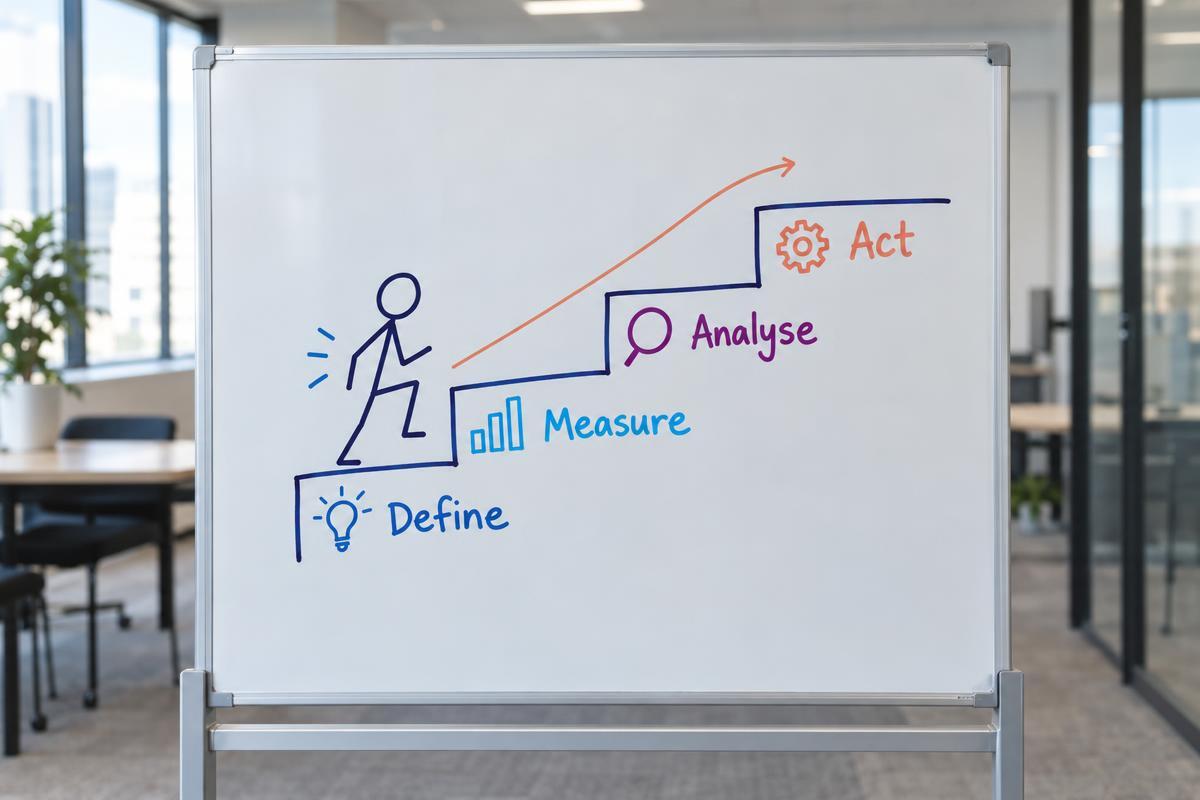
How to conduct a performance gap analysis in four steps
A performance gap analysis is a structured process for finding the distance between current reality and your expected standard. It removes emotion from the conversation and replaces it with data. Follow these four steps to get an accurate picture of your team's shortfalls.
Step 1: Define the expected standard
You must establish a baseline. What does right execution look like for this specific role? Write it down in measurable terms. Do not use adjectives. Use numbers, timeframes, and quality metrics.
Instead of saying "excellent customer service", define the standard as "resolving all tier-one complaints within 24 hours with a customer satisfaction score of 90% or higher". This gives you a concrete target to measure against.
Step 2: Measure the current reality
Gather the data on what is actually happening right now. Look at sales figures, error rates, project delivery times, or customer feedback. Do not rely on gut feeling or anecdotal evidence from a single unhappy client.
You need a statistically significant sample size to understand the true current state. Once you have the data, compare it to the standard you defined in step one. The difference between the two numbers is your performance gap.
Step 3: Identify the root cause
This is where most analyses fail. Managers see the gap and immediately jump to conclusions. You must investigate why the gap exists. Talk to the employees involved. Ask them what is preventing them from hitting the target.
Use a diagnostic approach. Do they know what is expected of them? Do they have the necessary skills? Do they have the right tools? Are there external roadblocks preventing success? Keep asking "why" until you hit a systemic issue you can actually fix.
Step 4: Design the intervention
Once you know the root cause, you can build a solution that actually works. If the issue is a lack of skill, targeted development is the answer. For example, using Compono Develop allows you to push targeted learning journeys based on individual capability gaps rather than forcing the whole team through generic training.
If the issue is process friction, your intervention might involve buying new software or rewriting a policy. The intervention must directly address the root cause uncovered in step three.
Writing performance gaps in appraisals
When you identify a performance gap, you must document it clearly during the appraisal process. Vague feedback helps no one and creates legal risk for the business. You need to be direct, factual, and focused on behaviours rather than personality traits.
Use the Situation, Behaviour, Impact framework. Describe the specific situation where the performance fell short. Describe the exact behaviour you observed. Explain the business impact of that behaviour. Finally, outline the expected standard from here.
Instead of writing "John is careless with his reports", write "In the Q3 financial summary (Situation), John submitted data with three calculation errors (Behaviour). This caused the executive team to delay the board presentation by two days (Impact). From here, all financial summaries must be error-free and peer-reviewed before submission (Standard)." This approach removes the emotional sting and provides a clear path to improvement.
Strategies for closing the gap
Identifying the problem is only half the battle. You must execute a strategy to close the gap. The right strategy depends entirely on the root cause you uncovered during your analysis.
Targeted capability building
If your analysis revealed a genuine lack of ability, you need to build capability. This means moving away from passive learning and moving toward active verification. You need to assess your people against the required competencies and close the gaps before they become operational risks.
Using a tool like Compono Assure helps you verify capability before it matters. You can define what competence looks like for every role and ensure your people actually meet that standard before they are put in high-stakes situations.
Redesigning the environment
Sometimes the best way to improve performance is to change the environment. This might mean restructuring a team to ensure balanced coverage of different working styles. It might mean changing your incentive structures to reward the behaviours you actually want to see.
It also requires connecting company culture with employee performance. If you want a high-performing team, you need a culture that supports high performance. You must remove the friction that slows your people down and provide the psychological safety required for them to take calculated risks and innovate.
How Compono can help with performance gaps
Stop guessing why your teams are missing their targets. Our platform helps you measure capability, understand team changing, and deliver the exact development your people need to succeed.
FAQ
What is the difference between a skills gap and a performance gap?
A skills gap means an employee lacks the knowledge or ability to perform a task. A performance gap means the employee is not delivering the expected outcome, which could be due to a lack of skill, but is often caused by poor tools, unclear expectations, or a misaligned work environment.
What is the first step in identifying performance gaps?
The first step is always defining the expected standard. You cannot measure a gap until you have a clear, quantifiable baseline of what successful execution looks like for that specific role.
How do you write a performance gap in an appraisal?
You should write performance gaps using specific, factual language focused on outcomes. Describe the situation, the observed behaviour, the business impact, and the required standard from here. Avoid using emotional language or attacking the employee's character.
How often should you conduct a gap analysis?
You should conduct a formal gap analysis whenever a team consistently misses its targets, during major strategic shifts, or before implementing large-scale training programs. Continuous monitoring of key metrics will help you spot minor gaps before they require a full formal analysis.
Can a toxic culture cause a performance gap?
Yes. If a culture rewards the wrong behaviours, punishes innovation, or creates unnecessary friction, even your most capable employees will underperform. Culture dictates how work actually gets done, making it a primary driver of overall business performance.

