


7 min read
HR plan 2027: a practical planning guide with a free template
 Mathan Allington
October 26, 2026
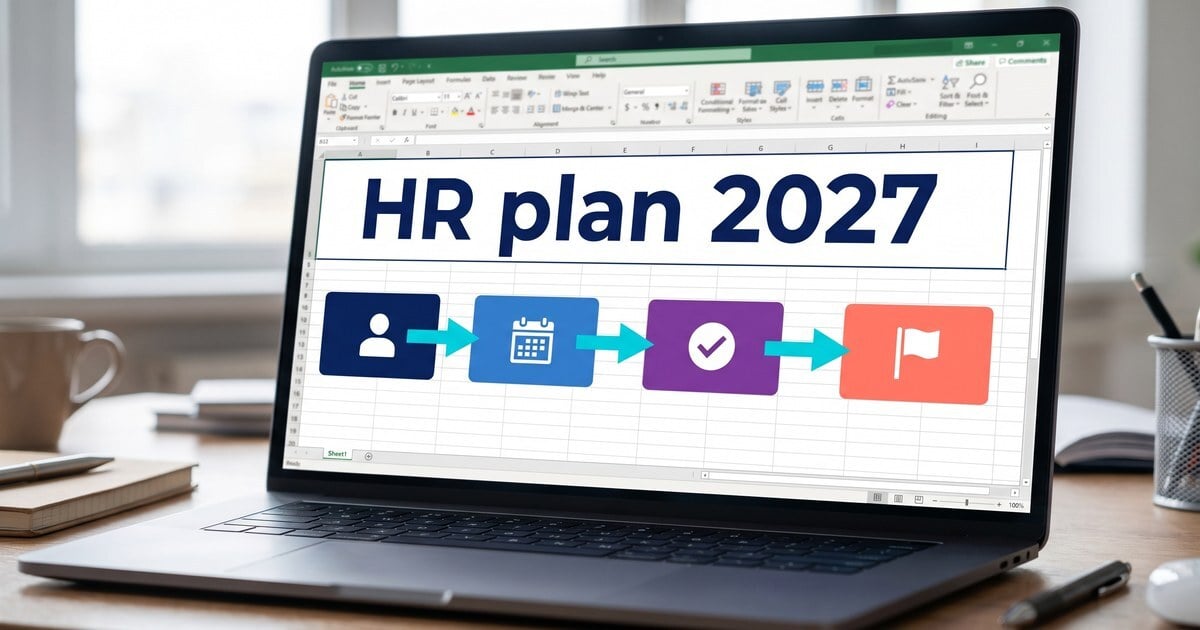
A strong 2027 HR plan starts from the business plan, turns it into headcount, hiring and capability needs, then covers both kinds of risk: process risk (payroll, super, award rates, reporting) and people insight risk (hiring 'fit', capability, culture and keeping the people you can't lose). This guide gives you eight steps, a free one-page template and an Australia and New Zealand calendar.
Last reviewed October 2026. Written for HR leaders in Australia and New Zealand building their 2027 HR plan.
In short
- Write the business plan's targets as people questions your finance team will recognise.
- Turn growth targets into a headcount and full-cost plan for every team.
- Plan hiring around 'fit', because most applicants aren't suitable.
- Plan learning against named capability gaps, and measure whether capability changed.
- Decide when you'll read engagement and culture, and who you can't afford to lose.
- Give managers their own line in the plan, because the rest of it runs through them.
- Lock in the 2027 compliance calendar, including the first full financial year of Payday Super.
- List the decisions your HR systems can't support before you set the budget.
2027 is the first full calendar year of Payday Super, and 30 June closes its first full financial year, so super timing, award rates and reporting all need a place in the plan. Most annual HR plans stop there, as last year's plan with new dates. That covers process but leaves out the decisions that cost the most when they go wrong: who you hire, which managers you back and who stays. Our HR trends 2027 roundup covers what's changing around the plan.
This guide is the practical, one-year layer. For the strategy layer, read our guide to developing a human resource strategy. The template, calendar and checklist below are free and ungated.
1. Start with the business plan, not last year's HR plan
Get the 2027 business plan (or the latest draft) first. Pull out every target that depends on people (new markets, new products, sites opening or closing, margin goals) and rewrite each one as a people question. A growth target becomes "which roles do we need, and by when?"
Our take: An HR plan written in HR language gets read as a cost list. If the chief financial officer (CFO) can find their own targets in it, line by line, the budget conversation starts from shared ground instead of a headcount haggle.
2. Turn growth targets into a headcount and cost plan
Map today's headcount as full-time equivalent (FTE) by team, then model where each team needs to be by December 2027. Price every new role at its whole cost: salary, super, leave, on-costs, equipment and the months it takes to get productive. The true cost of an employee calculator gives you a per-hire number you can defend when finance asks.
3. Plan hiring around 'fit', not just volume
On average, Australian employers aren't short of applicants. Jobs and Skills Australia's Occupation Shortage Report for the March quarter 2026 found 21.5 applicants per vacancy, of whom 5.2 were suitable, with a national fill rate of 68.2%. The hard part is choosing well from the pile.
For each planned role, agree what good looks like before the ad goes live, including how the person needs to work with their new team, then assess every candidate against it with structured interviews and a shared scoring rubric. The recruitment trends for 2027 explain why matching matters more than volume.
Our take: Most hiring plans count requisitions and time to hire, which are both process measures. Add one people insight measure, such as how many new starters are performing well at 12 months, and you'll see whether your hiring is working.
4. Plan capability, not training hours
List the skills the business plan needs that you don't have yet. The skills gap analysis calculator helps you size each gap and weigh building the skill internally against hiring for it. Then plan learning against those gaps, with a measure for each that shows capability changed. Our L&D trends for 2027 cover where the evidence bar is heading.
Our take: Completion rates are a process metric that gets reported as a capability metric. A 2027 learning and development (L&D) plan should name the capability, the people who need it and how you'll know they have it.
5. Plan how you'll read engagement, culture and retention
Low turnover can hide a lot. When fewer people leave, you keep the people you'd hate to lose and also the ones who would have left in a hotter market.
Decide when you'll measure engagement and culture in 2027 (the engagement and culture trends for 2027 show what to look for) (see our guide on how often to run engagement surveys) and who owns the response. Name the people and roles you can't afford to lose, and book stay conversations with them early.
Our take: Low turnover in 2027 will flatter a lot of culture dashboards. Plan to read how people work together and what drives them alongside how they feel, so the action plan knows which team to start with.
6. Put managers in the plan by name
Most of your plan runs through managers. Check each manager's load with the span of control calculator, then plan support for the ones who are overloaded or new to leading people.
Our take: Plans that treat managers as delivery channels for HR programs stall in the middle of the org chart. Give manager capability its own line, with its own budget and owner.
7. Lock in the 2027 compliance calendar
This is the process risk half of the plan. Payday Super started on 1 July 2026, so 2026-27 is the first full financial year in which super guarantee must reach the fund within seven business days of each payday (20 business days for a new employee's first contribution), according to the Australian Taxation Office (ATO). Award rates change each year after the Fair Work Commission's Annual Wage Review. In 2026 the Fair Work Ombudsman confirmed a 4.75% rise in minimum award wages from 1 July. The award wage increase calculator shows what a range of 2027 outcomes would do to wages under each modern award.
2027 HR calendar for Australia and New Zealand
| Month or quarter | What changes or is due | Action |
|---|---|---|
| March to June 2027 | The Annual Wage Review usually runs, with the decision published at the end | Budget a range now, update when the decision lands |
| 31 March 2027 | Workplace Gender Equality Agency (WGEA) reporting period (1 April 2026 to 31 March 2027) ends | Confirm workforce data and snapshot date |
| 1 April 2027 (NZ) | NZ minimum wage changes have taken effect on 1 April every year since 2007 (adult rate NZ$23.95 an hour from 1 April 2026) | Check Employment New Zealand for 2027 rates and update payroll |
| 1 April to 31 May 2027 | WGEA lodgement period (extensions to 30 June or 31 July on application) | Book CEO sign-off early |
| 1 July 2027 | New award and minimum wage rates usually apply from the first full pay period on or after 1 July; the high income threshold also changes | Update payroll and recheck thresholds |
| Every payday | Super guarantee due at the fund within seven business days (12% rate unchanged in 2027-28) | Test clearing house timing and new starter set-up |
| 14 July 2027 | Single Touch Payroll (STP) finalisation declaration due for 2026-27 | Reconcile super and payroll data first |
| 1 April 2028 (NZ) | KiwiSaver default employee and employer rate rises from 3.5% to 4% | Put it in your 2027-28 cost forecast now |
This calendar is general information checked in October 2026, not legal or payroll advice. Confirm dates with the ATO (and its STP page), WGEA, Employment New Zealand and Inland Revenue, and get professional advice on how they apply to you.
8. Fix HR tech and data gaps before you set the budget
Check whether your systems can support the decisions your plan depends on. Sapient Insights Group's 2024-2025 HR Systems Survey found mid-market organisations (500 to 4,999 employees) run an average of 15 HR system integrations. More systems rarely means more clarity, because each tool was built on its own definitions. Put the plan's cost and payback in one document with our HR business case template.
Our take: Each tool in your stack probably does its own job well. The gap sits between them. If your hiring data can't talk to your culture data, your 2027 plan will run on guesswork where people decisions matter most.
Your 2027 HR plan on one page
Copy it into your own doc or spreadsheet, no sign-up, and fill in one row per section.
| Plan section | Question to answer | Evidence to bring | Owner | Free Compono tool or resource |
|---|---|---|---|---|
| Business goals and headcount | What does the business need from its people by December 2027? | Business plan targets, current FTE by team | CEO, CFO and HR lead | FTE workforce planning calculator |
| Hiring | Which roles, when, and what does a good hire look like? | Last year's hires, early leavers, time to hire | HR and hiring managers | Cost of a bad hire calculator |
| Capability and L&D | Which skills gaps put the plan at risk? | Skills audit, performance data | HR and team leads | Training ROI calculator |
| Engagement and culture | Where is culture helping or hurting the plan? | Last survey results, exit themes | HR and executive team | Employee survey questions |
| Managers and leadership | Which managers are overloaded, and who needs support? | Team sizes, manager survey results | HR and executives | Manager multiplier calculator |
| Compliance and policy | What changes in pay, super and reporting this year? | Award coverage, payroll audit, WGEA status | HR, payroll and finance | Rates and thresholds for Australia and New Zealand |
| HR tech and data | Which people decisions can't we make with today's systems? | System list, integration gaps | HR and IT | HR tech requirements builder |
| Budget | What does the plan cost, and what does it save? | Salary costs, award increase, tool spend | HR lead and CFO | HR business case builder |
Your 2027 HR planning checklist
| Done? | Item | Why it matters |
|---|---|---|
| ☐ | Mapped FTE by team, now and December 2027 | Shows the gap to hire or develop into |
| ☐ | Priced each new role at full cost | Keeps the people budget honest |
| ☐ | Agreed what a good hire looks like for each role | Gives hiring managers something to assess against |
| ☐ | Listed priority capability gaps by team | Puts L&D spend where the plan needs it |
| ☐ | Named the people you can't afford to lose | Retention effort goes where the risk is |
| ☐ | Checked every manager's span of control | Finds overloaded managers early |
| ☐ | Modelled the 1 July award increase | Avoids underpayment and budget surprises |
| ☐ | Tested Payday Super timing with payroll | Late super attracts the super guarantee charge |
| ☐ | Added WGEA (if you report) and NZ 1 April dates | Deadlines don't move for busy quarters |
| ☐ | Listed decisions your systems can't support | Builds the tech case on evidence |
| ☐ | Agreed owners and a quarterly review date | Keeps the plan in use after February |
Plan for both kinds of risk in 2027
A 2027 HR plan that gets payroll, super and reporting right has process risk covered. People insight risk sits in the decisions behind every line, and that's where most HR tools are incomplete. Compono is a workforce intelligence platform that handles both, with hiring, culture and capability data built on the same behavioural science, alongside compliance training, so you can go beyond the process, understand your people and make decisions you can defend. See how it works.
Build your 2027 plan on people data you can trust
One workforce intelligence platform for hiring, culture, capability and compliance, so every line of your plan has evidence behind it.
Talk to usFrequently asked questions
What should an HR plan for 2027 include?
A 2027 HR plan should cover business goals and headcount, hiring, capability and learning, engagement and culture, managers, compliance, HR tech and data, and budget. Give each section a question, evidence and an owner, and cover process risk (award and super changes) as well as people insight risk (hiring fit, keeping key people).
Is there a free HR plan template?
Yes. The one-page template in this guide is free and ungated: copy it into your own doc or spreadsheet, no sign-up. It has eight sections, each with the question to answer, the evidence to bring, the owner and a free Compono tool.
What HR compliance dates should Australian employers plan for in 2027?
Plan for new award and minimum wage rates from the first full pay period on or after 1 July, super guarantee reaching funds within seven business days of each payday under Payday Super, and the STP finalisation declaration by 14 July. WGEA reporters lodge between 1 April and 31 May. Confirm with each agency and get professional advice.
What's the difference between an HR strategy and an HR plan?
An HR strategy sets direction over several years: what the organisation needs from its people and how HR will help deliver it. An HR plan turns that direction into one year of actions, owners, budgets and dates. Most organisations need both.

Better hiring decisions, before the interview
Compono Hire helps you predict job-fit and team-fit using behavioural science, so you can shortlist with confidence.
Request a demoBuilt for mid-market hiring teams.
Practise your next tough conversation
Voice-first coaching that adapts to your personality. Get actionable steps you can take this week.
Start freeBuilt by Compono. Not therapy — practical behaviour change.