

 Mathan Allington
A career progression framework template is a structured document that defines exactly what skills, behaviours and milestones an employee needs to reach the next level in their role.
Last reviewed November 2026
Key takeaways
- A career progression framework maps out the specific competencies and expectations required for promotion.
- Modern frameworks must include a dual-track progression model to separate individual contributor growth from people management.
- Tying transparent compensation bands to your progression framework removes bias and title inflation.
- Spreadsheets become outdated quickly, so high-performing HR teams use dedicated capability platforms to manage career pathways.
- Rolling out a framework requires clear change management to ensure employees understand their development options.
Most businesses wing their promotions. Without a clear career progression framework, managers hand out new titles based on tenure, personal preference or the fear that an employee might leave. This approach creates massive people risk. You end up with title inflation, misaligned salaries and top performers walking out the door because they cannot see a future at your company.
The data paints a bleak picture of how most companies handle growth. HR.com's Future of Career Development and Mobility 2025–26 report shows that more than 80% of organisations rank at the "Defined" stage of career-development maturity or below. Worse, 40% of organisations do not offer career-development programs to all employees at all.
Process risk is having no documentation for how people get promoted. People insight risk is promoting a brilliant individual contributor into a management role they hate because your company offers no other path upward. This guide shows you how to solve both problems, complete with actionable templates you can use today.
What is a career progression framework?
A career progression framework is an agreed map of how people grow inside your business. It outlines job levels, the skills required at each level and the behavioural expectations for every role. It replaces the classic "career ladder" with something much more flexible.
A ladder assumes everyone wants to climb straight up into management. A framework acts more like a matrix. It allows for upward movement, lateral moves into new departments and deep specialisation within a single discipline. It answers the most common question employees ask during performance reviews: "What do I need to do to get a promotion?"
According to HR.com's Future of Career Development and Mobility 2025–26 research, goal-setting and performance-review cycles are the most common process for supporting employee development, used by 57% of organisations. However, performance reviews fall flat if neither the manager nor the employee understands what the next career step actually looks like.
Why your organisation needs a structured framework
Talent retention is the primary reason to build a competency framework for career progression. When high performers cannot see a clear path forward, they look outward. A documented framework removes the mystery from promotions and pay rises.
It also protects your business from accidental bias. When promotion criteria live entirely inside a manager's head, unconscious bias takes over. McKinsey's Women in the Workplace 2025 report found that four in 10 entry-level women received no promotion, stretch assignment, leadership opportunity or career training during the previous two years. A public, objective framework holds leaders accountable for developing all team members equally.
Finally, a framework stops title inflation. Startups often give people "Head of" or "VP" titles to make up for low salaries. When the company scales, you suddenly have six Vice Presidents doing the work of mid-level managers. A framework anchors titles to actual business impact and capability.
The dual-track progression model: IC vs Management
The biggest mistake HR leaders make when building a career progression framework template is forcing everyone into management. We have all seen it happen. You take your best software engineer and make them an engineering manager. Now you have lost your best coder and gained a terrible manager.
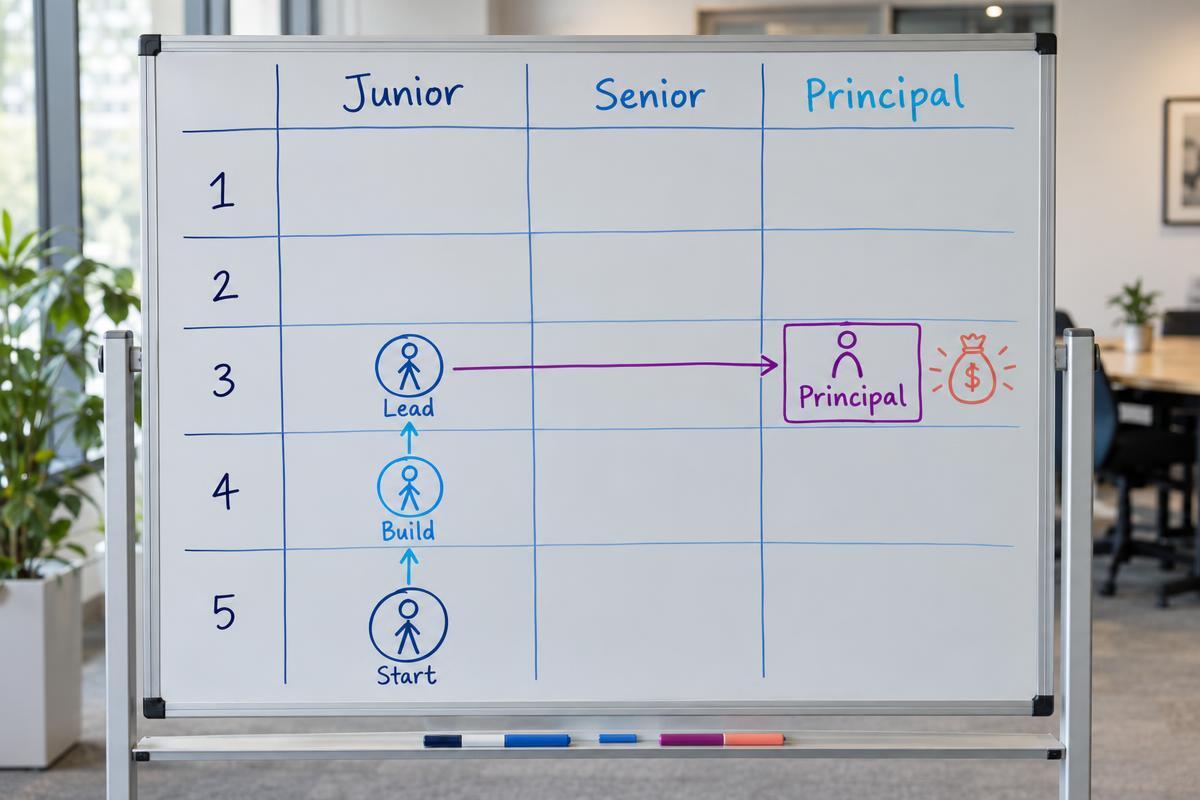
A modern framework must feature a dual-track progression model. This splits career paths into two distinct routes once an employee reaches a senior level. One track is for Individual Contributors (ICs). The other track is for People Managers.
The Individual Contributor (IC) track
This track is for people who want to deepen their technical expertise and solve complex business problems without managing a team. They still exercise leadership by mentoring peers, setting technical standards and driving strategy. Their compensation scales equally with the management track. You should pay a Principal Engineer just as much as an Engineering Director.
The People Manager track
This path is for employees who genuinely want to build teams, run performance reviews and align human capability with business goals. Their progression is measured by how well they develop others, manage budgets and scale operations.
A 5-step process to design your career progression framework
Building a framework from scratch feels overwhelming. The trick is to start broad and get specific later. Follow these five steps to design a capability framework template that actually works.
Step 1: Define job families and levels
A job family is a group of roles that share similar work and require similar skills. Examples include Engineering, Sales, Marketing and Customer Success. Once you have your families, you need to define your broad company levels.
Most mid-market businesses use a six-level system:
- Level 1: Entry level or graduate
- Level 2: Intermediate or developing
- Level 3: Fully competent professional
- Level 4: Senior professional or team lead
- Level 5: Principal expert or manager
- Level 6: Distinguished expert or director
Step 2: Map core and functional competencies
Competencies are the building blocks of your framework. You need two types. Core competencies are the behaviours every person in the company must show. These might include communication, commercial awareness and teamwork. Functional competencies are specific to the job family. A salesperson needs negotiation skills, while a developer needs systems architecture skills.
Step 3: Define proficiency levels for each role
It is not enough to say a role requires "communication". You must explain what communication looks like at Level 1 versus Level 5. If you want to know who needs proficiency levels, the answer is any business trying to remove bias from promotions. Level 1 communication might mean "writes clear internal emails". Level 5 communication might mean "presents technical strategy to the executive board".
Step 4: Align compensation bands to progression tiers
A progression framework falls apart if it is not tied to money. Employees need to know that moving from Level 3 to Level 4 brings a meaningful salary increase. Map a transparent salary band to every level in your framework. This stops managers from making arbitrary pay decisions and ensures internal pay equity across different departments.
Step 5: Move beyond the spreadsheet
Most HR teams build their first career progression framework in a massive spreadsheet. This works for about three months. Then roles change, people get promoted and the spreadsheet gathers dust. To make capability a living part of your business, you need proper tools.
The Compono Assure platform lets you build changing competency frameworks and link them directly to roles. Instead of an isolated document, your framework becomes the engine that drives hiring decisions, skills gap analyses and learning pathways.
Plug-and-play career progression framework templates
To help you get started, here are simplified examples of what a dual-track progression matrix looks like in practice. You can adapt these templates for your own job families.
Engineering career progression template
This example shows how an engineering department splits into IC and Management tracks at Level 4.
| Level | Title | Impact expectations | Core competency focus |
|---|---|---|---|
| Level 1 | Junior Engineer | Completes defined tasks with heavy guidance. Focuses on learning the codebase. | Follows instructions and writes clear documentation. |
| Level 2 | Mid-Level Engineer | Owns small features end-to-end. Requires minimal daily supervision. | Collaborates with peers and reviews code accurately. |
| Level 3 | Senior Engineer | Designs and builds complex systems. Mentors junior team members. | Solves ambiguous problems and communicates technical limits. |
| Level 4 (IC) | Staff Engineer | Sets technical direction across multiple teams. Solves business-critical problems. | Influences stakeholders and drives technical strategy. |
| Level 4 (Manager) | Engineering Manager | Builds and coaches a team of engineers. Owns delivery metrics. | Develops people and manages project resources. |
| Level 5 (IC) | Principal Engineer | Defines long-term technical vision for the entire organisation. | Industry-level expertise and executive communication. |
| Level 5 (Manager) | Director of Engineering | Manages multiple engineering teams and managers. Owns department budget. | Strategic planning and cross-functional leadership. |
Marketing career progression template
Marketing teams often struggle with career mapping because the discipline covers both highly creative and highly analytical roles. Competency framework examples for marketing must focus on business outcomes rather than just output.
| Level | Title | Impact expectations | Core competency focus |
|---|---|---|---|
| Level 1 | Marketing Coordinator | Executes campaigns and manages administrative marketing tasks. | Strong attention to detail and reliable delivery. |
| Level 2 | Marketing Specialist | Runs specific channels independently. Analyses basic campaign data. | Data interpretation and cross-team collaboration. |
| Level 3 | Marketing Manager | Designs campaign strategy and manages agency relationships. | Commercial awareness and project management. |
| Level 4 (IC) | Senior Strategist | Defines go-to-market strategies for major product lines. | Market positioning and executive persuasion. |
| Level 4 (Manager) | Head of Marketing | Leads the marketing team. Owns the demand generation pipeline. | Team building and budget allocation. |
Common implementation mistakes and how to avoid them
Even the best career progression framework template will fail if you roll it out poorly. HR.com's Future of Career Development and Mobility 2025–26 report notes that coaching is used to support career development by 44% of organisations, while individual development plans are used by only 33%. You need both a framework and the coaching to support it. Watch out for these three common pitfalls.
Mistake 1: Rolling out without manager training
You cannot just email a PDF to your managers and expect them to use it. Managers need training on how to hold career conversations using the new framework. They need to understand how to assess someone objectively against the proficiency levels and how to deliver tough feedback when an employee is not ready for the next tier.
Mistake 2: Forgetting your remote workers
In a hybrid or fully remote environment, visibility is a major issue. Managers naturally favour the people they see in the office. Your framework must explicitly measure output and behaviour, not physical presence. Ensure your progression criteria focus on asynchronous communication skills and documented results.
Mistake 3: Treating the framework as a checklist
Employees often mistake a progression framework for a guaranteed checklist. They believe that checking off three skills automatically triggers a promotion. You must communicate clearly that progression requires both the capability to do the next job and a business need for that role to exist. You cannot promote everyone to a Director level just because they meet the criteria.
The importance of changing skills mapping
Static templates break down when your business strategy pivots. If your company suddenly needs to focus on artificial intelligence, your engineering and product frameworks must update immediately to reflect those new required competencies.
This is where modern HR technology replaces traditional documents. A dedicated platform allows you to update a competency definition once and have it reflect instantly across every job description, performance review and learning pathway in the business. It turns a theoretical HR exercise into operational business intelligence.
How Compono can help with competency management
Spreadsheets and PDFs are not enough to manage complex career pathways. Compono Assure takes your career progression framework and turns it into a living, measurable system. You can define roles, map competencies, link proficiency levels to performance and prove that your people have the exact capabilities your business needs to grow.
Frequently asked questions
How many levels should a career progression framework have?
Most mid-market businesses find success with five or six levels. Fewer than four levels creates bottlenecks where employees wait too long for a promotion. More than seven levels causes title inflation, where the difference between a "Senior" and an "Advanced" role becomes impossible to define objectively.
How often should we update our progression framework?
You should review your core competencies every two to three years and your functional competencies annually. As your business introduces new technology or enters new markets, the specific technical skills required for roles will shift. However, your foundational behavioural expectations usually remain stable.
What is the difference between a career track and a career ladder?
A career ladder suggests a single, vertical path upward, usually ending in people management. A career track or matrix provides multiple directions for growth. It allows technical experts to advance in pay and influence without managing staff, and it accommodates lateral moves between different departments.
How do you map salaries to a career progression framework?
You attach a specific compensation band to each job level within a family. For example, every Level 3 role in the Engineering family shares the same salary band. The bottom of the band is for people newly promoted into the level, while the top of the band is for people who have mastered it and are preparing for Level 4.