

 Mathan Allington
The best iCIMS alternatives for 2026 include Compono Hire, SmartRecruiters, Greenhouse, Lever, and Ashby, depending on your team size and reporting needs.
Last reviewed October 2026
Quick answer
- Price: Enterprise platforms range from $5,000 to over $200,000 annually, while mid-market solutions offer significant per-user savings.
- Best for: HR teams needing modern user interfaces, deeper reporting capability, and people intelligence alongside standard compliance tracking.
- Verdict: Choose Compono Hire for culture fit assessment, Greenhouse for structured interviewing, or SmartRecruiters for complex enterprise configuration.
Why talent teams are replacing iCIMS in 2026
Most legacy Applicant Tracking Systems (ATS) handle process risk well. They track applications, enforce compliance steps, and manage approval workflows across thousands of candidates. But the recruitment market has shifted. Modern hiring teams need systems that manage process risk while also tackling people insight risk. You need to know who a person is, not just what they can do on paper.
When you evaluate iCIMS today, the platform remains a reliable compliance engine. However, users often cite rigid reporting limits, steep learning curves, and high overhead costs. Vendr buyer data cited in a 2026 comparison places the average annual iCIMS contract near $20,781, while a separate marketplace sample shows a median closer to $5,000, according to Treegarden. The variance often comes down to add-on modules and implementation fees.
For mid-market and growing enterprise teams, finding a platform that offers transparent pricing and intuitive workflows is a strategic priority. The goal is to move from basic transactional tracking to true workforce intelligence without breaking the budget.
At-a-glance feature and pricing comparison matrix
| Platform | Best for | Key differentiator |
|---|---|---|
| Compono Hire | Culture and team fit | Integrated behavioural science |
| SmartRecruiters | Enterprise configuration | Deep integration marketplace |
| Greenhouse | Structured hiring | Diversity and inclusion tracking |
| Lever | Proactive sourcing | Combined ATS and CRM |
| Ashby | Custom analytics | High-growth tech reporting |
| Workday Recruiting | Set of tools consolidation | Native HRIS integration |
Compono makes Compono Hire. We've included it and kept every entry's strengths and limits honest.
Ranking summary: the top iCIMS alternatives
- Compono Hire
- SmartRecruiters
- Greenhouse
- Lever
- Ashby
- Workday Recruiting
In-depth reviews of the top iCIMS alternatives
Compono Hire
- Price: Platform and user pricing available on request.
- Best for: Mid-market and enterprise teams wanting to measure culture fit alongside skills.
- Limits: Not designed for micro-businesses looking for a basic spreadsheet replacement.
Compono Hire is an applicant tracking system (ATS) that matches candidates to culture, not just keywords. While iCIMS and other traditional platforms focus heavily on process compliance, Compono Hire addresses both process risk and people insight risk.
The platform embeds validated behavioural science directly into the candidate journey. When a candidate applies, you see their skills, their qualifications, and their alignment with your organisational culture. This approach creates consistent hiring outcomes across large, distributed workforces. For example, The Coffee Club uses Compono Hire to deliver one hiring standard across more than 400 outlets, resulting in 8 percent lower turnover.
SmartRecruiters
- Price: Custom enterprise pricing available on request.
- Best for: Large enterprises needing deep configuration and a marketplace of integrations.
- Limits: Implementation can be heavy and resource-intensive for smaller teams.
SmartRecruiters positions itself as a direct competitor to legacy enterprise systems. It offers a highly configurable applicant tracking system that excels at managing complex global hiring workflows. Teams leaving iCIMS often appreciate the modern user interface and the extensive integration marketplace available here.
While evaluating SmartRecruiters alternatives, buyers should note that the platform is built for scale. It handles massive application volumes and complex approval chains effectively. The primary limitation is the implementation timeline, which requires dedicated technical resources to deploy properly.
Greenhouse
- Price: Estimated between $10,627 and $75,900 annually, according to CostBench in 2026.
- Best for: Structured interviewing and detailed diversity reporting.
- Limits: The interface requires training and the total cost of ownership scales quickly with add-ons.
Greenhouse is one of the most prominent names in modern recruitment software. It forces hiring managers to use structured interviewing scorecards, which helps reduce bias and keeps interview panels aligned. Greenhouse is rated 4.7 out of 5 among iCIMS alternatives in a 2026 comparison by HROpsLab, reflecting its strong reputation in the market.
Teams seeking alternatives to Greenhouse often cite pricing structure as the main hurdle. Because the platform relies heavily on tiered packages and add-on modules, the total cost of ownership can climb as your headcount grows.
Lever
- Price: Estimated between $5,000 and $140,000 annually, according to CostBench in 2026.
- Best for: Combined applicant tracking and proactive candidate relationship management.
- Limits: Reporting capabilities can feel rigid for highly custom data needs.
Lever blurs the line between an applicant tracking system and a candidate relationship management (CRM) tool. It is designed for talent teams that need to actively source passive candidates rather than simply wait for inbound applications. The platform makes it easy to build nurture campaigns and track engagement over time.
Cost is a major factor when comparing Lever to legacy systems. A pricing comparison estimates that switching from iCIMS can reduce per-user costs by 20 to 70 percent, depending on the alternative selected and the final negotiated rate.
Ashby
- Price: Ashby Foundations starts at $3,600 annually ($300 monthly) according to LatestRemote in 2026.
- Best for: High-growth technology companies wanting advanced custom analytics.
- Limits: Built primarily for tech sector workflows rather than traditional high-volume retail or healthcare.
Ashby has gained significant traction by offering best-in-class analytics and reporting capabilities. Where legacy ATS platforms require users to export data to external business intelligence tools, Ashby builds deep reporting directly into the interface. This allows talent leaders to track complex metrics like pass-through rates and sourcing ROI instantly.
When reviewing Ashby alternatives, you will find that its feature set is highly tailored to modern technology companies. Organisations outside the tech sector might find some of the workflows less relevant to their specific high-volume or frontline hiring needs.
Workday Recruiting
- Price: Custom enterprise pricing based on overall Workday footprint.
- Best for: Existing Workday set of tools users wanting single-platform consolidation.
- Limits: The recruitment module is less agile than standalone ATS platforms and requires IT support to configure.
Workday Recruiting is the default choice for enterprises already using Workday for payroll and core HR. The main advantage is data continuity. When a candidate becomes an employee, their profile transitions seamlessly without requiring third-party API integrations.
However, recruiter experience often takes a back seat to system architecture. Talent acquisition teams frequently find the interface rigid compared to specialist tools, making daily sourcing and pipeline management more tedious.
Key evaluation criteria: what to look for when migrating
Switching from a legacy ATS is a major operational project. To ensure the move is successful, HR leaders must evaluate alternatives across three critical dimensions beyond basic feature checklists.
Total cost of ownership and hidden fees
Legacy software pricing is notoriously opaque. When moving away from iCIMS, you must calculate the true total cost of ownership. This includes the base platform fee, per-user license costs, data storage limits, and mandatory add-on modules.
Many modern platforms look cheaper on the surface but charge heavily for essential features like custom reporting, API access, or text messaging capabilities. Ask vendors for a five-year cost projection that accounts for your planned headcount growth.
Compliance and enterprise security parity
Enterprise platforms excel at risk mitigation. If you operate in multiple jurisdictions, your new ATS must match your current compliance standards. This includes GDPR data deletion workflows, EEOC reporting in the United States, and right-to-work verification in Australia and New Zealand.
Do not assume that a modern, visually appealing ATS automatically handles these regulatory requirements. Verify that the platform offers automated compliance triggers and audit-ready data logs before signing a contract.
Solving the reporting deficit
The most common frustration with legacy systems is getting data out of them. Talent teams spend hours downloading spreadsheets just to build a weekly pipeline report. Your replacement ATS must offer intuitive, self-serve analytics.
Look for platforms that allow hiring managers to build custom dashboards without submitting an IT ticket. Real-time visibility into time-to-hire, source quality, and bottleneck identification is non-negotiable for a modern talent acquisition function.
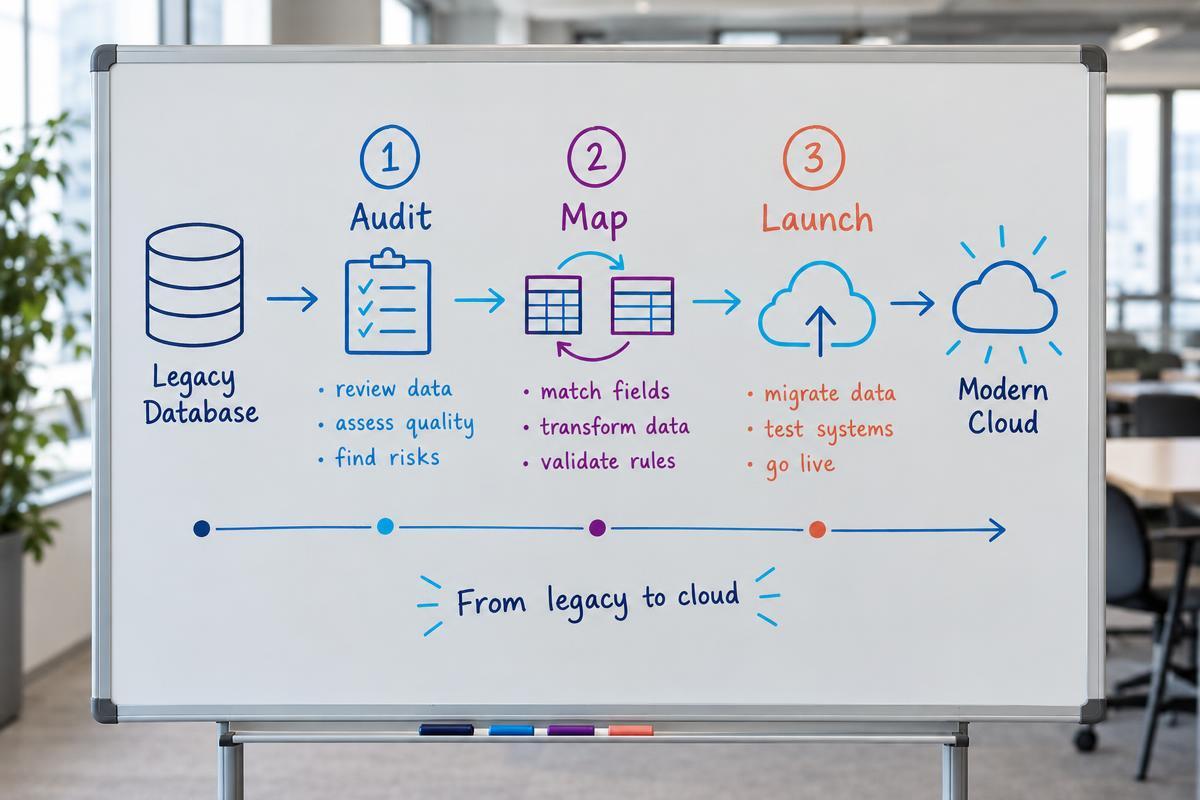
Step-by-step guide to data migration
The biggest fear holding teams back from replacing iCIMS is data loss. Decades of historical applicant data, interview notes, and talent pools live in your current system. A structured migration plan mitigates this risk completely.
Step 1: Data auditing and cleanup
Do not migrate bad data. Before extracting anything from iCIMS, conduct a thorough audit. Archive closed jobs from five years ago, delete duplicate candidate profiles, and purge data that no longer meets your privacy compliance standards. A clean dataset reduces migration costs and ensures your new platform starts fast.
Step 2: Mapping custom fields
Every organisation customises their ATS over time. You likely have custom fields for specific certifications, union memberships, or internal division codes. Work with your new vendor to map these legacy fields to the new architecture. Modern platforms often use tags or custom attributes that handle this data more elegantly than rigid text boxes.
Step 3: Phased implementation timelines
Segment your transition by migration complexity. A low-friction switch for a mid-market team might take six weeks, while a heavy enterprise migration can take four to six months. Run the new ATS in parallel with iCIMS for a brief overlap period. This ensures your active candidate pipelines are not disrupted while recruiters learn the new interface.
The AI trust gap in modern recruiting
Artificial intelligence is heavily marketed by nearly every ATS vendor today. While AI can draft job descriptions and schedule interviews efficiently, using it to evaluate human potential is risky.
Only 26 percent of job applicants trust AI to evaluate them fairly, according to a July 2025 Gartner candidate survey cited by Klearskill. Candidates want to know their applications are reviewed by human beings, not black-box algorithms.
This is why leading HR teams prefer transparent, validated psychometrics over opaque AI resume parsing. Assessing a candidate's Work Personality provides objective, scientific insight into how they communicate and solve problems. It removes bias without removing the human element from the hiring decision.
How Compono can help with your ATS transition
If you are tired of wrestling with legacy interfaces and want a recruitment platform that actually tells you who will thrive in your organisation, we can help. Compono Hire manages your compliance processes while giving you deep insight into candidate culture fit.
Frequently asked questions
What are the main reasons companies look for iCIMS alternatives?
Companies typically seek alternatives due to rigid reporting limitations, an outdated user interface, and the high total cost of ownership. Growing teams often want software that is more intuitive for hiring managers and provides better candidate relationship management out of the box.
How long does it take to migrate from iCIMS to a new ATS?
Migration timelines vary based on organisational complexity and data volume. A mid-market company can usually complete a transition in six to eight weeks. Large enterprise migrations involving complex HRIS integrations and massive historical data transfers typically take three to six months.
Do modern ATS platforms handle enterprise compliance as well as legacy systems?
Yes, top-tier modern platforms are built with enterprise compliance in mind. They include reliable features for data privacy, equal opportunity reporting, and automated candidate consent workflows. However, buyers must verify these capabilities during the procurement process, as entry-level tools often lack deep compliance features.
Can we keep our historical candidate data when switching?
Yes, your historical candidate data belongs to you. Most modern vendors provide dedicated implementation teams that map and import your existing resumes, notes, and talent pools via CSV exports or direct API connections from your legacy system.