
.webp)

 Mathan Allington

How to choose the right employee engagement software
 Mathan Allington
What engagement software has to do well: continuous feedback, driver analysis, safe channels for staff, manager coaching, and a link back to hiring.

A company culture platform is software that measures what working at your organisation is actually like and turns that into something managers can act on. The category covers five quite different things: engagement and pulse survey tools, recognition platforms, continuous listening tools, culture measurement paired with work personality data, and culture modules bundled into an HR system. The best one for you depends on whether your problem is that you cannot hear your people, cannot explain what you are hearing, or cannot get managers to do anything about it.
Last reviewed September 2026.
Strip away the marketing and every workplace culture platform is doing some combination of four jobs. It collects signal from employees, through surveys, pulses, open comments, recognition activity or assessment. It organises that signal into something readable, by team, by location, by tenure. It compares the result against a benchmark or against your own history so you know whether a number is good. And it hands managers something specific to do next.
Most tools are strong at the first two and weak at the last two. Collecting sentiment is easy. Telling a team leader what to change on Monday morning is the part that decides whether the investment was worth it, and it is where most implementations quietly stall.
It is also worth separating two things that get sold under the same word. Culture is the set of values and behaviours the organisation actually rewards, and it moves slowly. Climate is how people feel this quarter, and it moves with a restructure, a bad manager or a busy season. Engagement scores measure climate. If you only ever measure climate, you will keep treating symptoms, which is the reason so many organisations run surveys for years without the underlying thing changing. Our guide to engagement surveys compared with culture measurement sets out where each one is the right instrument.
Shortlists usually go wrong because two products in the same list are not doing the same job. Sorting by category first makes the comparison honest.
| Type of platform | What it measures | Where it falls short | Best suited to |
|---|---|---|---|
| Engagement and pulse survey tools | How people feel right now, tracked over time, usually with benchmarks by industry and company size | Tells you the score dropped, rarely why. Survey fatigue sets in if nothing visible follows | Organisations with no regular listening at all |
| Recognition and rewards platforms | Peer to peer appreciation, values-based nominations, participation by team | Recognition activity is a proxy for culture, not a measure of it. Quiet teams look disengaged when they are simply quiet | Dispersed or frontline workforces where visibility is the gap |
| Continuous listening tools | Frequent short check-ins, open text at scale, sentiment and theme analysis across comments | Generates a lot of input and needs someone with the time and skill to interpret it | Larger organisations with a people analytics capability already in place |
| Culture measurement with work personality data | The values and behaviours an organisation rewards, the shape of each team, and where individual preferences and role demands do not line up | Asks more of leaders than a survey does, because the findings point at structure and management, not perks | Organisations that already know engagement is slipping and need to know why |
| Culture modules inside an HR system | Basic surveys and reporting sitting next to payroll, leave and performance records | Usually the shallowest option, and the data rarely goes deeper than a satisfaction score | Small teams that want one system and modest expectations |
Plenty of organisations run two of these together, commonly a listening tool for frequency and a measurement tool for diagnosis. That is a reasonable answer as long as somebody owns reconciling the two sets of numbers.
The demo will show you dashboards. These are the questions that decide whether the thing works a year later.
Before the business case meeting, it helps to have a figure for what the current situation is costing. A cost of disengagement calculator gives you a defensible number to sit next to the licence quote, which is a far better conversation with a chief financial officer than an employee engagement score in isolation.

Passing roughly 200 employees is where the founder-led culture starts to fray. At 20 people everyone knew the mission because they sat near the person who set it. With several departments and a layer of management in between, that connection stops happening on its own. Communication feels slower, and teams start to operate as islands.
The mid-market has a specific buying problem. Enterprise culture suites are priced and scoped for organisations with a people analytics team to run them, and small business tools stop being useful somewhere around the first restructure. What a company of 150 to 800 people usually needs is depth of insight without a dedicated analyst, which in practice means the platform has to do the interpretation rather than hand over raw data.
The stakes are also higher than they were. One difficult senior hire or one misread team dynamic ripples across the business, and the high performer who quietly erodes the team around them is hard to identify from a satisfaction score. Measuring how people work, not only how they feel, is what surfaces that pattern before the resignations start.
Many culture tools are a suggestion box with better charts. They tell you that seventy per cent of your staff are happy. They do not tell you what to do for the thirty per cent who are not, and at any real headcount that average hides more than it shows.
Alignment is the thing underneath the sentiment. When people's natural preferences match what their role actually demands, and when the behaviours the organisation rewards match the ones it talks about, engagement tends to follow. When they do not, you get friction that shows up as a low score with no obvious cause. Measuring sentiment alone means measuring the symptom, which is the argument we make at more length in measuring company culture beyond sentiment.
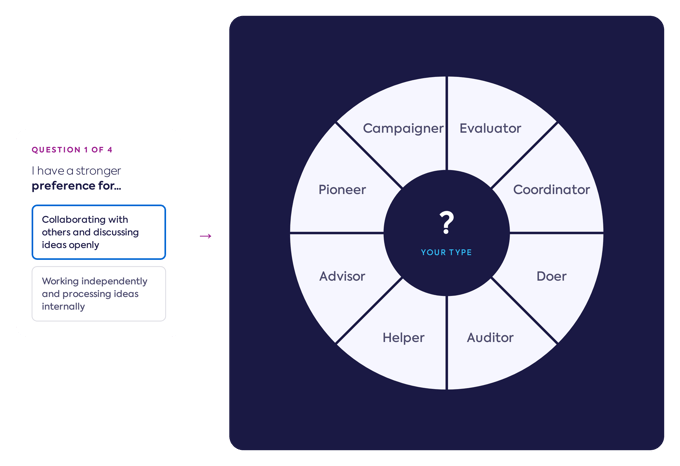
One of the more practical ways to strengthen culture is to give everyone the same vocabulary for how they work. Compono's framework describes eight work personalities: Doer, Auditor, Helper, Advisor, Pioneer, Campaigner, Evaluator and Coordinator. They describe preferences for kinds of work, not categories of person, and nobody is only one of them.
The value shows up in ordinary situations. A manager who knows they lean Evaluator and that their direct report leans Helper runs a different one-on-one, because they stop reading each other's defaults as a problem. A team that is heavy on one preference and empty on another can see why it keeps making the same kind of mistake. Hiring into a gap becomes a specific brief rather than a vague sense that the team needs someone different.
At an organisational level, mapping preferences across the workforce shows you the shape of the place: which functions are structured, which run on improvisation, and where a well-intentioned restructure is about to put two incompatible ways of working in the same room.
The fastest way to kill a culture program is to ask people for honest input and then do nothing visible with it. A few things decide how the first year goes.
This is the work Compono Engage is built for: measuring culture and climate together, reading them alongside the work personality data already in the platform, and giving leaders a specific action rather than a number. It suits organisations that want to understand why a result happened. If all you need is a fast weekly pulse and a recognition feed, a lighter tool will serve you better.
Compono Engage measures culture, climate and team shape together, so you get the reason behind the score and not just the score.
Talk to usIt is software that measures what working somewhere is actually like and helps leaders act on the result. Depending on the product that can mean engagement and pulse surveys, recognition activity, continuous listening, or culture measurement combined with data on how people prefer to work.
An engagement survey tool measures how people feel over time, which moves with workload, managers and season. A culture platform aims at the values and behaviours the organisation actually rewards, which changes slowly and explains why the sentiment scores look the way they do. Many products do some of both, so ask which one a given feature is really measuring.
For companies of roughly 150 to 800 people the practical test is whether the platform interprets results without needing a dedicated analyst, whether managers get a specific action rather than a dashboard, and whether culture data can be read next to turnover and performance. Enterprise suites tend to be overbuilt for this size and small business tools tend to run out of depth.
Pricing in this category is almost always charged per employee per year and is rarely published, so the only reliable approach is to request a total at your current headcount including implementation, benchmark access and any per-survey fees, then ask for the same figure at the headcount you expect in two years.
Be explicit before you collect anything about who will see the results and the minimum team size for reporting, keep open comments genuinely confidential, report back quickly including the parts that are unflattering, and make two visible changes. Trust in the process is built by what happens after the survey, not by the survey design.

What engagement software has to do well: continuous feedback, driver analysis, safe channels for staff, manager coaching, and a link back to hiring.

Where Culture Amp surveys and benchmarking are strong, which teams it suits, and the gaps to plan for if you need culture and hiring data together.

The signs of a bad workplace culture, what usually causes them, and the steps that rebuild trust without another round of values posters.