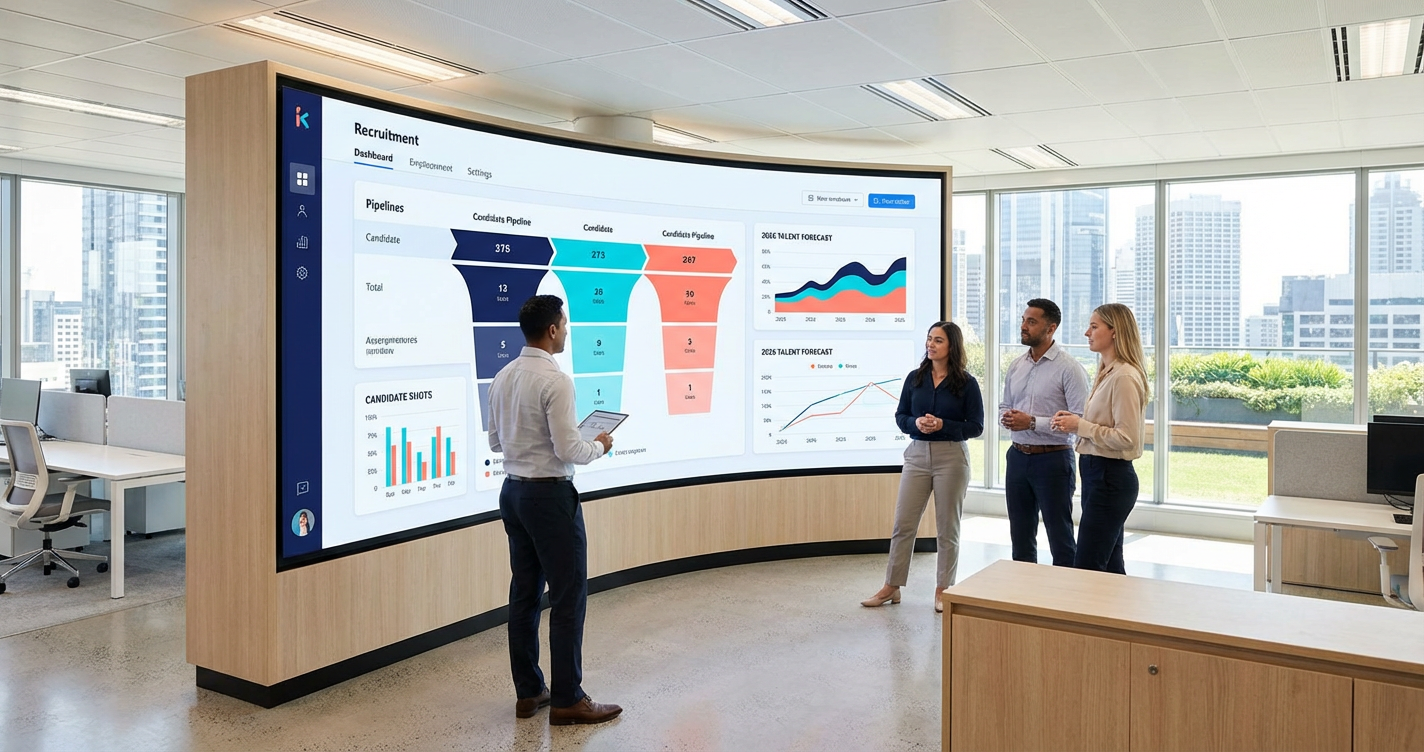
Finding the best applicant tracking system for small business Australia teams comes down to choosing a platform that balances local compliance, seamless payroll integration, and candidate experience – with cloud-based options like Compono, JobAdder, and Employment Hero leading the pack for 2026.
Key takeaways
- Australian small businesses are rapidly adopting cloud-based applicant tracking systems to reduce manual administration and compete for top talent.
- An effective ATS can cut your time-to-hire by more than half, ensuring you secure the best candidates before your competitors do.
- Local support, seamless integration with existing HRIS platforms, and intuitive candidate experiences are the most critical features for Australian SMEs.
- Understanding pricing models – from pay-per-user to flat monthly fees – is essential to finding a scalable solution that fits a small business budget.
- Prioritising behavioural and skills-based assessments within your ATS leads to higher quality, longer-term hires.
For many small business owners and HR managers in Australia, recruitment feels like a second full-time job. Between sorting through overflowing email inboxes, managing spreadsheets, and trying to keep hiring managers updated, the manual administration can quickly overwhelm a lean team. In today's competitive talent market, moving slowly means losing out on the best candidates. If you are still relying on manual processes, you are not alone – surprisingly, only 20% of small and mid-sized businesses currently use an ATS, indicating significant adoption gaps for Australian SMEs. However, bridging this gap is the fastest way to transform your hiring from a chaotic chore into a strategic advantage.
Implementing the right recruitment technology is no longer just for large enterprises. Modern software is designed to be accessible, affordable, and highly effective for smaller teams. In this comprehensive guide, we will explore why you need an ATS, the features that matter most, how much you should expect to pay, and the top vendors operating in the Australian market today.
Does your small business need ATS software?
It is easy to assume that applicant tracking systems are only necessary for massive corporations hiring hundreds of people a month. However, small businesses often have the most to gain from automating their recruitment processes. When you are operating with a small team, every hour spent manually acknowledging applications or scheduling interviews is an hour taken away from growing your business. The primary goal of an ATS is to centralise your hiring efforts, ensuring that no candidate falls through the cracks and every hiring manager has visibility over the pipeline.
The efficiency gains are substantial. Research shows that an effective ATS can decrease the average hiring cycle by as much as 60%, a critical efficiency gain for small businesses with limited recruiting resources. When you can review resumes, schedule interviews, and send feedback from a single dashboard, the entire process accelerates. Furthermore, 86% of recruiters agree that their ATS has reduced their overall time-to-hire, directly addressing the speed needs of small Australian employers.
Beyond speed, an ATS fundamentally improves the candidate experience. Top talent expects a smooth, professional recruitment process. If your application process requires candidates to fill out lengthy forms or if they never receive an acknowledgement email, they will likely abandon the application or accept an offer elsewhere. An ATS automates these touchpoints, keeping candidates engaged and informed. When it comes to outcomes, 79% of recruiters agree that the quality of their new hires has increased after implementing an ATS, supporting better talent outcomes for small teams.
What ATS features support small companies?

Not all applicant tracking systems are created equal, and small businesses have distinct needs compared to enterprise organisations. You do not need overly complex enterprise resource planning modules; instead, you need intuitive, high-impact features that save time and integrate with your existing tools. It is easy to see why cloud-based ATS platforms dominate the market with a 58% share due to low upfront costs and scalability, making them ideal for Australian SMEs.
First and foremost, multi-board job posting is a non-negotiable feature. A strong ATS allows you to write a job description once and publish it across major Australian job boards – like SEEK, Indeed, and LinkedIn – with a single click. This feature alone saves hours of repetitive data entry and ensures your job ads reach the widest possible audience immediately.
Resume parsing and automated screening are also critical. When you receive dozens or hundreds of applications, manually reading every CV is impossible. A modern ATS will parse resumes, extract relevant skills, and allow you to set up screening questions. This ensures that only the most qualified candidates make it to the top of your review list, helping you to choose an ATS that reduces hiring bias by focusing on objective criteria rather than subjective first impressions.
Finally, seamless communication and scheduling tools are vital for small teams. Look for platforms that offer email templates, automated interview reminders, and calendar integrations. The ability to sync your ATS with Outlook or Google Workspace means you can schedule interviews without the endless back-and-forth emails, providing a vastly superior experience for both your team and the candidate.
How much does an ATS system cost for small businesses?
Budget is understandably a primary concern for small businesses evaluating new software. Fortunately, the ATS market has evolved to offer a variety of pricing models that cater to smaller budgets without sacrificing essential functionality. Understanding these models will help you choose a platform that scales with your business without causing bill shock.
The most common pricing structure for small businesses is the pay-per-user or per-seat model. In this scenario, you pay a flat monthly or annual fee for each recruiter or hiring manager who needs administrative access to the system. This is highly cost-effective if you only have one or two people managing recruitment. Prices typically range from $50 to $150 per user per month, depending on the feature set. Many platforms allow unlimited candidates and job postings under this model, making your costs predictable.
Another popular option is the pay-per-active-job model. If your hiring volume fluctuates throughout the year – perhaps you hire seasonal staff or only recruit a few times a year – this model can be highly economical. You only pay for the number of job openings you have active at any given time. This means during quiet hiring periods, your software costs drop significantly.
Lastly, some vendors offer a flat monthly fee based on your total employee headcount, regardless of how many jobs you post or how many users access the system. This is often the case when the ATS is bundled with a broader HRIS platform. While this can provide excellent value if you need an all-in-one HR solution, it is important to ensure you are not paying for heavy enterprise features you will never use.
7 top ATS vendors for small businesses
Navigating the software market can be overwhelming, but several platforms stand out specifically for Australian small businesses. Here is a breakdown of seven top vendors that offer the right mix of features, usability, and local relevance.
1. Compono Hire
For small businesses that want to move beyond traditional resume screening, Compono Hire offers a unique advantage. The platform uses behavioural science and psychometric insights to match candidates to your specific role and company culture. By assessing organisation fit alongside skills and qualifications, Compono Hire helps small teams make highly accurate, long-term hires, reducing the costly risk of employee turnover.
2. JobAdder
A well-known name in the Australian market, JobAdder (rated 4.4) is a Sydney-built ATS favoured by agency and talent teams in Australia, offering a strong local option for small businesses. It is highly customisable and integrates seamlessly with local job boards like SEEK. While it was originally built for recruitment agencies, its corporate version is robust and user-friendly for in-house SME teams.
3. Employment Hero
If you are looking to consolidate your software stack, Employment Hero is a compelling choice. Employment Hero (rated 4.4) is recommended for small businesses wanting hiring integrated directly inside HR and payroll systems. Because it handles everything from applicant tracking to onboarding and payroll, it is ideal for small businesses that want a single source of truth for all people management.
4. Sentrient
Focusing heavily on compliance and ease of use, Sentrient is rated 4.7 on Capterra and used by more than 1,000 Australian organisations, making it a top local recommendation for SMEs. It offers a straightforward interface that is perfect for small business owners who do not have a dedicated HR background but need to ensure their hiring processes meet Australian regulatory standards.
5. BambooHR
BambooHR is a globally recognised platform that is highly popular among small to medium businesses. While it is a comprehensive HRIS, its built-in ATS is incredibly intuitive and offers excellent candidate communication tools. It is particularly well-suited for companies that prioritise employee experience and want a clean, modern interface for both applicants and hiring managers.
6. Teamtailor
Teamtailor takes a marketing-first approach to recruitment. It is designed to help small businesses build beautiful, engaging career pages without needing a web developer. If your small business relies heavily on employer branding to attract talent – such as creative agencies or tech startups – Teamtailor provides excellent tools to showcase your culture and attract passive candidates.
7. Pinpoint
Pinpoint is an emerging favourite for small businesses looking for a modern, agile ATS. It focuses heavily on reducing administrative burden through smart automation and offers excellent reporting features. Pinpoint is ideal for small teams that want to track their hiring metrics closely and continually optimise their recruitment funnel for better efficiency.
Comparison of the best ATS software for small business
When comparing these platforms, it is vital to look beyond the marketing materials and focus on how the software will function in your day-to-day operations. If you are evaluating multiple tools, reviewing a comprehensive HR software Australia comparison can help you map out exactly which features align with your specific business goals.
First, evaluate the user interface. Small business teams rarely have the time for lengthy software training. The best ATS will be intuitive enough that a hiring manager can log in, review a candidate profile, and leave feedback within minutes. If the system requires a manual to navigate, it will likely suffer from low adoption rates across your team.
Second, consider the integration ecosystem. Your ATS should not exist in a vacuum. It needs to speak to your email client, your calendar, your payroll software, and your onboarding tools. Australian businesses should specifically look for seamless integration with local platforms like Xero, MYOB, or popular local HRIS systems to ensure data flows smoothly from the moment a candidate applies to their first day on the payroll.
Finally, assess the level of customer support. When you are trying to get an urgent job ad live and something goes wrong, you need responsive, local support. Vendors that offer Australian-based customer service or dedicated account managers for small businesses provide a massive advantage over platforms that only offer delayed email support from overseas time zones.
How to choose ATS software for small business hiring
Selecting the right ATS requires a strategic approach to ensure you do not overspend on unnecessary features or underspend on a tool that cannot grow with you. The first step is to conduct a thorough audit of your current hiring process. Identify your biggest bottlenecks – is it taking too long to post jobs? Are you losing track of candidate emails? Are you struggling to assess cultural fit? Documenting these pain points will give you a clear checklist of must-have features.
Next, establish a realistic budget and determine your preferred pricing model. If your hiring is consistent year-round, a pay-per-user model might be best. If you experience seasonal spikes, look for a pay-per-active-job model. Be sure to ask vendors about any hidden costs, such as implementation fees, premium job board posting charges, or costs for additional data storage.
Once you have a shortlist of vendors, request live demonstrations. During these demos, ask the vendor to walk through a specific scenario, such as posting a job to SEEK, reviewing a parsed resume, and scheduling an interview. This will give you a true sense of the platform's workflow. Do not hesitate to ask for a free trial or sandbox access so your team can test the software hands-on before signing a contract.
Key insights
- Transitioning from manual spreadsheets to a cloud-based ATS is the most effective way for Australian small businesses to reduce administrative burden and compete for top talent.
- Choosing a platform with seamless local integrations – particularly with Australian job boards and payroll systems – ensures a smooth workflow from application to onboarding.
- Evaluating software based on your specific hiring volume and budget constraints is critical; look for flexible pricing models like pay-per-active-job or per-user subscriptions.
- The best ATS platforms go beyond basic tracking by incorporating behavioural insights and automated communication, fundamentally improving both the quality of hire and the candidate experience.
Where to from here?
Ready to transform your hiring process and build a high-performing team with precision?
- Explore the platform: Compono Hire
Related reading
FAQ
What is the best applicant tracking system for small business Australia?
The best ATS depends entirely on your specific needs. For businesses wanting all-in-one HR, Employment Hero is popular. For recruitment-heavy teams, JobAdder is a strong local choice. For teams focused on finding the perfect behavioural and skills fit to reduce turnover, Compono Hire offers unique psychometric matching capabilities tailored for high-performing teams.
How much should a small business pay for an ATS?
Small businesses should expect to pay anywhere from $50 to $150 per user, per month for a quality cloud-based ATS. Some platforms offer pay-per-active-job pricing, which can be highly cost-effective for businesses that only hire a few times a year. Always check for hidden implementation fees before signing a contract.
Do small businesses really need an applicant tracking system?
Yes. Even if you only hire a few people a year, an ATS saves countless hours of manual administration, ensures compliance with local data privacy laws, and provides a professional experience that helps you secure top candidates who might otherwise accept offers from faster-moving competitors.
What is the difference between an ATS and an HRIS?
An Applicant Tracking System (ATS) is specifically designed to manage the recruitment process – from posting jobs to tracking candidates and scheduling interviews. A Human Resources Information System (HRIS) is a broader platform used to manage existing employees, handling payroll, leave requests, performance reviews, and benefits. Many modern HRIS platforms include a basic ATS module.
How long does it take to implement an ATS for a small business?
For a small business with relatively straightforward hiring processes, a cloud-based ATS can often be implemented and ready to use within a few days to a couple of weeks. The timeline depends on how much historical candidate data you need to migrate and how many team members need to be trained on the new system.

Better hiring decisions, before the interview
Compono Hire helps you predict job-fit and team-fit using behavioural science, so you can shortlist with confidence.
Request a demoBuilt for mid-market hiring teams.

Practise your next tough conversation
Voice-first coaching that adapts to your personality. Get actionable steps you can take this week.
Start freeBuilt by Compono. Not therapy — practical behaviour change.
.webp?width=559&height=292&name=2026.07.21%20Fireside%20KV%20-%201200x627%20(event%20featured).webp)
.png?width=383&height=200&name=team%20(1).png)
Compono