


 Mathan Allington

Applicant tracking system for insurance: a guide to hiring
 Mathan Allington
What brokers and insurance firms need from an ATS: compliance-ready records, structured assessment to cut bias, and a candidate experience that holds...

An applicant tracking system (ATS) is recruitment software that collects every application in one database, moves candidates through defined hiring stages and keeps each note, message and score attached to the person it belongs to. It covers the hiring stage only. Talent management software and onboarding software pick up where it stops, which is the part most buyers work out too late.
Last reviewed September 2026.
Strip away the marketing and an ATS does four jobs. It publishes a job to your careers page and the boards you use. It collects applications into one searchable database instead of an inbox. It moves people through stages your team agreed on, with the notes and scores stored against each candidate. It reports on what happened, so you can see where candidates drop out and how long each stage takes.
That is worth real money when hiring is frequent. Manual hiring breaks in predictable ways: a strong candidate waits nine days for a reply, two managers interview the same person without knowing, the shortlist lives in someone's sent items. Nothing about that is a character flaw. It is what happens when a process that needs a system is being run by memory.
What an ATS does not do is tell you who will be good at the job. Tracking is a record of movement. The judgement still sits with the people reading the applications, which is why the assessment question below matters more than the pipeline features that get demoed first.

In an IT or procurement context the acronym still means applicant tracking system. What changes is who is asking and why. When an ATS purchase reaches the IT team, the recruiting features are rarely the issue. The review covers single sign-on and user provisioning, where candidate data is stored and under which jurisdiction, how the system connects to your HR and payroll platforms, what the API allows, and how the vendor handles security questionnaires and incident reporting.
Bring IT in before the shortlist rather than after it. A platform that fails a security review at contract stage costs you the whole selection process, and the questions are easy to ask during a demo.
There is a second reading worth covering. People hiring for IT roles ask what an ATS means for technical recruitment specifically. The honest answer is that parsing and keyword search handle the visible part of a technical CV, and handle it badly for candidates whose experience does not use the same words as your job ad. Structured assessment and a clear scorecard do more for technical hiring quality than any amount of keyword tuning.
Searches for ATS talent management usually come from someone who has been told a single system will cover both. Sometimes it does, and the two halves are built for different jobs. Hiring software is designed around people who are not yet employees, with high volume and short relationships. Talent management is designed around people who already work for you, with long relationships and far less volume.
| Capability | Applicant tracking system | Talent management platform | HR information system |
|---|---|---|---|
| Job ads and applications | Core function, including job board posting and a careers page | Sometimes included, usually lighter | Rarely, beyond a requisition record |
| Interview scheduling and scorecards | Core function | Occasionally | No |
| Candidate assessment | Varies widely, from none to full psychometric assessment | Focused on employees rather than applicants | No |
| Offer and contract | Usually, including e-signature | No | Sometimes, as part of the employee record |
| Onboarding tasks | Sometimes, and often only to the signed offer | Sometimes | Commonly, as the record of truth |
| Performance and development | No | Core function | Basic, if present |
| Employee records and payroll data | No | Reads from the HR system | Core function |
The table is deliberately about categories rather than brands, because the labels move around. Plenty of products sold as talent management suites are an ATS with a performance module attached, and plenty of HR systems claim recruitment on the strength of a requisition form. Compare what each one does with your process, not what the category page says. Our guide to an ATS compared with an HRIS covers the third side of that triangle.
The gap between a signed offer and a productive first month is where most hiring value leaks away. An ATS that ends at the offer leaves someone re-keying the same personal details into a second system, chasing tax and super forms by email, and building an induction plan from a template that was last updated two managers ago.
When you evaluate an ATS against onboarding, ask four things. Does it create the employee record, or does someone type it again. Does it collect compliance documents and verify them. Does it assign pre-start tasks to the hiring manager, the new starter and IT. Does the data reach payroll without a spreadsheet in the middle.
If the answers are thin, you are buying two systems, which is a perfectly reasonable decision as long as you plan the join. Our guide to employee onboarding software covers what to look for on that side, including the difference between a task list and an onboarding experience someone remembers.

HR is managing two kinds of risk and most recruitment software only solves one. Process risk is the missed reply, the duplicated interview, the audit trail nobody can produce. Tracking handles that well. People insight risk is the hire who interviewed beautifully and left in five months, and no amount of pipeline reporting sees it coming.
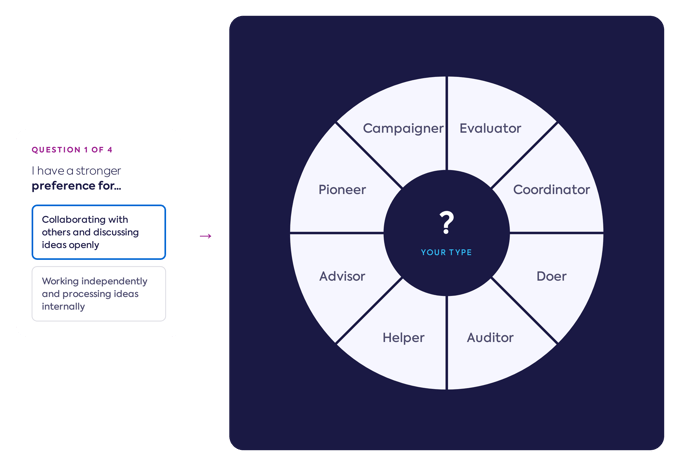
Compono Hire is built for the second half. Candidates are assessed on organisational fit alongside skills and qualifications, so a shortlist arrives with evidence rather than a ranking by application date. Underneath sits work personality, eight ways people prefer to work: Doer, Auditor, Helper, Advisor, Pioneer, Campaigner, Evaluator and Coordinator. A team heavy with Pioneers generates ideas and struggles to finish them, and hiring another one because the interview felt familiar is how that pattern repeats.
The fit boundary. If your hiring is high-volume and transactional, and speed is the only measure that matters, a lean tracking tool may serve you better than anything with assessment in it. Assessment earns its place when the cost of the wrong person is high.
Measure your current process first, because the business case depends on it. Time to hire is the usual starting metric, and our time to hire calculator gives you a number to compare against after implementation rather than an impression.
Then run the demo on your own roles. Post one of your real job ads, apply as a candidate on a phone, and ask a hiring manager to review a shortlist without help. Most of what matters shows up in that half hour: whether the application takes eleven minutes or three, whether a manager can find what they need without training, and whether the system tells you anything you did not already know.
Compono Hire scores every candidate on organisational fit alongside skills and qualifications, so hiring managers argue about the right things.
Talk to usIn HR and IT procurement conversations, ATS means applicant tracking system: the software that collects job applications and moves candidates through hiring stages. IT teams usually get involved to review single sign-on, user provisioning, data residency, integrations and security, rather than the recruiting features themselves.
No. An applicant tracking system covers the hiring stage, from job ad to offer. Talent management software covers what happens after someone joins, including performance, development, succession and internal mobility. Some suites sell both, though the depth on each side varies.
Some do, and many stop at the signed offer. Ask specifically whether the system creates the employee record, collects compliance documents, assigns pre-start tasks and hands data to payroll without re-keying. If it does not, you need onboarding software alongside it and a clear handover point.
Once hiring becomes regular rather than occasional, yes. Teams hiring a handful of people a year can run a careful manual process. Beyond that, candidates start falling through gaps, response times slow down, and the good applicants accept somewhere else first.
Coverage of your actual hiring process, honest integration with your HR and payroll systems, a candidate experience you would be happy to go through yourself, and evidence beyond keyword matching. A system that only tells you who applied leaves the hardest judgement exactly where it was.

What brokers and insurance firms need from an ATS: compliance-ready records, structured assessment to cut bias, and a candidate experience that holds...

Recruitment software for New Zealand teams: what to look for, how to weigh local needs against global tools, and how to assess fit before you...

The five categories of recruitment software, what each one actually automates, and how to tell which fits the hiring problem you have.