Skip to the main content.
FOR GOVERNMENT

AssureArrow Left

Become the expert on delivering
valid and fair assessments for
your training and education.

Compono Assure


FOR BUSINESS

HireArrow Left

Engage Arrow Left

Develop Arrow Left

Automatically match to candidates who are a great fit for your team culture and who are intrinsically motivated to succeed.

Deeply understand your organisation with science-backed analytics on your culture, team design, and engagement.

Back your onboarding, compliance and skill development with industry-leading credentialling, competency and capability expertise.


The AI that actually understands you.

Hey Compono helps you understand your personality and how to turn it into your superpower.

First 1,000 users get 10 minutes free.
Just $15 a month after that — cancel anytime.

Hey Compono


5 min read

AI talent acquisition: how to hire smarter in 2026

AI talent acquisition: how to hire smarter in 2026
9:40

The recruitment landscape has shifted dramatically in 2026, and if you are still manually sifting through hundreds of applications, you are likely losing your best candidates to faster, more agile competitors. AI talent acquisition is no longer a futuristic concept or a 'nice-to-have' experimental tool; it is the engine room of modern HR departments across Australia. By embracing intelligent automation, your team can move away from administrative drudgery and focus on what truly matters – building meaningful human connections with the people who will drive your business forward.

The evolution of AI talent acquisition in 2026

As we navigate through 2026, the role of artificial intelligence in recruitment has matured. We have moved past the initial 'hype' phase where AI was feared as a replacement for recruiters. Instead, we have entered an era of augmented intelligence, where the Compono platform acts as a sophisticated co-pilot for hiring managers and talent acquisition specialists.

Today, AI talent acquisition is about precision. It is about using data-driven insights to predict candidate success, cultural alignment, and long-term retention. In the Australian market, where skills shortages in key sectors remain a challenge, the ability to identify 'silver medallist' candidates or passive talent through intelligent algorithms is a significant competitive advantage.

The focus has also shifted towards ethical AI. Companies are now prioritising transparency and fairness, ensuring that their automated systems are audited for bias and designed to promote diversity. This ensures that your hiring process is not just faster, but fairer and more representative of the modern workforce.

Why manual recruitment is holding your business back

If your current process involves downloading PDFs, manually entering data into spreadsheets, and relying on 'gut feel' during the initial screening, you are facing several risks. Firstly, there is the 'time-to-hire' problem. In 2026, top-tier talent is often off the market within days, not weeks. If your screening process takes a fortnight, you have already lost.

Secondly, human bias is an inescapable reality of manual screening. Even the most well-intentioned recruiters can be swayed by 'affinity bias' – favouring candidates who went to the same university or share similar hobbies. This limits your diversity and can lead to a stagnant company culture. AI talent acquisition helps to neutralise these unconscious biases by focusing on objective skills and behavioural data.

Finally, there is the candidate experience. Modern applicants expect a seamless, digital-first experience. They want instant updates, easy scheduling, and a process that feels personalised. A clunky, manual system sends the message that your company is behind the times, which can be a major turn-off for tech-savvy professionals.

The core pillars of an AI-driven recruitment strategy

To successfully implement AI talent acquisition, you need to look beyond just 'buying a tool'. It requires a strategic approach that integrates technology into every stage of the candidate journey. Let's break down the essential components of a modern, intelligent hiring strategy.

1. Intelligent sourcing and talent pooling

Gone are the days of 'post and pray'. AI now allows you to proactively find talent before you even have an open role. By analysing vast amounts of public data and internal databases, AI can identify individuals whose career trajectory aligns with your future needs. This allows you to build a robust talent pipeline that you can tap into the moment a vacancy arises.

With Compono Hire, for example, you can centralise your sourcing efforts and use intelligent matching to see which candidates in your database are the best fit for new roles. This reduces your reliance on expensive external job boards and puts you back in control of your talent data.

2. Automated screening and skills assessment

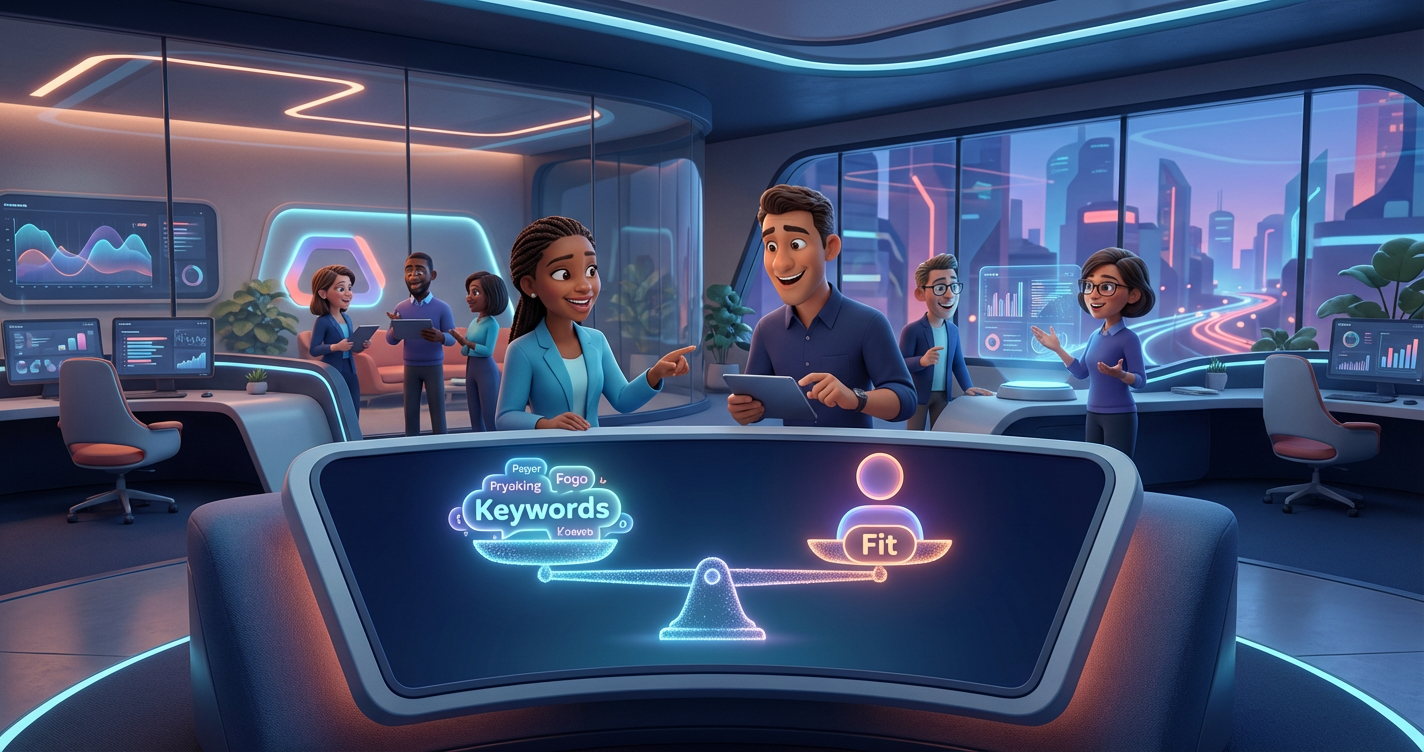
The most time-consuming part of recruitment is often the initial screen. AI can now handle this by reviewing resumes, cover letters, and even video introductions against specific job criteria. However, the real magic happens when you move beyond the resume. Advanced behavioural assessments can provide a deeper look at a candidate's cognitive abilities and personality traits.

This data-led approach ensures that the candidates who make it to the interview stage are not just good on paper, but have the actual skills and attributes required to excel in the role. It removes the guesswork and allows your team to spend their time interviewing the 'cream of the crop'.

3. Enhancing the candidate experience through personalisation

AI doesn't have to be cold and robotic. In fact, it can make your recruitment process feel more human. AI-powered chatbots can provide 24/7 support to candidates, answering questions about the role, the company culture, and the status of their application. This ensures no candidate is left in a 'black hole'.

Furthermore, AI can help personalise communication. Instead of generic rejection emails, you can provide constructive feedback based on the candidate's assessment results. This leaves a positive impression of your brand, even for those who didn't get the job this time around.

Overcoming the challenges of AI implementation

While the benefits are clear, implementing AI talent acquisition is not without its hurdles. One of the biggest concerns for HR leaders is data privacy and security. In Australia, compliance with the Privacy Act and various state-based regulations is paramount. You must ensure that any AI vendor you partner with has robust data protection measures in place.

Another challenge is change management. Your existing recruitment team may feel threatened by the introduction of AI. It is vital to communicate that AI is there to empower them, not replace them. By automating the repetitive tasks, you are freeing them up to do more strategic work, such as employer branding, candidate relationship management, and workforce planning.

Finally, there is the 'black box' problem – not knowing how the AI reached a certain decision. To solve this, you should look for 'explainable AI' solutions. These are systems that provide transparent reasoning for their recommendations, allowing recruiters to understand why a candidate was ranked highly and to make the final informed decision themselves.

Measuring the ROI of your AI talent acquisition

How do you know if your investment in AI is actually paying off? In 2026, we have moved beyond simple metrics like 'cost-per-hire'. While still important, they don't tell the whole story. To truly measure success, you need to look at quality-of-hire and long-term performance.

By using tools like Compono Engage, you can track how candidates hired perform over their first 12 to 24 months. Are they staying with the company longer? Do they fit well within their teams? This feedback loop is essential for refining your AI models and ensuring your recruitment strategy is aligned with your business goals.

You should also monitor your diversity and inclusion metrics. If your AI is working correctly, you should see a more diverse range of candidates progressing through your funnel and being hired into key roles. If the numbers aren't moving, it's a sign that your algorithms may need adjusting to remove hidden biases.

The future of work: what's next for AI in HR?

Looking ahead, the integration of AI in talent acquisition will only deepen. We are already seeing the rise of generative AI for crafting highly personalised job descriptions and reach-out messages. In the near future, we can expect to see even more advanced predictive analytics that can forecast future skills gaps within your organisation before they even happen.

The key for HR leaders is to remain curious and adaptable. The world of work is changing fast, and the technology that supports it is evolving even faster. By staying informed and choosing the right partners, you can ensure your organisation is well-positioned to attract and retain the best talent in 2026 and beyond.

Key takeaways for Australian HR leaders

  • Speed is a currency: Use AI to drastically reduce your time-to-hire and secure top talent before your competitors do.
  • Focus on quality, not just quantity: AI assessments provide deeper insights into a candidate's potential than a resume ever could.
  • Prioritise the human element: Use the time saved by automation to build better relationships with candidates and employees.
  • Demand transparency: Ensure your AI tools are ethical, unbiased, and compliant with Australian regulations.
  • Measure what matters: Track quality-of-hire and retention to prove the long-term value of your AI strategy.

Are you ready to transform your recruitment process and embrace the future of hiring? Our team is here to help you navigate the complexities of modern HR technology. Discover how our suite of tools can help you find, hire, and keep the best people for your business.

To see our technology in action and learn how we can support your specific needs, book a demo with one of our experts today.

Related