

 Mathan Allington

A team engagement survey can be as short as nine statements on a five-point scale, answered in about five minutes. Copy the statements below and run them yourself, or use Compono's free employee engagement survey for one team, which adds the culture behind the score and returns one report.
Last reviewed November 2026.
Most engagement surveys are built for a whole company. A manager or HR lead who wants to check one team has little to work with: a 40-question template, a tool that needs a rollout, or a score with no explanation. Below are nine statements to ask, how to run them so people answer honestly, and how to read the results.
What's a simple engagement survey I can run with my team?
A simple engagement survey asks people to rate a handful of statements from Strongly disagree (1) to Strongly agree (5). Nine statements are enough to see how a team feels about its work and about the company, and they take about five minutes to answer.
Here are the nine statements Compono's survey uses, in the order the survey groups them.
Four on the company
- Our company is performing well financially.
- Our company runs effectively and efficiently.
- Our company learns and improves from past experiences.
- Our company produces quality products or services that meet customer expectations.
Five on work
- I am engaged in my job.
- I am satisfied with the tasks and responsibilities of my job.
- I am unlikely to leave the company in the next year.
- I am motivated to achieve work goals and objectives.
- My work environment is positive and supportive.
Use the same five-point scale for every statement:
| 1 | 2 | 3 | 4 | 5 |
|---|---|---|---|---|
| Strongly disagree | Disagree | Neither agree nor disagree | Agree | Strongly agree |
Add one open box at the end, "What one thing would improve how you work here?", so people can say what the numbers can't. Keep it optional.
What does each group tell you?

The company group shows how much people believe in the organisation they work for: whether it is doing well, running well, learning and delivering. A team can like its work and still lose faith in the company, and that gap is worth seeing early.
The work group shows how people feel about their own job day to day: energy, satisfaction, motivation, how supportive the environment is and whether they plan to stay. Statement 7 is the closest the survey gets to asking about leaving, so watch it.
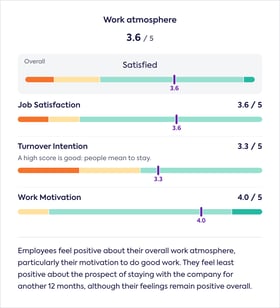
Averaging each group gives you two scores out of 5. Reading them side by side matters. A team that scores high on work and low on company is telling you something different from the reverse.
How do I measure my team's engagement for free?
You can measure it for free in two ways. Copy the nine statements into any survey form your organisation already has, or run them in Compono's free survey, which sends one link to your team and returns one report.
Compono's survey is not a file to download. The nine statements above are public, so you can copy them and run them yourself in whatever tool you have. If you run them in Compono's survey, the 12 culture dimensions come with them, because the survey reads the score beside how the team works now and how it wants to work. The report then shows the two engagement scores, what the scores suggest, the biggest gaps in culture and what people wrote, with no names. It is free and secure, with access via verified email.
The trade-off with doing it yourself is time. You build the form, protect anonymity, work out the averages and find a way to explain them. That is fine for a first look. If you would rather have the report ready, the survey does that part.
How do I keep an engagement survey anonymous in a small team?
Keep it anonymous by combining answers before anyone sees them, hiding results when too few people have answered, and never showing a person's line. In a small team these rules matter more, because five people can guess who wrote what.
Five habits help:
- Report only combined scores. Never show an individual's ratings, even to the manager.
- Set a minimum number of answers. If fewer people than your minimum have answered a statement, don't show a count for it. Compono's survey does this automatically: no count shows under any statement until five people have answered.
- Keep names apart from answers. If you need to know who has responded, so you can remind people, store that list separately from the answers.
- Strip identifying detail from comments. A line such as "since the Brisbane restructure" can point to one person. Group comments by topic and remove names and obvious clues.
- Say all of this before people answer. One sentence at the start of the message saves a lot of guessing.
In Compono's survey, no name or email sits with anyone's answers. Each person's first name and email are stored apart from the answers and used to send the report, never to show who said what.
When should I run it, and how do I share results back?
Run it when you can act on what you hear, and share results within a couple of weeks. Avoid the week before a holiday, a deadline or a restructure announcement, because those moods leak into the scores.
A simple run looks like this:
- Tell the team why. Say what you will do with the results and that answers are anonymous.
- Open it for about a week. It is five minutes of work, so a short window with one reminder is enough.
- Read the scores before the team does. Look at both groups and the comments, and check for any statement that stands out.
- Share the results back. Show the two scores and the main themes in your next team meeting. Name one or two things you will change and one you won't, with the reason.
- Check back. Tell the team what has moved at the next meeting. A survey with no visible follow-up teaches people to stop answering.
How often to repeat it is a separate question, covered in our guide to how often to run engagement surveys.
How do I read the scores beside the culture?

Read the engagement scores as a symptom and the culture as the cause. A score tells you where the team stands. The culture tells you what sits behind it. The same score can mean different things in different teams.
Take two teams that both score 3.0 on work. In the first, the team works in a very Task Centered way and people want it to be far more People Centered. The gap between how it works now and how people want it to work is wide, and the score is likely to slide if nothing changes. In the second, how the team works is close to what people want, and a score of 3.0 points to something else, such as workload or unclear roles. The number is the same. The next step is different.
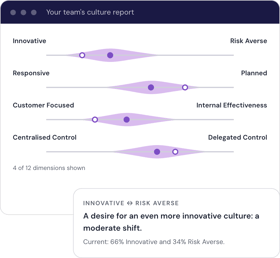
That is why Compono's survey asks about culture as well. Everyone places where work is now and where it should be on 12 culture dimensions, and the report reads the scores beside the biggest gaps. If you run the nine statements on your own, add a simple question to each person: "What is one way our team works today that you would change?" It won't replace the dimensions, but it points you at the cause.
Some rough guidance on how to read the average of each group, using the bands in Compono's survey:
| Average out of 5 | Reading |
|---|---|
| 1.0 to 1.8 | Very dissatisfied |
| 1.9 to 2.6 | Dissatisfied |
| 2.7 to 3.4 | Neutral |
| 3.5 to 4.2 | Satisfied |
| 4.3 to 5.0 | Very satisfied |
Neutral is not fine. People in the middle are often still deciding. If leaders act, a neutral team can move up. If they don't, it tends to drift down.
Two patterns need a closer look. A low score with large culture gaps means the team may be under strain, so change is probably needed, and the pace, the communication and the trust you build matter as much as the change itself. A low score with small culture gaps is different: people may have stopped expecting anything to change, and you need to talk to them in person.
My engagement scores look fine, so why are people leaving?
Scores can look fine while people leave because an average hides the people close to the exit, and because a score shows how people feel now, not what they want to change. We cover this in more detail in what to do when the survey says fine but people keep leaving.
Three things to check in your own results:
- Statement 7 on its own. "I am unlikely to leave the company in the next year" is the nearest the survey gets to intent. A good average can sit on top of a low score here.
- The spread, not just the average. A team with moderate engagement may include some people who are highly engaged and others who are close to leaving.
- The culture gap. High engagement with large culture gaps usually means people still believe in the company but feel the way of working needs to change. That is a strong position for change, as long as leaders act before frustration builds.
How many questions should an engagement survey have?
For a first check on one team, a short survey is enough. Longer surveys give more detail, but a team of eight does not need 45 questions to tell you how it feels. Our guide on how many engagement survey questions to ask covers the trade-off by company size.
If you do want a longer bank to choose from, see essential employee engagement survey questions. The nine statements in this article are the short version for one team.
What happens when you need more than one team?
One team at one point in time is a good start, and it is where the free survey stops. Compono Engage reads the same statements across every team and over time, with culture beside them, so you can see where engagement is dropping first.
How your team feels about work, and about the company
Nine anonymous statements, about five minutes each. You get the engagement scores, and the culture gaps behind them.
Get started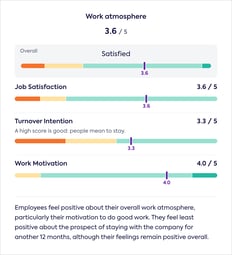
Frequently asked questions
What are the best questions to measure engagement?
Start with statements on how people feel about their work and the company, rated Strongly disagree (1) to Strongly agree (5). Nine are enough for a team: four on the company (performance, efficiency, learning, quality) and five on work (engagement, satisfaction, intent to stay, motivation, a supportive environment). The full list is in this article.
Is there an employee engagement survey template I can download?
Compono's survey is not a download. You can copy the nine statements from this article and run them in any survey form, or run them in Compono's free survey, which sends one link to your team and returns one report with the 12 culture dimensions beside them.
How many questions should an engagement survey have?
For a first check on one team, a short survey is enough, and about five minutes is a fair ask. Company-wide surveys can run longer. See our guide to how many engagement survey questions to ask for the detail.
How do I keep an engagement survey anonymous in a small team?
Report only combined scores, hide results until a minimum number of people have answered, keep names apart from answers, and remove identifying detail from comments. Tell people how this works before they answer.
How is the engagement survey scored?
Average each group, the company and the work, into one score out of 5. In Compono's survey the scores are read as Very dissatisfied (1.0 to 1.8), Dissatisfied (1.9 to 2.6), Neutral (2.7 to 3.4), Satisfied (3.5 to 4.2) or Very satisfied (4.3 to 5.0).
My engagement scores look fine, so why are people leaving?
An average can hide the people close to leaving, and a score does not show what people want to change. Look at the statement on intent to stay, the spread of answers and the culture gaps behind the score.