

 Mathan Allington
LearnUpon is a cloud-based learning management system designed to deliver both internal employee training and external customer education through a unique multi-portal architecture.
Last reviewed November 2026
Quick answer
- Price: Estimated from US$600 to US$2,000+ per month based on active users (exact pricing on request).
- Best for: Mid-sized to large organisations running customer academies, partner training networks, or multiple branded portals.
- Verdict: LearnUpon is a powerful, user-friendly platform for delivering content at scale, though it focuses more on tracking course completion than measuring deep behavioural capability.
Choosing a learning management system requires a clear understanding of what problem you are trying to solve. Most HR and learning teams hit a wall when they realise their internal compliance tool cannot handle external customer training. Others find that their customer education platform is too superficial to develop complex internal capabilities.
You need to know where a platform sits on the spectrum of tracking completions versus building capability. Managing process risk means tracking who finished a compliance module, storing audit-ready records, and automating enrolments. People insight risk is the failure to understand what drives your employees and whether their learning actually changes their performance.
LearnUpon excels at process risk. It is a highly capable delivery mechanism for courses across different audiences. This review breaks down its technical capabilities, real-world feedback from administrators, pricing structures, and how it compares to other options on the market.
Core features and technical capabilities
LearnUpon built its reputation on making complex learning delivery feel simple. The platform aims to centralise training materials while allowing administrators to distribute them across distinct audiences.
LearnUpon has a 4.5/5 rating in verified G2 reviews, with users highlighting its centralised learning resources, reporting, customisation, and responsive support (G2). This high rating reflects a platform that does exactly what it promises on the box. It delivers content reliably and tracks who interacted with it.
The multi-portal architecture
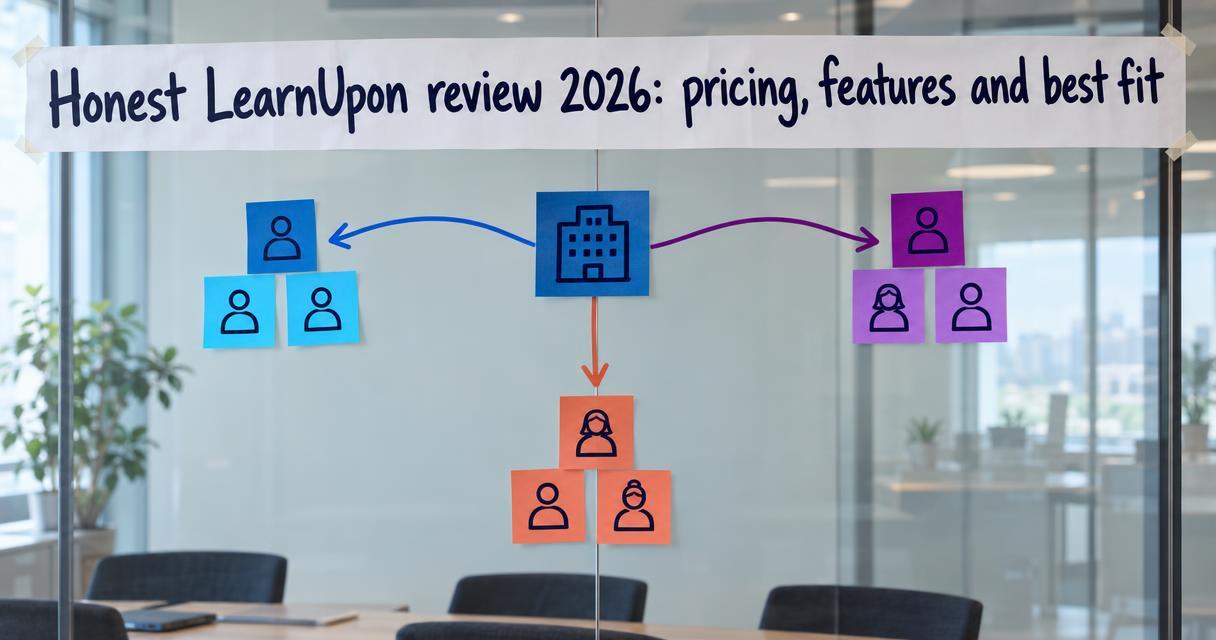
The standout feature of LearnUpon is its multi-portal functionality. A portal is essentially a standalone learning environment. You can set up one portal for your internal staff, a completely separate portal for your software customers, and a third for external channel partners.
Each portal can have its own branding, URL, user management rules, and course catalogue. The main administrative account sits at the top level and pushes content down into the child portals. If you update a product training course at the top level, you can push that update to the customer portal and the partner portal simultaneously.
A customer using LearnUpon for SaaS onboarding and customer education reported that automated enrolment based on role, language, and lifecycle stage reduced manual administration (G2). For software companies, training providers, and associations, this division of audiences is incredibly valuable.
Integrations and workflows
An LMS cannot operate in a silo. LearnUpon connects with major HR information systems, customer relationship management platforms like Salesforce, and webinar tools like Zoom and Microsoft Teams.
The Salesforce integration is particularly reliable. Sales teams can assign customer education modules to clients directly from Salesforce, and the completion data flows back into the client record. This connection proves the value of training in reducing customer churn and support tickets.
Content creation and instructional design

How an LMS handles content dictates how much time your instructional designers will spend fighting the system. LearnUpon supports SCORM and xAPI files, meaning you can build interactive courses in external authoring tools like Articulate Storyline and upload them seamlessly.
Native authoring tools
If you do not have external authoring software, LearnUpon includes native tools to build courses using text, images, video, and quizzes. The same reviewer noted above said LearnUpon’s AI-powered course authoring tool dramatically reduced the time required to build and update content (G2).
These native tools are highly functional for standard text-and-video courses. You can construct learning paths that require users to finish one module before opening up the next. However, instructional designers often note that native LMS authoring tools rarely match the deep interactivity of dedicated SCORM builders. If your strategy relies on highly gamified or scenario-based branching logic, you will still need a third-party authoring tool.
Assessment and reporting
Testing knowledge is a core function of any LMS. LearnUpon offers standard quiz formats including multiple choice, true or false, and fill in the blanks. Administrators can set passing grades, limit the number of attempts, and issue digital certificates upon completion.
The reporting engine is comprehensive. You can pull data on course completion rates, exam scores, and login activity. Scheduled reports can land in your inbox every Monday morning, keeping stakeholders informed without manual data entry. While it tracks these metrics perfectly, it remains focused on completion data rather than mapping learning back to specific behavioural shifts in the workplace.
The learner experience
A clunky interface kills learning engagement before a course even begins. If employees cannot find their assigned training, they will simply ignore it.
A G2 reviewer described LearnUpon as offering a "super intuitive UI" for learners and administrators, along with a highly responsive client-success team (G2). The dashboard is clean, presenting enrolled courses, pending deadlines, and earned certificates clearly. The platform is also fully mobile-responsive, allowing frontline staff or remote partners to complete training on their phones.
The emphasis here is on removing friction. When a customer logs into an academy to learn how to use your software, the experience needs to mimic the polish of a modern streaming service. LearnUpon achieves this consumer-grade look and feel.
Real-world limits and practitioner feedback
No platform is right. While the marketing materials highlight the strengths, speaking with instructional designers and reading aggregator data reveals where the platform encounters friction.
Users frequently praise LearnUpon for ease of use and responsive customer support, while limited forum functionality is a recurring criticism (G2). If your learning strategy relies heavily on social learning, peer-to-peer discussion, or community moderation, you may find the native forum tools basic compared to a dedicated community platform.
A third-party LMS comparison reports that ease of use is the most common positive theme, appearing in 71 LearnUpon reviews, while limited features appear in 33 reviews and limited customisation in 23 (EdTech Map). The customisation limits usually apply to the deeper layout of the portals. You can change colours, logos, and banner images easily. You cannot rewrite the underlying CSS or fundamentally alter how the dashboard operates.
This is the standard trade-off in modern software. By restricting deep customisation, LearnUpon guarantees that updates will not break your portal. If you need a fully bespoke learning environment coded from scratch, a commercial off-the-shelf LMS will always feel restrictive.
Pricing transparency and models
Understanding the financial commitment is difficult because LearnUpon does not publish its prices publicly. You must speak to their sales team for a quote. However, industry data and historical pricing models provide a clear picture for budgeting for HR technology.
The active user model
LearnUpon charges based on active users rather than registered seats. If you have 5,000 employees but only 500 log into the LMS in a given month, you only pay for those 500 active users. This model is exceptionally fair for customer academies and associations where learner activity fluctuates wildly throughout the year.
Plans typically start at 50 active users and scale up into the tens of thousands. Higher tiers open up additional features like white-labelling (removing the LearnUpon logo), API access, and a higher number of portals.
Implementation costs
When evaluating the total cost of ownership, factor in implementation. Setting up a single internal portal is straightforward. Configuring five separate portals with Salesforce integrations and Single Sign-On (SSO) requires time and technical resources. LearnUpon provides excellent customer success support, but complex enterprise rollouts will always incur internal resource costs.
Best fit scenarios for LearnUpon
If you are assessing whether a learning management system meets current organisational needs, you need to match your use case to the platform's strengths.
Customer and SaaS academies: This is where LearnUpon truly shines. The Salesforce integration, the active user pricing model, and the clean UI make it an ideal choice for training your customers on your software.
Associations and training companies: If you sell courses to external groups, the multi-portal architecture allows you to spin up a branded environment for each corporate client you land.
Mid-market corporate compliance: For internal teams of 200 to 2,000 people, LearnUpon handles compliance tracking, policy distribution, and onboarding pathways effectively.
Top alternatives to LearnUpon in 2026
If LearnUpon does not fit your specific requirements, the market offers several strong LearnUpon alternatives. Some focus entirely on enterprise complexity, while others prioritise actual capability building over simple course delivery.
| Vendor | Best for | Limits |
|---|---|---|
| Compono Develop | Linking learning directly to capability gaps and behavioural profiles. | Requires a commitment to evaluating people insight, not just ticking compliance boxes. |
| Docebo | Complex enterprise deployments and AI-driven content recommendations. | Premium pricing and a heavy administrative lift for small teams. |
| TalentLMS | Small businesses needing a fast, affordable LMS setup. | Struggles with highly complex, multi-layered enterprise hierarchies. |
| LearnUpon | Customer academies and multi-portal external training. | Limited social learning forums and a focus on completion data over performance mapping. |
Compono makes Compono Develop. We've included it and kept every entry's strengths and limits honest.
If you are exploring the Docebo learning management system, you are likely looking for deep enterprise features. Docebo offers powerful AI categorisation and social learning, but comes with a steeper learning curve and higher price point than LearnUpon.
If your goal is to build a high-performing team rather than just tracking course completions, you need a system that addresses people insight risk. A traditional LMS tells you an employee finished a leadership module. It does not tell you if they have the work personality and behavioural traits to actually lead people. Connecting those data points is where modern HR technology is moving.
How Compono can help with capability development
Compono Develop is a learning management system that connects development to real capability gaps, not just completion rates. We help you build your own training, bring your own content, and align your learning strategy with what your people actually need to succeed.
Frequently asked questions
Does LearnUpon support SCORM files?
Yes, LearnUpon fully supports SCORM 1.2 and SCORM 2004, as well as xAPI (Tin Can) files. You can upload content authored in external tools like Articulate Storyline or Adobe Captivate without any issues.
How does LearnUpon active user pricing work?
An active user is defined as anyone who logs into the platform during a billing cycle (usually a month). You can have thousands of registered accounts in the system, but you are only billed for the individuals who actively access the learning environment in that specific timeframe.
Can I use LearnUpon to sell my courses?
Yes, LearnUpon includes ecommerce functionality. You can integrate payment gateways like Stripe or PayPal, set up storefronts, and sell courses directly to external learners or corporate clients.
Is LearnUpon suitable for small businesses?
While small businesses can use LearnUpon, its pricing and multi-portal features are generally geared toward mid-market and enterprise organisations. Very small teams with basic internal training needs might find simpler, lower-cost platforms more appropriate.
Does LearnUpon have an open API?
Yes, LearnUpon offers a REST API that allows developers to build custom integrations. This lets you connect the LMS with your proprietary internal systems, automate user provisioning, and extract granular reporting data.