

.webp)

 Mathan Allington


Licence vs certification vs Credential
 Mathan Allington
Learn the exact difference between a licence, a certification, and a credential to protect your business from compliance risks. Discover how to...
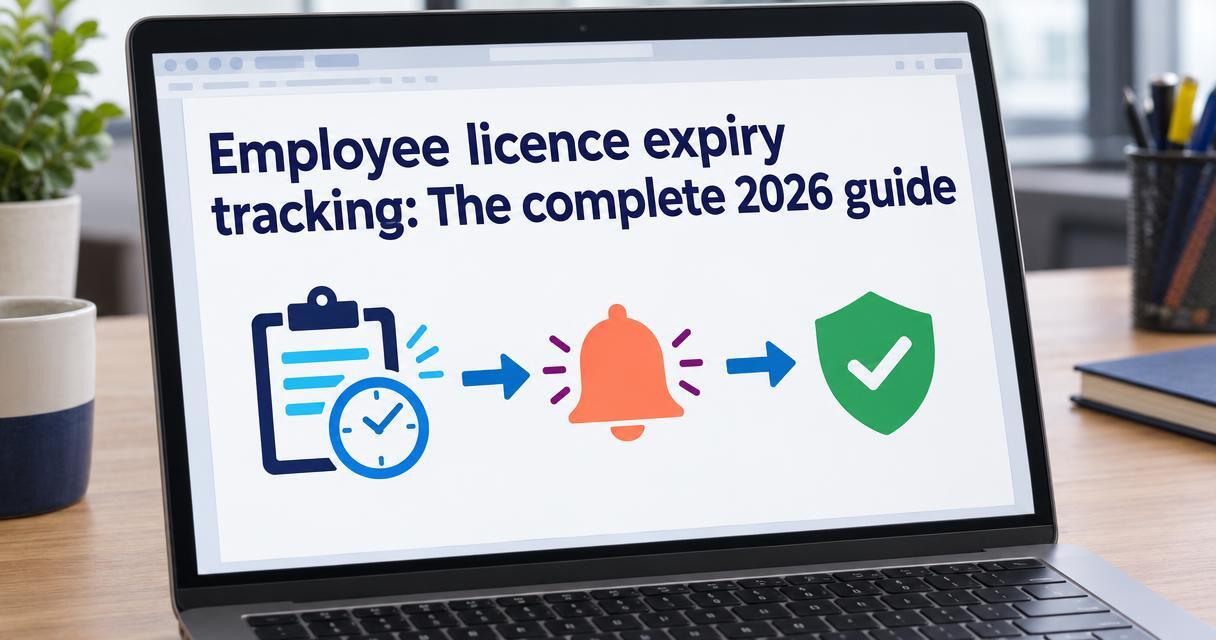
Effective licence expiry tracking is the process of monitoring and renewing mandatory employee qualifications before they lapse to prevent legal penalties and operational downtime.
Last reviewed October 2026
Many organisations still rely on spreadsheets to manage this data today. That approach works right up until a single missed renewal leads to a grounded fleet, a failed safety audit, or a voided insurance policy. Modern workforce management requires automated alerts, verified evidence uploads, and clear audit trails to keep operations running smoothly.
Key takeaways
- Manual tracking systems create unacceptable legal and financial risks for businesses operating in regulated industries.
- Automated licence expiry tracking prevents operational downtime by notifying managers and staff well before a qualification lapses.
- A central source of truth for workforce credentials makes regulatory audits simple and stress-free.
- Integrating your tracking system with your broader competency framework ensures staff only perform tasks they are legally qualified to do.
Managing workforce compliance is a high-stakes responsibility. When an employee steps onto a construction site, gets behind the wheel of a heavy vehicle, or treats a patient, they must hold the correct, valid credentials. If their qualifications have expired, the consequences extend far beyond a simple administrative error.
The immediate risk is regulatory. Government bodies and industry regulators conduct random audits and site inspections. Finding an employee working with an expired licence often results in immediate stop-work orders and severe financial penalties for the business. The secondary risk is financial liability. If an incident occurs and the worker involved did not hold a valid licence, your corporate insurance policy may be entirely voided. The business becomes liable for all damages and compensation.
Despite these massive risks, many HR and safety teams spend their days manually chasing staff for updated cards. They send generic emails asking for copies of renewed licences and update rows in a master spreadsheet. This administrative burden distracts leaders from strategic safety initiatives and creates a single point of failure. If the person managing the spreadsheet goes on leave, the entire compliance tracking process stops.
Licence expiry tracking is not just about driver licences. Depending on your industry, the volume and variety of credentials you need to monitor can be overwhelming. A comprehensive tracking program must account for multiple categories of compliance data.
First, you have standard operating licences. These include driver licences for standard vehicles, heavy vehicle accreditations, and forklift tickets. These are standard requirements across logistics, warehousing, and field services. Second, you have high-risk work credentials. These cover activities like working at heights, operating cranes, or handling hazardous materials. Managing these requires precision, which is why many safety teams start by implementing a high risk work licence register template to standardise their data collection.
Third, there are professional registrations and background checks. Healthcare providers must track AHPRA registrations and annual CPR refreshers. Education and community service providers must constantly monitor Working with Children Checks and police clearances. Finally, you have site-specific inductions and internal training certifications. These often expire annually and require employees to complete refresher courses before they can access specific locations or systems.
Spreadsheets are excellent tools for data analysis. They are terrible tools for compliance management. The fundamental flaw of a spreadsheet is that it is passive. It does not send you an email when a date is approaching. It relies entirely on a human remembering to open the file, check the dates, and take action.
Version control is another major issue. When multiple managers need to update employee records, you often end up with conflicting versions of the same document. A site supervisor might update a worker's record on their local copy, but that update never makes it to the HR team's master file. This creates a false sense of security where the business believes it is compliant, but the actual records are fragmented and outdated.
Furthermore, spreadsheets cannot store verified evidence securely in the same view as the data. You might have a cell that says an employee holds a valid licence, but the actual photograph of that licence is buried in an email folder or a separate shared drive. When an auditor asks to see proof of compliance, finding the matching evidence takes hours of manual searching.
To eliminate these risks, organisations are moving away from manual methods and adopting dedicated employee licence management software. A purpose-built system transforms compliance from a reactive scramble into a proactive, automated process.
The most important feature is automated notifications. A good system allows you to set custom reminder schedules for different types of credentials. For example, you might want a 90-day warning for a complex professional registration that takes time to renew, but only a 30-day warning for a simple internal induction. These alerts should go directly to the employee and escalate to their manager if ignored.
Another essential feature is direct evidence upload. Employees should be able to take a photo of their renewed licence on their phone and upload it directly into their profile. The system then flags this upload for managerial review. Once approved, the new expiry date automatically updates the central record. This creates a closed-loop system where the data and the evidence are always linked.
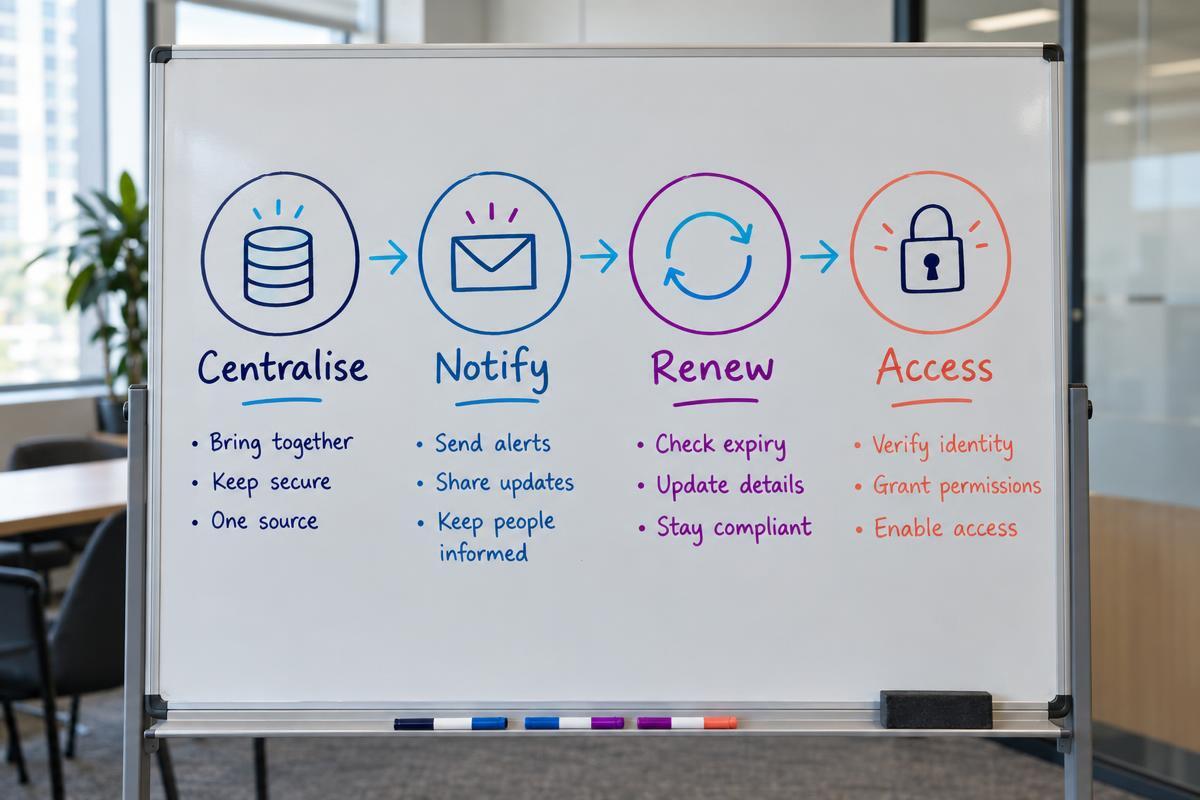
Implementing a new tracking process requires more than just buying software. You need a clear methodology to ensure all data is captured accurately and maintained over time. The process follows four distinct phases.
The first step is a complete audit of your current compliance requirements. You must define exactly which roles require which licences. Once you have this matrix, you need to gather all existing records from spreadsheets, filing cabinets, and email folders. This initial data migration establishes your baseline source of truth.
Once the data is centralised, you need to configure your communication flows. Decide who gets notified and when. Best practice is to notify the employee first, giving them autonomy to manage their own compliance. If the employee does not upload their new evidence within a set timeframe, the system should automatically alert their direct supervisor.
The renewal process should be entirely self-service for the employee. When they receive an alert, they should click a link, complete any required training, and upload their new documents. This is especially important when tracking compliance training that requires a quiz or assessment before the new certificate is issued.
The final phase is integrating your compliance data with your daily operations. If an employee's mandatory licence expires at midnight, the system should automatically flag them as non-compliant the next morning. In advanced setups, this status can integrate with rostering software to prevent the employee from being scheduled for shifts that require that specific qualification.
To understand the operational impact of upgrading your process, it helps to look at how specific tasks change when you move from manual tracking to an automated platform.
| Compliance Task | Spreadsheet Tracking | Automated System |
|---|---|---|
| Expiry notifications | Manual calendar entries and emails | Automated email and SMS alerts |
| Evidence collection | Chasing staff via email or in person | Self-service mobile uploads by staff |
| Record verification | Cross-referencing emails with spreadsheets | Manager approval dashboard |
| Audit preparation | Days of compiling files and folders | Instant export of active records |
| Risk visibility | Requires manual data sorting | Real-time dashboard of upcoming expiries |
Audits are a reality for any regulated business. Whether it is a routine check by a government safety regulator or a thorough review by a major client before signing a contract, you must be able to prove your workforce is qualified. A manual system makes audits highly stressful. You spend days finding the right spreadsheet, hoping the dates are accurate, and digging through digital folders to find the matching photographs of the licences.
With an automated system, you can evidence licence compliance in an audit in minutes. You simply generate a report showing all active employees, their required competencies, and their current licence status. Because the system forces staff to upload evidence before updating a date, you know every record is backed by proof. You can hand the auditor a clean, verifiable report and get back to your actual job.
This level of transparency also builds trust with regulators. When an inspector sees that you have a proactive, systematised approach to managing workforce qualifications, they are far more likely to view your organisation as a low-risk operator. Good compliance tracking is not just defensive administrative work. It is a competitive advantage that proves your business is professional, safe, and reliable.
We built our platform to handle the heavy lifting of workforce compliance and credential management. It provides a single source of truth for all employee qualifications, automates the entire renewal notification process, and ensures your business is always audit-ready.
Licence expiry tracking is the process of monitoring the validity dates of mandatory employee qualifications, such as driver licences, professional registrations, and safety certifications. The goal is to ensure staff renew their credentials before they expire so the business remains legally compliant and operational.
You should begin tracking and notifying staff at least 90 days before a complex licence expires, especially if the renewal requires external training or background checks. For simple internal certifications, a 30-day notice period is usually sufficient to ensure the employee completes the requirements in time.
Yes. A modern compliance management platform allows you to track everything from heavy vehicle licences and medical registrations to internal safety inductions in a single central dashboard. This gives you a complete view of your workforce capability.
If a mandatory licence expires, the employee is legally prohibited from performing the tasks associated with that credential. Allowing them to work without a valid licence exposes the business to severe regulatory fines, immediate site shutdowns, and the total voiding of corporate insurance policies.
Spreadsheets are passive documents that cannot send automated alerts when a deadline approaches. They suffer from poor version control, they cannot securely store photographic evidence alongside the data, and they rely entirely on manual data entry, which inevitably leads to human error and missed renewals.

Learn the exact difference between a licence, a certification, and a credential to protect your business from compliance risks. Discover how to...

How government agencies manage workforce credentialling, stay compliant, and plan capacity in 2026, plus what to look for in a system.
To evidence licence compliance in an audit. Discover how to build a defensible register and prove your workforce is qualified without relying on.