 Compono


From Certified Skills to Assure: A purpose-driven evolution

Sometimes, a name isn’t just a name—it’s a statement of purpose. That’s what guided the transition from Certified Skills to Compono Assure, a move...


Become the expert on delivering
valid and fair assessments for
your training and education.
Hire
|
Engage
|
Develop
|
|
Automatically match to candidates who are a great fit for your team culture and who are intrinsically motivated to succeed. |
Deeply understand your organisation with science-backed analytics on your culture, team design, and engagement. |
Back your onboarding, compliance and skill development with industry-leading credentialling, competency and capability expertise.
|


.png?width=383&height=200&name=team%20(1).png)

The road does not offer multiple-choice questions when a situation turns critical. Success behind the wheel or on a motorcycle is not just about knowing the rules of the road; it is about the split-second decisions you make when a hazard begins to develop.
For years, licensing systems have focused heavily on knowledge tests and supervised hours. While these are essential, the highest-risk period for any road user is the transition to unsupervised driving or riding. This is where hazard perception becomes your most vital asset. However, across different jurisdictions, the availability and quality of Hazard Perception Tests (HPT) remain inconsistent. This is particularly true for motorcyclists, who face a distinct set of risks that are often overlooked in standard car-based assessments.
Recent research, including the Austroads Literature Review on Hazard Perception Tests (February 2026), highlights a growing need for realism and valid measurement in road safety assessments. To meet this need, we are seeing a shift away from simple reaction-time 'click tests' toward a more robust methodology: the video-based Situational Judgement Test (SJT). By dropping learners into real-world situations, we can assess their judgement safely and at scale.

It is a common misconception that hazard perception is simply about how fast you can click a button when you see danger. In reality, safe driving and riding require sophisticated cognitive processing. You must scan the environment, interpret subtle cues, anticipate potential outcomes, and then select the safest response. This is the definition of judgement.
When we frame hazard perception as a Situational Judgement Test (SJT), we align it with a well-researched assessment method used in high-stakes environments globally. An SJT presents you with a realistic scenario and asks you to choose the most effective course of action. In a road safety context, this means moving beyond 'did you see the car?' to 'how will you respond to the car pulling out?'.
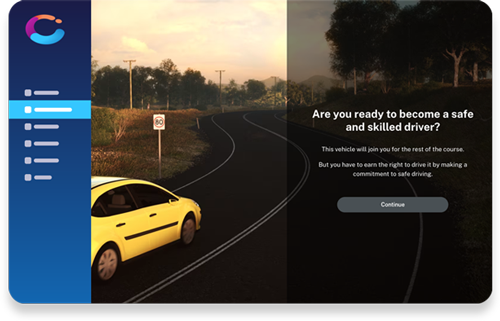
At Compono, we believe that assessing this level of nuance is critical for building high-performing road users. Our platform, Compono Assure, operationalises this by using video-based scenarios that measure actual judgement rather than just simple reflexes. This ensures that learners are not just fast, but safe and deliberate in their decision-making processes.
Why does video matter so much in an SJT? The answer lies in fidelity. A text-based description of a hazard requires the learner to use their imagination, which can lead to inconsistent interpretations. Video-based SJTs increase fidelity by presenting realistic cues – such as movement, timing, occlusion, and traffic context – exactly as they appear in the real world.
Research by McDaniel et al. (2007) in the Journal of Applied Psychology has shown that SJTs provide significant incremental validity in assessments. Furthermore, video-based versions offer a closer 'point-to-point' correspondence to real-life tasks. For a learner, this means the experience is much closer to actual driving. They learn to recognise the shimmer of a ball rolling into the street or the slight drift of a distracted driver before the hazard becomes an emergency.
This realistic exposure is a core component of Compono's People Intelligence Platform, which focuses on using data-driven insights to understand and improve human behaviour. By applying these assessment principles to road safety, we can identify exactly where a learner's judgement might be failing and provide targeted interventions before they hit the road alone.
One of the most pressing issues in current road safety policy is the lack of motorcycle-specific hazard perception coverage. Riders are significantly more vulnerable than car drivers, and the hazards they face are fundamentally different. Surface risks like gravel or oil, visibility issues at intersections, and the complexities of lane positioning require a different set of scanning habits.
A 'copy-paste' approach from car driver testing is not enough. To truly prepare riders, we need dedicated scenario libraries that reflect the unique perspective of a motorcyclist. Using video-based SJTs allows jurisdictions to create these specific environments safely. A rider can practice judging a 'smidsy' (Sorry Mate, I Didn't See You) situation a dozen times in a digital environment, building the mental models necessary to survive it on the road.
By using a scalable platform like Compono Assure, jurisdictions can deploy these specialised motorcycle HPTs consistently. This ensures that every rider, regardless of their location, is held to the same high standard of readiness. It is about equity in safety – ensuring that the most vulnerable road users have access to the best possible preparation.

As jurisdictions look to modernise their licensing systems, several principles should guide the development of scenario-based HPTs. First and foremost is the resistance to 'gaming' the test. Simple click-based tests can often be memorised or passed through sheer repetition. A true SJT approach uses large item banks and varied scenarios to ensure the learner is actually judging the situation, not just the test format.
Clarity and standardisation are also vital. Instructions must clearly define what constitutes a hazard and what a safe response looks like. This consistency allows for fair assessment across thousands of learners. Finally, the best assessments include a feedback loop. When a learner makes a poor judgement in a video scenario, they should understand why it was unsafe and have the opportunity to practice that specific cue recognition again.
This methodical approach is what transforms a simple test into a genuine learning tool. It moves the needle from 'compliance' to 'capability'. When we focus on the science of judgement, we create road users who are better equipped to handle the ambiguity and pressure of modern traffic environments.
Currently, hazard perception preparation is uneven across national jurisdictions. This creates a disparity in road safety outcomes. A national move toward standardised, video-based SJTs for all vehicle classes – including motorcycles – represents a significant opportunity to improve public safety.
By adopting a consistent, evidence-aligned method, policy makers can have greater confidence in the readiness of new drivers and riders. This approach is not experimental; it is an established methodology that can be audited, updated, and scaled. It provides a clear, data-backed baseline for what 'safe' looks like in 2026 and beyond.
An SJT is an assessment method that presents learners with realistic road scenarios and asks them to choose the safest or most effective response. It measures judgement and decision-making rather than just basic knowledge or reflexes.
Video provides 'high fidelity', meaning it contains the same visual cues – such as speed, timing, and movement – that you encounter while driving. This makes the assessment more realistic and effective than reading a description of a hazard.
By training and assessing a learner's ability to recognise hazards early, SJTs help build safer scanning habits. This allows drivers and riders to anticipate danger and act before a situation becomes critical.
Yes. Riders face unique hazards like road surface changes and higher visibility risks. Dedicated motorcycle HPT scenarios are essential to ensure riders are prepared for the specific challenges of being on two wheels.
Absolutely. With digital platforms capable of deploying assessments at scale, a national standard becomes not only possible but practical. This ensures consistent safety outcomes regardless of where a learner is located.

Sometimes, a name isn’t just a name—it’s a statement of purpose. That’s what guided the transition from Certified Skills to Compono Assure, a move...

Public sector training isn’t just about ticking compliance boxes anymore; it’s about equipping the people who keep our society running with the...

We have all been there: sitting through a mandatory training session, watching the minutes tick by, and wondering if the sandwich at lunch was the...