

.webp)

 Compono


1 min read
Who needs free work personality test tools to build stronger teams
 Compono
Every manager trying to fix communication breakdowns, every recruiter fighting high turnover, and every employee feeling misunderstood is exactly who...

Culture alignment assessment is important for HR because it predicts how a candidate's natural work preferences will interact with your existing team dynamics, reducing the risk of early turnover and workplace friction.
Key takeaways
- Culture alignment relies on shared working behaviours rather than shared personal interests.
- Assessing alignment with data removes the unconscious bias inherent in unstructured interviews.
- Understanding a team's existing work personality gaps helps HR leaders hire for specific behavioural needs.
- Structured culture assessments protect team productivity by ensuring new hires naturally complement the group's workflow.
We have all seen the perfect resume turn into a problematic hire. The candidate had the technical skills and they navigated the interview process with ease. Three months later, the team is frustrated and productivity has dropped. The new hire is struggling to communicate with their manager and the broader group feels disconnected.
This happens when HR teams rely on gut feeling to determine if someone will fit into the organisation. Technical skills are easy to verify on paper. Behavioural alignment requires a more deliberate approach. When you bring a new person into an established group, you are altering the dynamic of that team. Without a clear understanding of how that person prefers to work, you are leaving their success up to chance.
Many hiring managers treat culture fit as a test of shared hobbies. They look for candidates they would enjoy having a coffee with. This approach simply breeds homogeneity and limits diversity of thought.
Culture alignment assessment measures something entirely different. It evaluates how people prefer to work. It looks at how they communicate and handle conflict. It examines whether they prefer structured environments or open-ended problem solving. Two people with completely different backgrounds and interests can have perfectly aligned work personalities.
When HR leaders shift their focus from culture fit to culture alignment, they build stronger teams. They stop looking for clones of their top performers. They start looking for individuals whose natural working style complements the existing group.
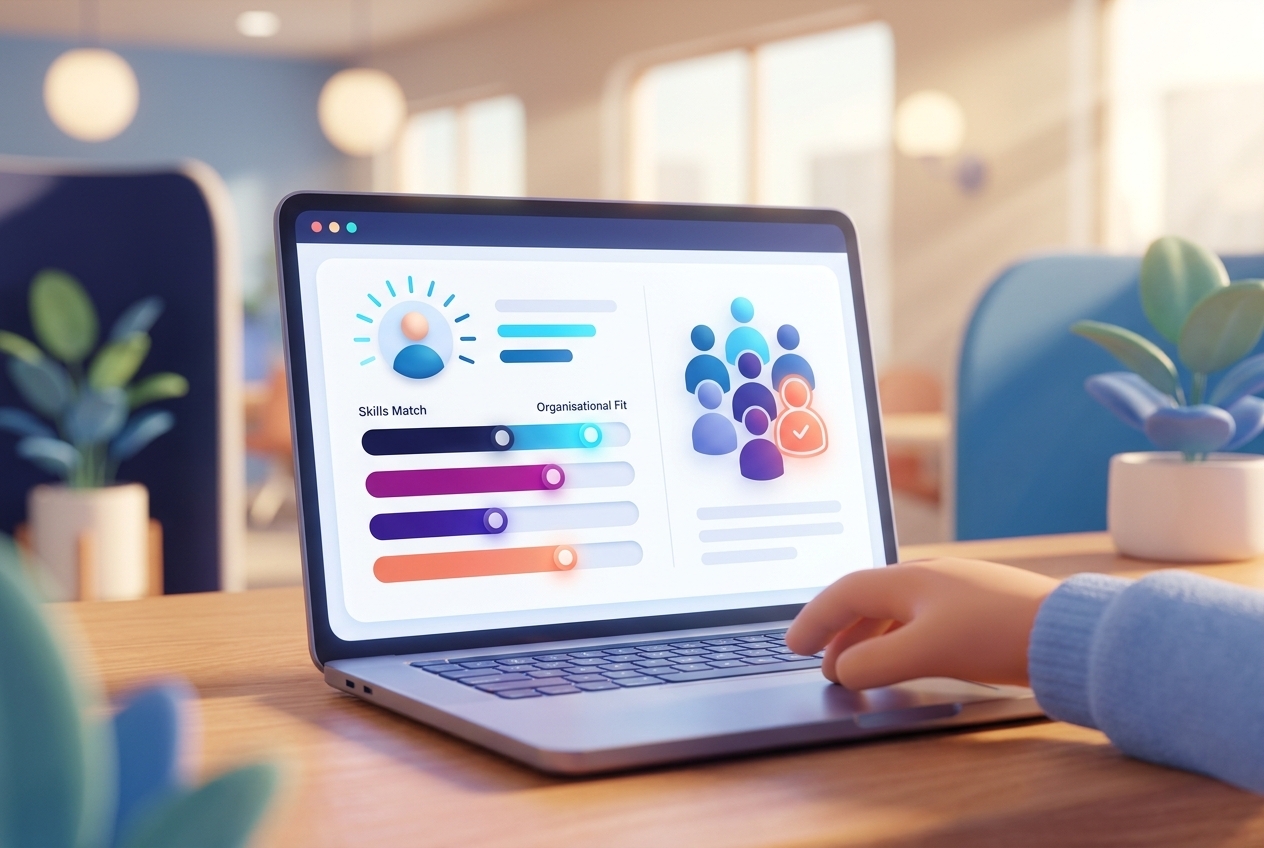
When a new employee leaves within their first year, it is rarely because they forgot how to do the job they were hired for. Why new hires fail usually comes down to a tools and process problem during the recruitment phase.
If the hiring process only evaluates past experience, it misses the behavioural indicators that dictate future success. A candidate might be an excellent project manager in a highly structured corporate environment. If you drop them into a fluid startup that requires constant adaptation, their strict adherence to process might cause friction.
This is where purpose-built technology changes the equation. Compono Hire evaluates candidates across three distinct dimensions: Organisation Fit, Skills and Qualifications. By measuring Organisation Fit early in the process, HR teams can identify candidates whose natural work preferences align with the reality of the role.
You cannot assess whether a candidate aligns with your team if you do not understand how your team currently operates. High-performing teams require a balance of different working styles to function effectively.
Based on our research into The Compono Culture, Engagement & Performance Model, we know that successful teams balance eight distinct work activities. These include evaluating risks, coordinating tasks, campaigning for ideas and doing the practical work. Each person has a natural preference for certain activities over others.
Consider a team composed entirely of people who love brainstorming and exploring new possibilities. They are highly creative but struggle to hit deadlines. If HR hires another highly creative thinker, the team's output will not improve. The team actually needs someone whose work personality naturally gravitates toward structure and task completion.
Culture alignment assessment gives HR the data to spot these gaps. It allows you to hire the missing piece of the puzzle rather than duplicating the pieces you already have.
Unstructured interviews are notoriously unreliable. Human beings are naturally drawn to people who remind them of themselves. This affinity bias leads managers to hire candidates who share their communication style, even if the team desperately needs a different perspective.
Implementing a culture alignment assessment provides an objective data point. It gives hiring managers a shared language to discuss candidate suitability. Instead of a manager saying they "just didn't get a good feeling" about an applicant, they have to articulate their concerns based on behavioural data.
This data-driven approach levels the playing field for candidates. It ensures they are evaluated on their actual working preferences rather than their ability to charm an interviewer. It helps organisations build teams that are diverse in thought and aligned in execution.
Maintaining a cohesive culture is relatively simple when an organisation has twenty employees. The founders know everyone and can personally oversee the team dynamics. When a company scales to two hundred employees, that informal oversight breaks down.
HR teams are tasked with preserving the core values of the business while hiring at volume. Without a scalable way to assess alignment, the culture begins to fracture. Different departments develop their own subcultures that may clash with the broader organisational goals.
Embedding culture alignment assessments into the standard recruitment workflow solves this scaling challenge. It ensures that every candidate, regardless of which department they are applying for, is evaluated against the same behavioural baseline. It protects the organisational culture while allowing individual teams to hire for their specific operational needs.
Key insights
- HR teams that use structured culture alignment assessments experience lower first-year turnover rates.
- Data-driven alignment tools prevent hiring managers from simply replicating their own personality types.
- Evaluating work personality provides a reliable framework for predicting team compatibility.
- Objective behavioural data removes the affinity bias that often plagues unstructured interviews.
Understanding your team's behavioural needs is the first step toward building a more connected and productive workforce. You can start mapping these dynamics and improving your hiring accuracy with the right tools.
It measures a candidate's natural work preferences, including how they communicate and handle conflict, comparing these traits against the existing team's dynamics.
Culture fit often relies on shared personal interests and can lead to hiring bias. Culture alignment focuses on complementary working behaviours and shared organisational values.
Yes. When employees naturally align with their team's working style and the broader organisational values, they experience less friction and are more likely to stay long-term.
Modern assessments are designed to be highly efficient. Candidates can often complete them in just a few minutes, providing HR teams with instant data that actually speeds up the decision-making process.
You can map your existing culture by having your current employees complete a brief work personality assessment. This reveals the dominant working styles and highlights any behavioural gaps in your team design.
1 min read
Every manager trying to fix communication breakdowns, every recruiter fighting high turnover, and every employee feeling misunderstood is exactly who...
1 min read
Culture fit hiring in cafes and restaurants works by identifying candidates whose natural work behaviours and values align with the specific energy,...
1 min read
To assess team fit, evaluate how a candidate's work personality, values and cognitive style align with your existing group dynamics, not just their...
 Mathan Allington