

.webp)

 Compono


Best LMS for Professional Services Firms in 2026: A Buyer's Guide
 Compono
What to look for in an LMS for a professional services firm: faster onboarding, billable skills tracking and compliance you can prove.

The primary difference between a corporate LMS and an academic LMS comes down to the end goal: corporate platforms are built to drive business outcomes, compliance, and rapid skill acquisition, while academic platforms are designed to manage semester-based curricula, grading, and deep theoretical learning.
Key takeaways
- Corporate LMS tools focus on microlearning, compliance tracking, and ROI, updating frequently to match business needs.
- Academic LMS platforms centre on semesters, grading rubrics, and deep theoretical exploration over extended periods.
- Integration needs differ drastically; corporate systems connect with HRIS and payroll, whereas academic systems sync with student information portals.
- Choosing an academic system for a business environment often leads to disengagement due to rigid, linear learning paths.
Many organisations assume learning is learning. They buy a platform that looks robust on paper, only to realise six months later that it forces their employees into a rigid, academic structure. This mismatch kills engagement and wastes budget.
The learning technology market is massive, and the corporate–vs–academic LMS split is roughly 58% corporate and 42% academic, according to iSpring data. The enterprise sector demands agility. If you try to force modern teams into a university-style syllabus, you will lose their attention.
Corporate learning management systems exist to solve business problems. They are deployed to close skill gaps, ensure regulatory compliance, and onboard new hires quickly. The success of a corporate LMS is measured by return on investment, reduced error rates, and faster time-to-productivity.
Academic platforms serve a completely different master. They are built to facilitate deep knowledge acquisition over months or years. Their primary objectives revolve around academic integrity, comprehensive understanding of theoretical concepts, and standardised evaluation.
Corporate LMS tools are often optimised for compliance and frequent content updates, because business training changes faster than academic curricula, as noted by industry analysts. When a new privacy law passes, a business needs to roll out updated training globally within days. An academic syllabus rarely requires that level of immediate, reactive updating.

Modern employees are time-poor. They need answers in five minutes, not five weeks. Corporate LMS platforms are built for microlearning and just-in-time training. Content is broken down into bite-sized modules, quick videos, and interactive scenarios that staff can consume between meetings or on the shop floor.
Academic platforms are built around the semester or term. Content delivery is linear and scheduled. A student must complete week one before moving to week two. The system is designed to pace the learner through a prolonged period of study.
Applying a linear, semester-based structure to a fast-moving business environment frustrates employees. They want to search for a specific policy, learn how to use a new software feature, and get back to work. The evolving Learning Management System landscape shows a clear shift toward self-directed, on-demand learning in the workplace.
How you measure success defines the platform you need. In an academic setting, assessment means essays, proctored exams, peer reviews, and complex grading rubrics. The goal is to assign a fair, comparative grade to a student's performance.
In the corporate world, assessment is about competency and compliance. Can the employee operate the forklift safely? Do they understand the new data privacy regulations? The assessment is usually a straightforward quiz, a practical demonstration, or a manager sign-off.
The Compono Develop module helps teams build targeted learning pathways that assess actual job readiness, bypassing the need for academic-style grading. Businesses need to know if an employee is competent and compliant – a letter grade is irrelevant.
An LMS never operates in isolation. The systems it needs to talk to will dictate which type of platform you should buy.
A corporate LMS must integrate seamlessly with your Human Resources Information System (HRIS), payroll software, and communication tools like Slack or Microsoft Teams. When a new employee is added to the HRIS, the LMS should automatically assign them their onboarding modules and compliance training.
Academic systems integrate with Student Information Systems (SIS), plagiarism checkers, and library databases. These integrations are highly specialised for the education sector and offer zero value to a commercial business.
The hierarchy within these platforms reflects their target audience. Academic systems are built for students, teaching assistants, professors, and sometimes parents. The permissions are structured around courses, departments, and faculties.
Corporate systems are built for employees, external contractors, line managers, and HR administrators. The permissions are structured around departments, job roles, and geographic locations. A manager needs a dashboard to see exactly who in their team has completed mandatory fire safety training. An academic system struggles to provide this specific operational view without heavy modification.
With ~89–93% of companies worldwide using an LMS for online learning, corporate LMS adoption is now mainstream (iSpring). These companies require granular role management that matches their organisational chart.
Data drives decisions in both sectors, but they are looking at entirely different metrics.
Academic reporting focuses on grade distributions, attendance records, and student engagement over a semester. It helps institutions identify struggling students and track overall cohort performance.
Corporate reporting focuses on completion rates for mandatory training, time-to-competency for new hires, and skill gap analysis. Business leaders want to see how training correlates with performance metrics. If the sales team completes a new negotiation module, the business wants to track if win rates increase in the following quarter.
Blended learning – mixing online modules with face-to-face instruction – happens in both environments, but the execution differs.
In universities, blended learning usually means watching a recorded lecture online and attending a physical tutorial for discussion. The LMS acts as a repository for readings and a submission portal for assignments.
In the corporate sector, blended learning might involve completing a safety theory module online before attending an in-person practical assessment. The corporate LMS must handle event management, track physical attendance, and record practical sign-offs from supervisors. If you are choosing the right LMS for your organisation, ensuring it handles real-world, on-the-job training events is critical.
Budgeting for these systems requires understanding their different pricing structures.
Academic platforms generally charge based on the total enrolled student body (FTE or Full-Time Equivalent). Since students use the system daily for months at a time, the pricing reflects heavy, sustained usage.
Corporate platforms often use active-user pricing or tiered models based on feature sets. Businesses appreciate this flexibility because employee usage is often sporadic. An employee might log in daily during their first month of onboarding, then only once a quarter for compliance updates. Furthermore, 83% of organisations manage their LMS internally while 23% outsource operations, reflecting the operational flexibility corporate buyers expect (iSpring).
A corporate LMS is a business tool designed to protect the company and increase revenue. By automating compliance training, it reduces legal risk. By streamlining onboarding, it reduces the time it takes for a new hire to become profitable. By offering continuous upskilling, it improves employee retention.
Academic systems are excellent at what they do, but they are not designed to drive corporate revenue or manage workplace compliance. Buying an academic LMS for a corporate environment is like buying a school bus for a delivery route – it might technically move things from A to B, but it is the wrong tool for the job.
Key insights
- Corporate platforms prioritise speed, compliance, and ROI over deep theoretical grading.
- Integration with HRIS and payroll is a non-negotiable feature for enterprise learning systems.
- User experience in a corporate LMS must cater to time-poor employees needing just-in-time information.
- Pricing models for business LMS tools are usually more flexible, catering to sporadic, active-user patterns.
Stop forcing your team into academic structures. Build a learning environment that actually drives performance, tracks compliance, and integrates with your business systems.
Related reading
Technically yes, but it is rarely a good idea. Academic platforms are built around semesters and grading, which frustrates employees who need quick, on-demand answers and simple compliance sign-offs.
Academic reporting focuses on grades and long-term student progress. Corporate reporting focuses on compliance tracking, completion rates, and the business impact of training.
Yes. A strong corporate LMS will include event management features to schedule, track, and record attendance for in-person workshops and practical assessments.
Content in a corporate setting is updated frequently – sometimes weekly – to reflect changes in company policy, new product releases, or shifting industry regulations. Academic content usually changes on a semester or annual basis.
Integrating your LMS with your HRIS automates the training process. When a new employee is hired or someone changes roles, the system automatically assigns the correct compliance and onboarding modules without manual admin work.

What to look for in an LMS for a professional services firm: faster onboarding, billable skills tracking and compliance you can prove.

How to choose an LMS for manufacturing in Australia, built around the safety and productivity pressures plants actually face.
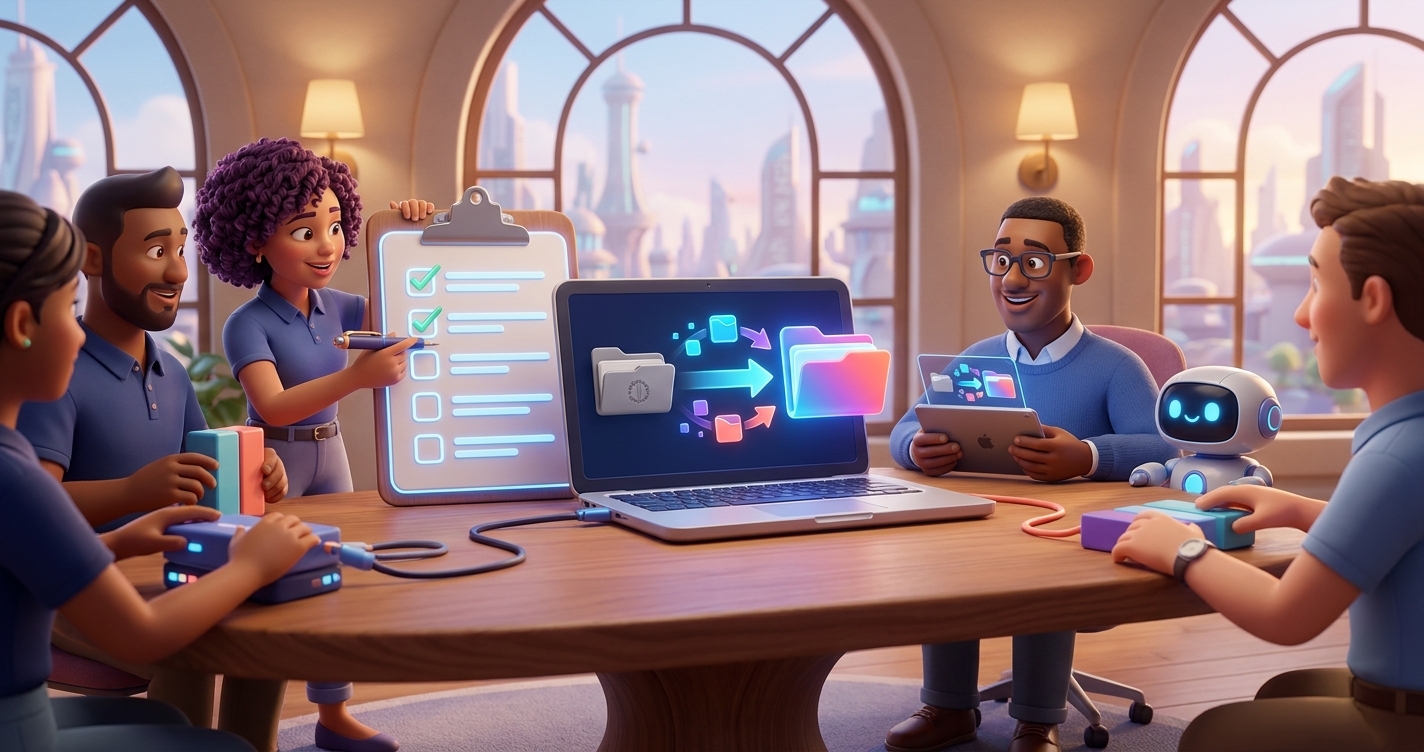
Planning a platform move? Use this comprehensive LMS migration checklist to audit data, map content, and ensure a smooth transition for your...