

.webp)

 Mathan Allington


1 min read
Culture as the Foundation of Business Success
 Mathan Allington
Culture is the foundation of business success because it shapes how decisions get made, how people treat each other, and whether strategy actually...

You measure workplace culture by tracking the gap between your stated organisational values and the daily behaviours of your people. In practice that means combining engagement surveys and stay interviews with behavioural data like turnover and internal mobility, then reviewing the results on a regular cycle rather than once a year.
Last reviewed July 2026.
Culture gets talked about as a feeling: the vibe when you walk into the office, the unwritten rules, how people treat each other under stress. Feelings are real, but they are not a strategy. For HR leaders and business owners, the job is turning those feelings into facts.
The common mistake is treating culture as a soft metric that cannot be justified to a board. In reality it drives your hardest numbers: turnover rates, customer satisfaction and your capacity to innovate all trace back to it. If you do not measure culture, you cannot manage it, and you will only learn it is broken when your best people resign.
In the Compono Culture, Engagement and Performance Model, culture is the soil in which the team grows. Measuring culture is a regular health check on that soil, because no amount of recruitment or training compensates for soil that has gone toxic.

Before sending a single survey, define what culture means for your organisation. There is no universal standard: what works for a fast-moving startup would suffocate a heritage law firm. What you are testing is alignment. Do the values on your website show up in your Monday morning meetings?
Work personality is a useful lens here. A team full of Pioneers builds a culture of risk-taking and new ideas; a team of Auditors builds one of precision and compliance. Neither is wrong. The measurement question is whether your collective behaviour suits the work you need to do. A business operating in a highly regulated market with a purely spontaneous culture has a measurable gap, whatever the engagement scores say.
For a full picture, measure three distinct things. Engagement tells you how much people care about their work. Alignment tells you whether they are rowing in the same direction. Behaviour tells you how they treat each other during the journey.
Surveys are the standard tool and the most commonly misused one. An annual survey is a single photo of a moving train; it says little about speed or destination. Pulse surveys and regular check-ins give you the moving picture. Compono Engage captures these signals in real time, so sentiment shifts are visible before they become systemic problems.
Then pair what people say with what they do. High turnover in one department is a cultural red flag. A steady stream of urgent after-hours email points to a culture of poor boundaries. Operational data keeps survey data honest.

A healthy culture is not one where everyone thinks alike; it is one where different perspectives get integrated. Mapping the work personality of your staff shows you the composition behind the culture. If everyone is a Doer, you likely execute well and strategise poorly. If your leadership bench is mostly Evaluators, people may experience the culture as overly critical, which lands directly on psychological safety.
Personality distribution explains the why behind survey results, and it upgrades the conversation. Instead of "our culture feels off", you can say "we are over-indexed on routine and need more creative energy to hit our innovation targets". Culture stops being a vague concept and becomes something you can design.
Data without action is noise. Once you have measured, share the results with the team, including the unflattering parts. Honesty about where the culture is failing builds trust faster than any values workshop, and it proves the exercise was not decorative.
Pick one or two areas to improve rather than overhauling everything at once. If communication is the weak point, start there, set benchmarks, and measure again in three months. Culture is a living thing and it responds to consistent tending, not annual grand gestures.
Compono Engage shows you the gap between stated values and daily behaviour, so you can fix causes instead of symptoms.
Talk to usRun monthly or quarterly pulse checks alongside a deeper annual review. Frequent, short measurements let you spot trends and act before issues turn into resignations.
Yes, and it matters even more there. Look at digital engagement, participation in virtual forums and targeted surveys that ask specifically about the remote experience.
No single number covers it, but employee Net Promoter Score (eNPS) and the alignment between personal values and company values are two of the strongest indicators of cultural health.
Anonymity is the key. People share their real views when there is no fear of retribution, and running the survey through an independent platform helps guarantee data is handled objectively and privately.
1 min read
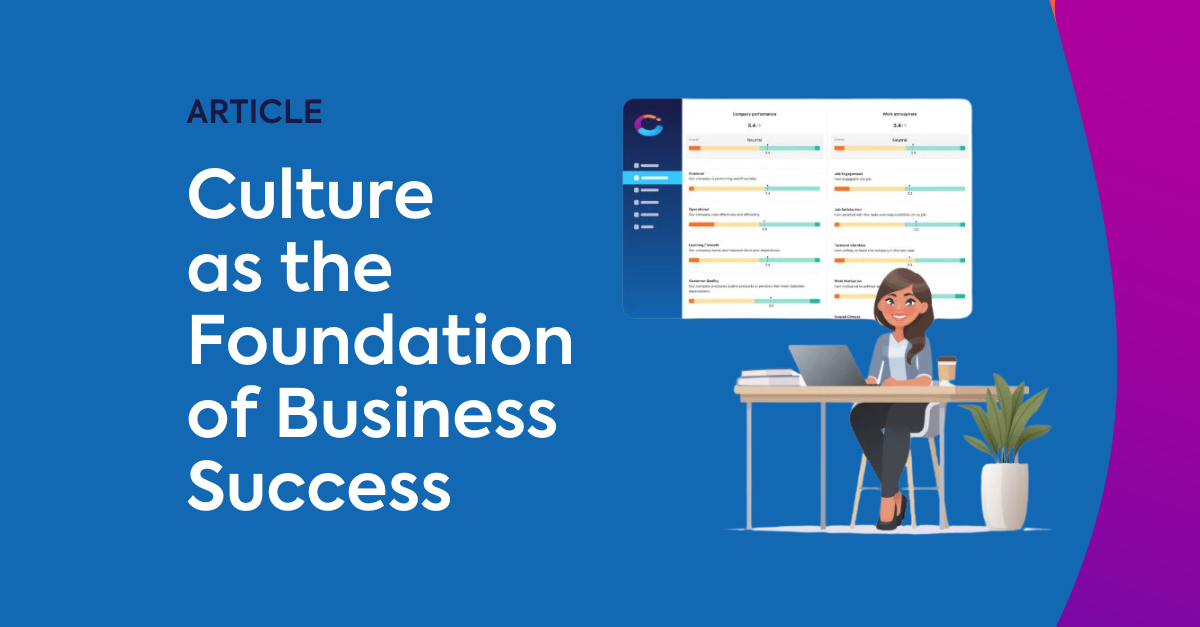
Culture is the foundation of business success because it shapes how decisions get made, how people treat each other, and whether strategy actually...

1 min read
The best employee engagement model is the one that connects engagement to outcomes you can measure. Four frameworks dominate the field: Gallup's Q12,...

1 min read
A culture alignment assessment works by measuring the psychological drivers and work preferences of a candidate against the established values and...
 Compono