

.webp)

 Compono


Why We Do Not Start With Proctoring
 Rudy Crous
Explore why proctoring isn't the primary solution for assessment integrity. Discover how investing in quality learning design enhances competence and...

A high stakes assessment platform is a secure digital environment designed to deliver tests where the outcomes significantly impact a person's career or public safety.
When you are testing for professional licensing or government certifications, the technology you use must guarantee identity verification, prevent cheating, and provide legally defensible results.
Key takeaways
- High stakes assessment platforms protect the integrity of exams that determine professional licensing and safety certifications.
- Active security measures like browser lockdowns are required to defend test results against scrutiny.
- Accessibility features must be built directly into the secure environment to ensure equitable testing for all candidates.
- The best platforms provide clear audit trails that track every interaction during the exam session.
- Advanced item analysis helps administrators track question performance and maintain test validity over time.
Running a standard learning quiz is relatively simple. Running an exam that decides if someone can legally drive a heavy vehicle or practice a regulated profession is a completely different challenge.
When the results of a test alter the course of a person's life, the margin for error disappears. A system crash during a major exam causes massive stress for the candidate. A security breach compromises the entire certification program.
If your testing environment lacks accessibility, you risk discriminating against capable candidates. Organisations handling these critical evaluations need technology built specifically for the pressure.
They need systems that treat every single question, answer, and user session as a highly secure transaction.
The stakes of an assessment are determined by the consequences of the result. If a failed test means a candidate must review a training module and try again tomorrow, the stakes are low.
If passing the test grants someone a licence to operate heavy machinery on public roads, the stakes are incredibly high. These scenarios require a testing environment that eliminates doubt from the process.
The organisation issuing the credential must be absolutely certain that the person taking the test is who they say they are. They must know the candidate completed the assessment without unauthorised help.
They also need proof that the test itself was fair and accurately measured the required competencies. This level of certainty requires specialised technology.
Standard learning management systems are rarely equipped to handle the strict security and auditing requirements of high-stakes testing.

Security in high-stakes testing involves active protection of the exam environment from the moment the candidate logs in until the final score is recorded. Identity verification is the first major hurdle.
The system needs to confirm the candidate's identity before granting access to the exam materials. Once the test begins, the environment must be locked down to prevent external interference.
Secure browsers prevent candidates from opening other tabs, taking screenshots, or accessing unauthorised applications during the exam. Behind the scenes, the platform should monitor the session for unusual activity.
This might include tracking how long a candidate spends on specific questions or detecting irregular navigation patterns. These security layers work together to ensure that the final score reflects the candidate's actual knowledge.
High stakes exams require large, well-managed question banks to prevent item overexposure. If the same fifty questions are used for every candidate, the answers will eventually leak.
A strong high stakes assessment platform allows administrators to organise thousands of questions and randomise how they are presented. The platform should also support advanced item types beyond basic multiple choice.
Candidates might need to interact with hotspots, sequence items, or complete drag-and-drop tasks to demonstrate their competence. Delivering these complex question types securely is a core function of the platform.
The system must also provide detailed item analysis after the exams are completed. Administrators need to know if a specific question is consistently confusing the highest-performing candidates, which might indicate a poorly written item rather than a knowledge gap.
Strict security measures cannot come at the expense of accessibility. A high stakes assessment platform must provide a fair testing experience for every candidate, regardless of their physical abilities.
This means the platform must comply with strict accessibility standards, such as the Web Content Accessibility Guidelines (WCAG). Screen readers and keyboard navigation need to work flawlessly within the secure testing environment.
If a candidate requires extra time due to a documented learning requirement, the system must handle that adjustment smoothly without flagging the session as suspicious. Fairness also extends to the technical reliability of the platform.
A candidate in a rural area with a slower internet connection should have the same stable testing experience as someone in a major city. The platform must handle connectivity drops gracefully by saving progress and allowing the candidate to resume without losing their work.
Many organisations need to test thousands of candidates simultaneously. When a large cohort logs in for a scheduled exam at the exact same time, the platform must handle the load without lagging or crashing.
Performance issues during a high-stakes exam create an unacceptable level of anxiety for candidates. The infrastructure supporting the platform must be designed for high concurrency.
Scaling also involves managing different geographical requirements. A national certification body might need to deliver exams across multiple time zones with slightly different regulatory requirements for each region.
The platform should allow administrators to set specific rules, time limits, and passing scores based on the candidate's location or specific certification path.
When a candidate fails a high-stakes exam, they might challenge the result. Your organisation needs the ability to defend that outcome with concrete, verifiable evidence.
A strong platform maintains a comprehensive audit trail for every testing session. This log should capture every interaction, from the exact time a question was answered to any system warnings triggered during the exam.
If a result is questioned, administrators can review the session data to verify that the test was administered fairly. This is where purpose-built solutions prove their value in the market.
For example, delivering a driver knowledge test online requires a system that can securely process thousands of daily attempts without fail. When you can trust the integrity of your data, you can confidently issue credentials that hold real weight.
High-stakes exams are inherently stressful for the people taking them. The technology delivering the test should not add to that anxiety.
The candidate interface must be clean and entirely focused on the assessment. Candidates should know exactly how to navigate between questions, flag items for review, and submit their final answers.
Clear instructions and a straightforward layout help candidates focus on demonstrating their knowledge rather than fighting with the software. Administrators need an equally smooth experience to run the program effectively.
Setting up complex exam rules, managing question banks, and reviewing flagged sessions should be straightforward tasks. When the administrative backend is well-designed, your team can spend less time managing the software and more time improving the assessment program.
This purpose-driven evolution in testing technology allows organisations to focus on outcomes rather than administrative overhead.
Key insights
- High stakes assessment platforms are essential for exams that carry significant professional or legal consequences.
- Identity verification and secure testing environments are required to protect the integrity of the credential.
- Accessibility features must be built directly into the secure environment to ensure equitable opportunities for all candidates.
- Comprehensive audit trails provide the evidence needed to defend test results against legal challenges.
- Advanced question banks and item analysis allow administrators to maintain test validity over time.
- A clear user interface reduces candidate anxiety and allows them to focus entirely on the exam content.
Delivering secure and legally defensible exams requires technology built specifically for the pressure of high-stakes testing.
It is a specialised digital testing environment designed for exams that have major consequences, such as professional licensing or safety certifications. These platforms prioritise strict security, identity verification, and data integrity.
They use a combination of secure browsers that lock down the candidate's device and behavioural monitoring to ensure the test taker cannot access unauthorised materials. Identity verification checks also confirm the correct person is taking the exam.
Yes. The best platforms are built to comply with accessibility standards like WCAG. They support screen readers and keyboard navigation while maintaining the strict security required for the exam.
An audit trail records every action taken during the exam session. If a candidate challenges a failing grade, the audit trail provides the concrete evidence needed to defend the result and maintain the credential's integrity.
While a standard learning management system is great for training and low-stakes quizzes, it usually lacks the rigorous security and detailed forensic auditing required to deliver legally defensible exams.
A reliable platform will handle connectivity drops gracefully by saving the candidate's progress locally or freezing the timer. Once the connection is restored, the candidate can resume the exam exactly where they left off without losing their work.

Explore why proctoring isn't the primary solution for assessment integrity. Discover how investing in quality learning design enhances competence and...
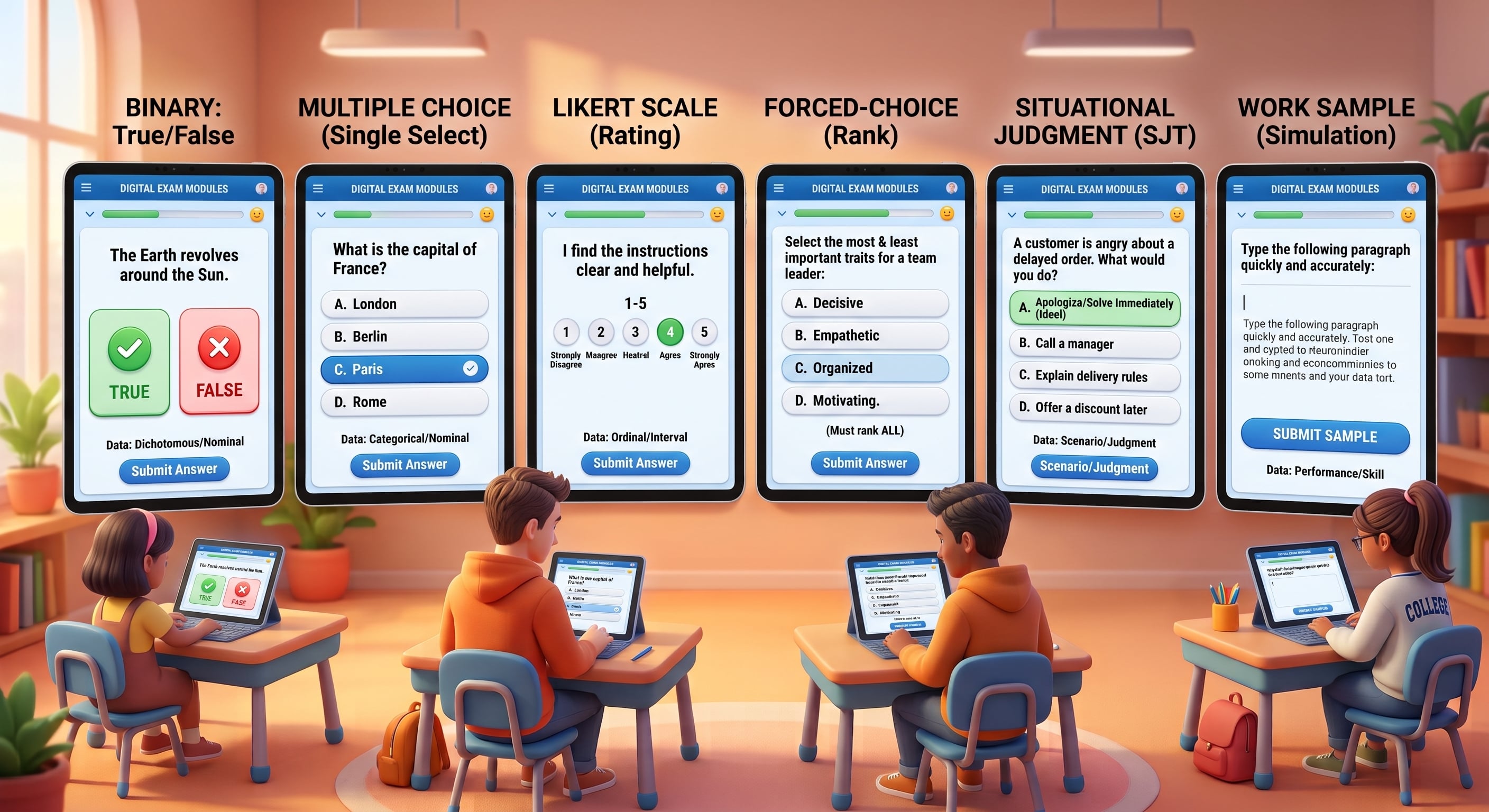
Discover how to choose the right question type for assessments to ensure valid decision-making and effective measurement of skills and attitudes.

Ensure your assessments challenge understanding, not comprehension. Learn how to manage cognitive load for effective and fair evaluation design.