

.webp)

 Compono


Who needs proficiency levels for team success
 Mathan Allington
What proficiency levels are, how they sit inside a competency framework, and when a growing team needs them to hire and promote fairly.

Logistics organisations need proficiency levels because they provide a standardised framework to measure technical skill, safety compliance, and operational maturity across a high-stakes workforce.
By defining exactly what 'competent' looks like for every role – from warehouse floor to fleet management – you can eliminate the guesswork that leads to costly supply chain bottlenecks and safety incidents. This systematic approach ensures that every team member is not just present, but capable of performing their specific duties to the required standard, which is the bedrock of any scalable distribution network.
Key takeaways
- Proficiency levels establish a clear 'source of truth' for skill standards, reducing operational errors and safety risks.
- They enable targeted training by identifying exact skill gaps rather than relying on generic, one-size-fits-all professional development.
- Standardised levels support internal mobility and succession planning by showing employees exactly how to progress to the next stage of their career.
- Implementing these levels allows leadership to make data-driven decisions about workforce readiness and resource allocation.
In the modern logistics landscape, relying on years of experience as a proxy for actual skill is a risky strategy. We often see organisations assume that a decade in the industry automatically translates to mastery of modern inventory systems or safety protocols. However, without defined proficiency levels, you have no way to verify if a team member is truly an expert or simply someone who has repeated the same basic mistakes for ten years. This lack of clarity often results in 'skill drift', where different shifts or sites develop their own – sometimes unsafe – ways of working.
When you lack a structured framework, performance reviews become subjective and training budgets are often wasted on people who already possess the skills being taught. For a mid-market logistics firm, this inefficiency isn't just a nuisance; it's a drain on the bottom line. You might find that your 'senior' operators are struggling with new digital freight platforms simply because their proficiency was never formally assessed against modern requirements. This disconnect creates a fragile workforce that struggles to adapt when market conditions shift or new technologies are introduced.
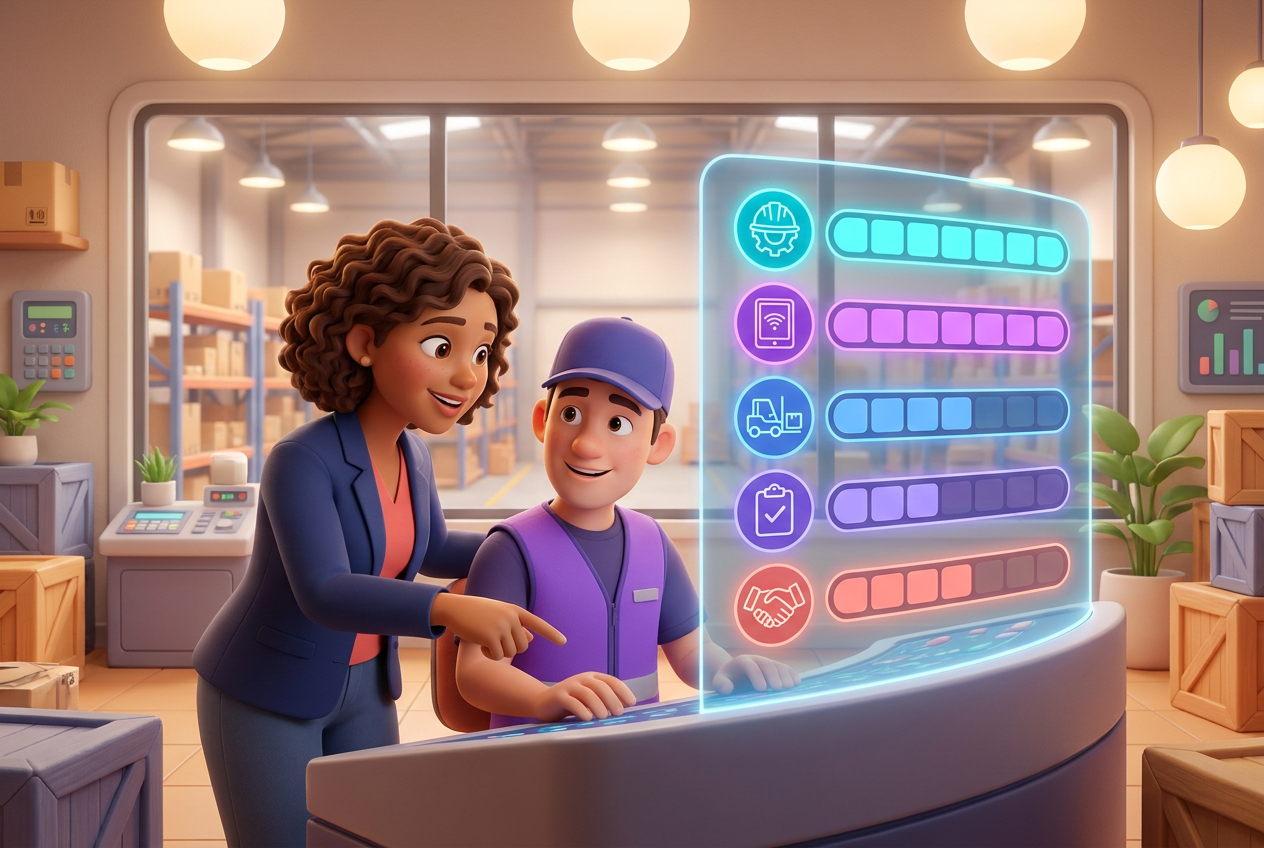
To solve this, we must move beyond binary 'can do/can't do' checklists. Logistics proficiency levels typically follow a four or five-tier structure that moves from foundational knowledge to strategic mastery. At the base level, an employee might be 'Aware' – they understand the concept but require constant supervision. As they move to 'Practitioner' or 'Competent', they can perform tasks independently. The goal for your key personnel is often 'Expert' or 'Lead' level, where they not only perform the task perfectly but can also troubleshoot complex issues and mentor others in the process.
By mapping these tiers to specific work actions, you create a common language for the entire organisation. For example, a forklift operator's proficiency isn't just about driving; it includes their ability to perform pre-start checks, manage hazardous materials, and use warehouse management software. When these are broken down into levels, a manager can see that an operator is a Level 4 in driving but only a Level 2 in software usage. This granular insight allows for surgical precision in workforce development, ensuring that support is provided exactly where it is needed most.
Safety in logistics is often treated as a compliance checkbox, but true safety is a byproduct of high proficiency. When employees are operating at a 'Mastery' level, they aren't just following rules; they have an intuitive understanding of the risks inherent in their environment. Proficiency levels allow you to set 'minimum safe standards' for high-risk activities. If a role involves managing dangerous goods, you can mandate that no one below a Level 3 proficiency is allowed to lead that process, significantly reducing the likelihood of incidents caused by simple incompetence.
This is where Compono Assure becomes a vital tool for logistics leaders. By moving from simple certification tracking to a purpose-driven model of evidence-based competence, you can verify that your team actually possesses the skills they claim to have. It’s about moving from 'they have a licence' to 'they have demonstrated the proficiency to lead this shift safely'. This shift in perspective transforms safety from a reactive cost centre into a proactive foundation for business success, protecting both your people and your reputation.
One of the biggest headaches in logistics is the 'war for talent' and high turnover rates. When you don't have clear proficiency levels, your best people often feel stagnant because they can't see a clear path to promotion. By defining what is required to move from a Level 2 Warehouse Hand to a Level 4 Shift Supervisor, you give your ambitious employees a roadmap for growth. This transparency builds trust and significantly improves retention, as people are more likely to stay with a company that invests in their career progression in a visible, measurable way.
From a leadership perspective, these levels allow you to conduct a 'gap analysis' of your entire workforce. You might discover that while your current operations are stable, you lack the Level 5 'Strategic' proficiency required to open a new distribution centre in a different state. This data allows you to hire for specific gaps or fast-track internal candidates through Compono Develop, which can provide the targeted learning required to bridge those exact proficiency divides. Instead of hiring a generic manager, you are building a talent pipeline that is perfectly aligned with your long-term business goals.
It is also essential to recognise that some people are naturally predisposed to reaching high proficiency in certain areas faster than others. For instance, someone with the The Auditor work personality is likely to reach Level 5 proficiency in quality control and compliance tasks much faster than someone who thrives on spontaneity. Conversely, Pioneers might reach high proficiency in process innovation but struggle to maintain Level 5 standards in repetitive, detail-heavy administrative tasks.
Understanding these natural leanings helps you place the right people in the right roles. When you align a person's natural work personality with the proficiency requirements of a role, you reduce the friction of learning and increase the speed to competency. At Compono, we’ve spent over a decade researching how these behavioural traits influence team performance. By combining personality insights with clear proficiency levels, you aren't just filling seats – you are architecting a high-performing team where every member is operating in their 'zone of genius'.
Key insights
- Proficiency levels eliminate the subjectivity of 'experience' and replace it with measurable evidence of skill.
- A tiered framework allows logistics firms to deploy staff based on actual competence, reducing safety risks and operational bottlenecks.
- Internal mobility is vastly improved when employees have a transparent roadmap of the skills required for their next promotion.
- Data-driven proficiency mapping enables leaders to identify 'hidden' gaps in the workforce before they become critical failures.
- Aligning natural work personality with proficiency requirements accelerates the time it takes for new hires to become fully productive.
Where to from here? Building a high-performing logistics team starts with knowing exactly what skills you have on the floor today. By implementing proficiency levels, you move from managing by 'gut feel' to leading with workforce intelligence.
p>
Start by identifying the 3–5 most critical work actions for each role. Instead of a long list of skills, focus on the outcomes that drive your business, then define what 'Basic', 'Intermediate', and 'Advanced' performance looks like for those specific actions.
Not if you frame it as a career development tool. When you explain that proficiency levels are the key to fair promotions and targeted training, most high-performers welcome the chance to have their expertise formally recognised and rewarded.
We recommend a formal review at least once a year, or whenever significant new technology or processes are introduced. However, 'micro-assessments' or check-ins can happen quarterly to ensure that skills aren't drifting and that new staff are progressing toward their targets.
While every insurer is different, many look favourably on organisations that can prove they have a rigorous, evidence-based system for managing staff competence and safety. It demonstrates a proactive approach to risk management that goes far beyond standard compliance.
A skill is the ability to do something (e.g., 'driving a truck'). A proficiency level describes how well you do it (e.g., 'can drive a truck in heavy traffic, at night, and mentor new drivers on fuel-efficient techniques'). Proficiency adds the necessary context of quality and complexity.
If you'd like to talk through how Compono can support your team, we're happy to walk you through it. No pressure, just a conversation.

What proficiency levels are, how they sit inside a competency framework, and when a growing team needs them to hire and promote fairly.

How defined proficiency levels help a council plan its workforce, build succession depth and hold one standard across very different roles.

How proficiency levels work inside an aged care competency framework, and how clear levels support clinical safety, retention and audits.
 Compono