
.webp?width=559&height=292&name=2026.07.21%20Fireside%20KV%20-%201200x627%20(event%20featured).webp)
.png?width=383&height=200&name=team%20(1).png)
 Compono

Finding the right onboarding software in Australia is the difference between a new hire hitting the ground running and them getting lost in a maze of PDFs, policy documents, and compliance forms.
Key takeaways
- Australian businesses require specialised onboarding software to handle local compliance, including ATO declarations, superannuation choice forms, and Fair Work Information Statements.
- Manual onboarding processes are significantly delaying time-to-productivity, costing organisations thousands of dollars per new hire in lost output.
- The best onboarding platforms automate administrative heavy lifting, allowing HR teams and managers to focus on culture, engagement, and team integration.
- Integrating behavioural science and work personality insights into your onboarding journey dramatically improves long-term employee retention.
- Modern onboarding is a 90-day continuous process, not a one-day event, requiring software that supports ongoing check-ins and milestone tracking.
The state of employee onboarding in the modern Australian workplace
The landscape of talent acquisition and retention has shifted dramatically, and the onboarding phase has become the critical bridge between a successful hire and a productive employee. Unfortunately, many organisations are still treating this vital transition as a purely administrative checklist. They focus heavily on getting the contract signed, only to leave the new starter languishing in a sea of generic welcome emails and confusing IT setup requests.
This administrative bottleneck has severe consequences for business performance. According to recent industry data, new hires in Australia now take 29% longer to reach productivity compared to prior years, requiring an extra 44 days to become fully productive. That is a staggering amount of time where an employee is on the payroll but not yet contributing at their full capacity. When you multiply that delay across dozens or hundreds of new hires a year, the financial impact is enormous.
Furthermore, the expectation from candidates has never been higher. In a competitive talent market, the onboarding experience is the first real test of your employer brand. If the process is clunky, manual, and disconnected, new starters immediately question their decision to join your organisation. It is no surprise that only 12% of employees strongly agree their organisation does a great job onboarding new hires, with the gap attributed primarily to workflow issues rather than a lack of intent from HR teams.
To combat this, forward-thinking businesses are turning to dedicated HR technology. The Australia client onboarding tool market was valued at approximately AUD 500 million in 2023, with a projected compound annual growth rate of around 12% through 2028. This rapid growth underscores a universal realisation – manual onboarding is no longer sustainable for any business looking to scale efficiently.
Why Australian compliance demands localised onboarding software
When evaluating onboarding software in Australia, global solutions often fall short because they are not built to handle our unique regulatory environment. Onboarding an employee in Sydney or Melbourne is fundamentally different to onboarding someone in New York or London. The administrative burden placed on Australian employers is heavy, and failing to meet compliance standards can result in severe financial penalties from regulatory bodies.
A robust Australian onboarding platform must seamlessly manage the collection of Tax File Number (TFN) declarations and Superannuation Standard Choice forms. It must also ensure that the correct, up-to-date Fair Work Information Statement – and where applicable, the Casual Employment Information Statement – is provided and acknowledged by the new hire. Attempting to manage these mandatory documents via email attachments and physical filing cabinets is a recipe for compliance breaches and lost data.
Beyond federal requirements, there are often state-specific or industry-specific compliance hurdles. Whether it is verifying Working with Children Checks, handling specific industry licences, or managing visa and right-to-work checks, your software needs to act as an impenetrable compliance safety net. The best platforms automatically flag missing documents and send gentle nudges to the new starter, entirely removing the HR team from the role of the nagging administrator.
By localising your tech stack, you ensure that every new employee's file is perfectly compliant before they even step foot in the office or log on for their first remote shift. This peace of mind allows HR leaders to sleep soundly, knowing that their digital paperwork is watertight and securely stored in accordance with Australian privacy laws.
The hidden costs of manual onboarding processes
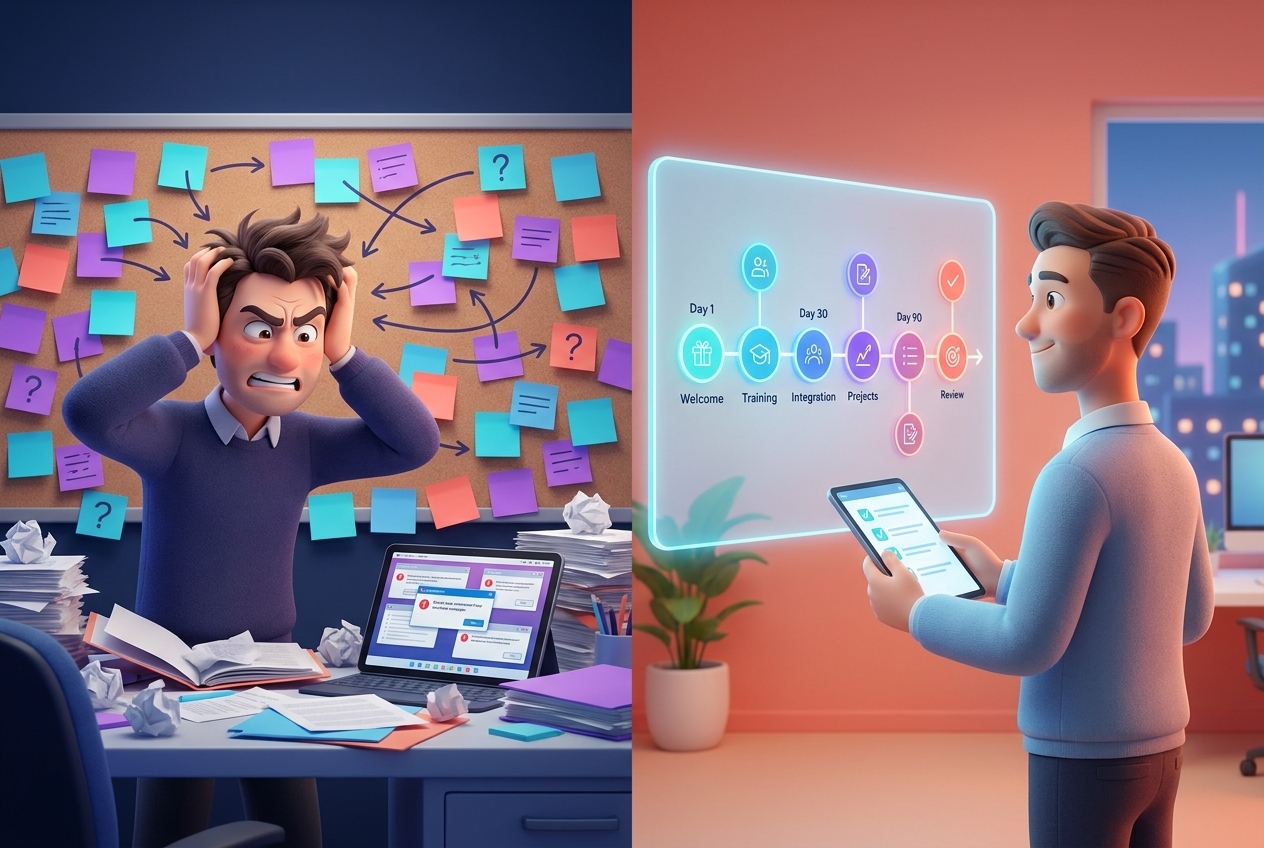
Many businesses vastly underestimate the true cost of a manual onboarding process. They look at the price tag of onboarding software and compare it to the "free" cost of using spreadsheets and email. However, this calculation ignores the massive hidden costs associated with administrative friction, delayed productivity, and early employee turnover.
Consider the hours spent by your HR team, hiring managers, and IT department manually setting up a single employee. Drafting contracts, sending emails, chasing signatures, creating system accounts, and organising desk space takes an average of 10 to 15 hours of collective administrative time per hire. When you automate these workflows, you instantly claw back those hours, allowing your team to focus on strategic initiatives rather than data entry.
The most significant hidden cost, however, is new hire churn. When an employee has a disjointed, frustrating first week, their engagement plummets. They feel unsupported and disconnected from the company culture, which often leads to them resigning within the first six months. If you are struggling with early attrition, understanding why new hires fail is the first step – and the data almost always points back to a flawed onboarding experience.
Conversely, the return on investment for getting this right is monumental. Research shows that organisations with strong onboarding improve new hire retention by 82% and boost productivity by over 70%. When you view onboarding software not as an IT expense, but as a retention and productivity tool, the business case becomes undeniable.
Core features to look for in onboarding software in Australia
With the market flooded with various HR tools, identifying the right onboarding software in Australia requires a keen understanding of which features actually move the needle. A shiny user interface is nice, but if the platform lacks deep functionality, you will end up creating more work for your team. The foundational feature you must insist on is a seamless, paperless workflow.
Your chosen platform should offer native digital signatures and dynamic contract generation. When a candidate accepts a verbal offer, the software should automatically pull their details from your Applicant Tracking System (ATS) to generate a bespoke employment contract. The candidate should be able to review and sign this document on their mobile phone while sitting on the train, creating a frictionless transition from candidate to employee.
Another critical feature is robust task management and cross-departmental automation. Onboarding is a team sport – HR handles compliance, IT handles hardware and access, and the direct manager handles training and team introductions. The best software acts as a central command centre, automatically dispatching tasks to the relevant departments the moment a contract is signed, ensuring no one drops the ball before day one.
Finally, look for a platform that offers a dedicated new starter portal. This is a secure digital space where the incoming employee can read up on company history, watch welcome videos from the leadership team, and review the employee handbook. By providing this information before their start date, you alleviate first-day anxiety and help them feel like part of the team before they even arrive.
The 90-day onboarding roadmap: Moving beyond day one
A common mistake Australian businesses make is treating onboarding as an event that concludes at 5:00 PM on the employee's first Friday. In reality, effective onboarding is a comprehensive journey that spans the first 90 days of employment. Your onboarding software must support this extended timeline, shifting its focus from compliance to performance and cultural integration.
During the first 30 days, the software should facilitate regular check-ins between the new hire and their manager. These shouldn't just be casual chats; they should be structured conversations guided by templates within the platform, ensuring the employee has the tools, clarity, and support they need. Automated pulse surveys can also be deployed during this period to catch any early signs of disengagement or confusion.
As the employee moves into days 30 to 60, the focus shifts to deeper training and goal setting. The onboarding platform should seamlessly integrate with your Learning Management System (LMS) to track the completion of role-specific training modules. This is also the time to establish clear, measurable performance objectives, transitioning the employee from a state of learning to a state of doing.
By the 90-day mark, the onboarding software should facilitate a comprehensive probationary review. Because all check-ins, training completions, and feedback have been tracked within the system since day one, managers have a wealth of data to draw upon. This ensures the 90-day review is an evidence-based conversation about long-term success, rather than a frantic attempt to remember what happened over the last three months.
Integrating behavioural science into the new starter experience
The most advanced onboarding strategies in 2026 are moving beyond simple task management and venturing into the realm of behavioural science. Every new hire brings a unique work personality to your team – some are analytical "Evaluators" who crave structure and detail, while others are creative "Campaigners" who thrive on social interaction and big-picture thinking. Treating them all to the exact same onboarding experience is a missed opportunity.
When you use an intelligent recruitment platform like Compono Hire, you gather invaluable data about a candidate's natural work preferences, skills, and organisational fit during the hiring phase. This data shouldn't sit in a drawer once the contract is signed; it should actively inform how you onboard them. A manager armed with this behavioural insight can tailor their communication style and training approach from day one.
For example, if the software highlights that a new starter is highly detail-oriented and cautious, the manager knows to provide comprehensive documentation and allow them quiet time to process new systems. Conversely, if the new hire is highly collaborative and action-oriented, the manager can prioritise team introductions and hands-on shadowing. This personalised approach accelerates psychological safety and trust.
By bridging the gap between talent acquisition and employee integration, you create a cohesive journey that feels intentional and deeply supportive. When employees feel understood by their managers from their very first week, their engagement skyrockets, and the risk of early attrition is drastically minimised.
Overcoming implementation hurdles and driving adoption
Even the best onboarding software in Australia will fail to deliver a return on investment if your team refuses to use it. Implementation is often where grand HR technology strategies stumble. To ensure success, you must approach the rollout as a change management exercise, not just an IT project. Communication and training are paramount.
Start by identifying your internal champions – usually a mix of HR professionals and highly engaged line managers. Bring them into the testing phase early, allowing them to poke holes in the workflows and provide feedback. When the broader business sees respected peers advocating for the new system, resistance to change naturally diminishes. You must clearly articulate "what's in it for them" – specifically, how the software will save them time and eliminate administrative headaches.
It is also crucial to map out your existing processes before digitising them. Simply moving a broken, convoluted manual process into a digital platform will just give you a faster broken process. Take the opportunity to audit your current onboarding journey, stripping away unnecessary approvals and redundant forms. Cleanse your processes first, and then configure the software to support this new, streamlined reality.
Finally, remember that implementation is not a "set and forget" activity. Gather feedback from your first few cohorts of new starters who pass through the platform. Ask them what was confusing, what was helpful, and what was missing. Continuous iteration based on real user feedback ensures your onboarding software remains a powerful asset rather than a stagnant digital filing cabinet.
Key insights
- Replacing manual onboarding with specialised software reclaims up to 15 hours of administrative time per new hire, allowing HR to focus on strategic initiatives.
- Australian compliance is complex, making it essential to choose a platform that natively handles TFN declarations, super choice, and Fair Work requirements.
- A strong onboarding process extends well beyond the first week, requiring a structured 90-day roadmap of check-ins, training, and goal setting.
- Personalising the onboarding experience based on a new hire's unique work personality and behavioural traits significantly accelerates their time to productivity.
- Successful software implementation requires mapping and refining your processes before digitisation, ensuring you aren't just automating broken workflows.
Where to from here?
Ready to transform your new starter experience from a pile of paperwork into a seamless, engaging journey that accelerates productivity?
- Explore the Compono platform: Platform / Business Platform
Frequently asked questions
What exactly does onboarding software do?
Onboarding software digitises and automates the entire process of bringing a new employee into your business. It handles everything from generating digital employment contracts and collecting compliance forms, to assigning IT setup tasks and delivering welcome content to the new starter before their first day.
Why do Australian businesses need specific onboarding tools instead of global ones?
Australia has highly specific employment regulations managed by the ATO and Fair Work. Localised onboarding software is pre-configured to handle mandatory Australian forms like TFN declarations, Superannuation Standard Choice forms, and the delivery of Fair Work Information Statements, ensuring you remain strictly compliant with local laws.
How does onboarding software actually improve employee retention?
A structured, digital onboarding process removes the administrative chaos of a new hire's first week. By providing a smooth, professional experience and freeing up managers to focus on human connection and training, new employees feel valued and supported, which directly reduces the likelihood of them leaving in their first six months.
Can onboarding software integrate with my existing payroll system?
Yes, the best onboarding platforms in Australia feature seamless integrations with major payroll and HRIS systems. Once a new hire completes their digital paperwork, their bank details, tax information, and personal data are automatically pushed into your payroll system, eliminating double data entry and reducing the risk of human error.
How long should a proper onboarding process last?
While the administrative paperwork might be completed before day one, a true onboarding journey should last at least 90 days. This allows enough time for structured check-ins, role-specific training, cultural integration, and a comprehensive probationary review, ensuring the employee is fully supported as they reach full productivity.
Where to from here?
If you'd like to talk through how Compono can support your team, we're happy to walk you through it. No pressure, just a conversation.

