

.png?width=383&height=200&name=team%20(1).png)
 Compono


1 min read
Predicting team dynamics for higher performance
 Compono
Team dynamics prediction is the process of using behavioural data and work personality insights to forecast how individuals will interact,...
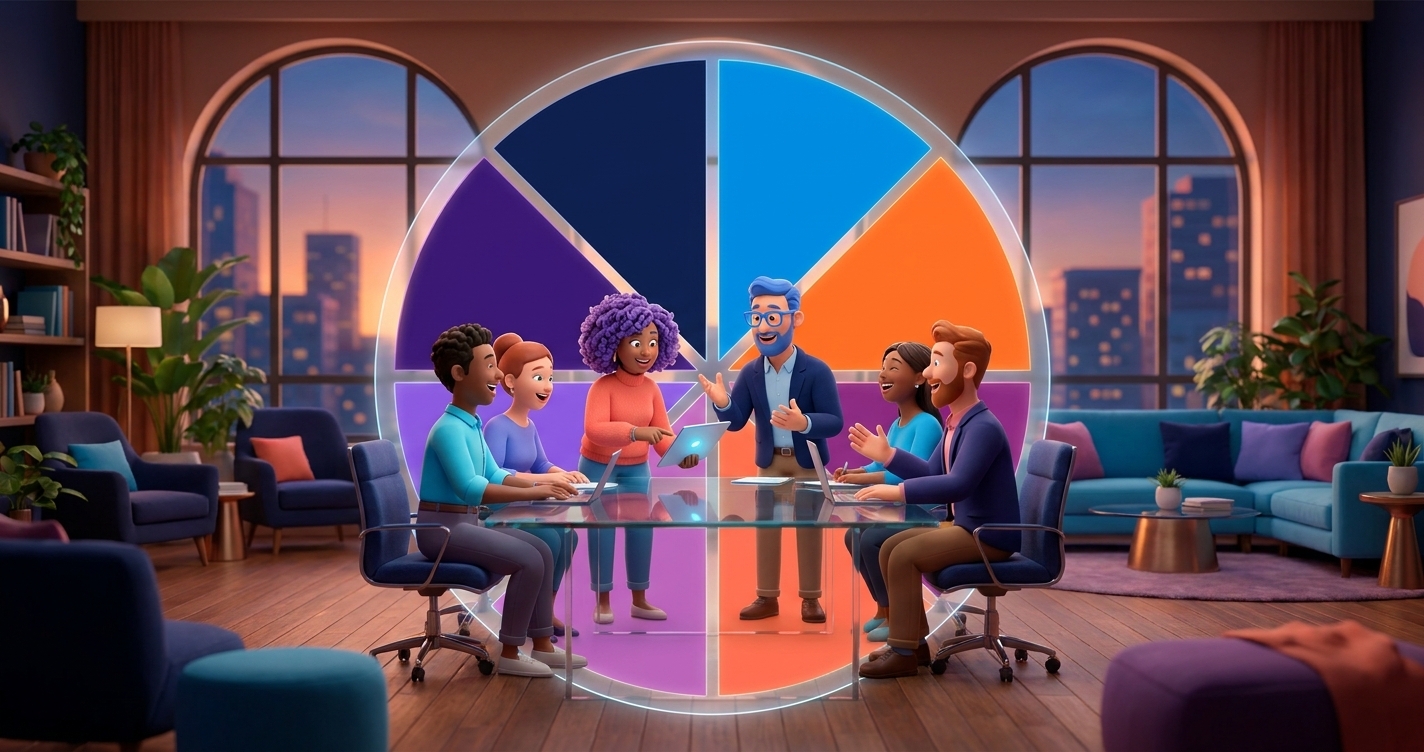
No, having an exact balance of all 8 work personalities is not strictly necessary for mid-market companies, but understanding which of the eight profiles currently dominate your workforce is critical for scaling without breaking your culture.
Key takeaways
- Mid-market companies do not need an equal distribution of all eight work personalities to succeed.
- Success depends on matching the right behavioural profiles to specific departmental goals and company growth stages.
- Personality monocultures create dangerous blind spots that can stall innovation or derail execution.
- Mapping your team's natural preferences helps predict conflict and improve cross-functional collaboration.
When a business grows past the startup phase and enters the mid-market space, the rules of team dynamics change entirely. You are no longer relying on a handful of generalists who wear every hat to keep the lights on. You need specialised departments, predictable performance and leaders who can manage increasingly complex interpersonal dynamics.
This is usually the point where HR and business leaders start looking closely at behavioural frameworks. When evaluating these models, a common question arises: is 8 work personalities necessary for mid-market companies, or is that level of detail reserved for enterprise organisations with thousands of staff?
The answer lies in how you view team design. You do not need to collect all eight profiles like a matching set. You do need to ensure your business has access to the specific work activities required to execute your current strategy.

To understand what your team needs, you first have to understand what you are measuring. At Compono, our research maps the natural work preferences of individuals into a work personality framework. This model identifies eight distinct profiles that drive high-performing teams.
Each profile represents a different way of approaching tasks, solving problems and interacting with colleagues. Here is how they break down:
If you have a company of 150 people, aiming for roughly 18 people in each of the eight categories is a mistake. Different departments require different dominant traits to function effectively.
Consider a high-performing finance department. You want this team heavily weighted toward Auditors and Evaluators. You need people who care deeply about precision, compliance and logical risk assessment. If your finance team is full of Pioneers and Campaigners, your ledgers will be highly creative – which is a major problem for any mid-market business.
Conversely, a marketing or product development team needs those Pioneers to generate fresh ideas and Campaigners to build enthusiasm for new launches. Forcing a perfectly even distribution across every team ignores the reality of what different roles actually demand.
The goal is functional balance. The organisation as a whole needs representation from all eight profiles to ensure all necessary work activities happen. If your entire company lacks Coordinators, you will have plenty of great ideas and energetic staff, but projects will constantly miss deadlines.
Mid-market companies are particularly vulnerable to personality monocultures. This happens when leaders unconsciously hire people who think and act exactly like they do. It feels highly efficient at first because everyone agrees quickly and friction is low.
Imagine a leadership team composed entirely of Doers and Coordinators. They are exceptional at executing plans and hitting quarterly targets. They run a tight ship. Over time, they will likely miss major market shifts because they lack the Pioneer's forward-looking imagination or the Advisor's willingness to investigate alternative approaches.
Monocultures create massive organisational blind spots. When a team is too similar, they share the same weaknesses. A team of Helpers will build a wonderfully supportive culture but might completely avoid the difficult conversations required to address poor performance.
Mapping your team's behavioural traits makes these blind spots visible. Once you know what you are missing, you can make deliberate choices about how to structure projects or who to hire next.
Understanding your current team composition changes how you approach recruitment. Instead of relying on gut feeling or generic culture fit, you can hire for culture add. You can specifically look for the behavioural traits your team is currently missing.
This is where behavioural science integrates with modern recruitment technology. The Compono Hire platform assesses candidates across three dimensions: organisation fit, skills and qualifications. By understanding a candidate's natural work preferences before the interview stage, you can see exactly how they will shift your team's dynamic.
If you know your operations team is struggling to adapt to new software, you might realise they are heavy on Doers who prefer established routines. Your next hire shouldn't be another Doer. You need a Coordinator to build the new processes or a Pioneer to help the team embrace a different way of working.
When you successfully build a diverse team representing multiple work personalities, you introduce a new challenge: friction. People with different dominant traits naturally approach problems from opposing angles.
An Evaluator wants to pause and analyse the data logically. A Campaigner wants to move fast and ride the wave of enthusiasm. Without a shared language to understand these differences, this dynamic quickly turns into personal frustration. The Evaluator views the Campaigner as reckless. The Campaigner views the Evaluator as a roadblock.
When you give your team the vocabulary of work personalities, you reframe this conflict. It stops being a personal failing and becomes a recognised difference in working style. The Campaigner learns to provide data to satisfy the Evaluator. The Evaluator learns to deliver feedback without crushing the Campaigner's momentum.
This shared understanding is highly valuable for mid-market companies. It reduces interpersonal friction and allows managers to adapt their leadership style based on who they are coaching.
Key insights
- Mid-market companies should pursue functional balance rather than an equal mathematical split of the eight work personalities.
- Departmental goals should dictate which behavioural profiles are most necessary for specific teams.
- Hiring people who think exactly like you creates personality monocultures that leave the business vulnerable to blind spots.
- Providing teams with a shared behavioural vocabulary turns personal frustrations into productive, managed friction.
Ready to map your team's behavioural strengths and find out exactly what you are missing?
When a team lacks a specific work personality, the activities associated with that profile tend to be neglected. For example, a team without an Auditor will likely struggle with quality control and detail accuracy. Managers must either step in to fill the gap themselves or consciously assign those tasks to team members who can adapt, even if it isn't their natural preference.
While core personality traits are relatively stable, an individual's work personality can shift slightly based on their environment, the demands of their role and their professional development. However, people generally have a dominant default preference they return to when under pressure or when allowed to work naturally.
Modern assessments are designed to be highly efficient. The assessment process typically takes an individual just a few minutes to complete online. Once the team has completed their profiles, managers get immediate access to the aggregated data and team insights.
Absolutely not. Work personality data should be used for development, communication and future hiring decisions – never as a punitive tool. If someone's profile doesn't match their role perfectly, it provides a coaching opportunity to help them adapt or highlights a need to adjust their responsibilities to better suit their strengths.
You need both. Skills and qualifications tell you if a candidate can do the job technically. Work personality tells you how they will go about doing it and how they will interact with your existing team. Evaluating both gives you a complete picture of a candidate's potential for long-term success.

1 min read
Team dynamics prediction is the process of using behavioural data and work personality insights to forecast how individuals will interact,...

1 min read
The Coordinator work personality is important for HR because these individuals provide the structural backbone of high-performing teams, ensuring...

1 min read
A work personality test for Sydney businesses is the most effective method to align natural employee behaviours with the specific demands of a highly...