

.webp)

Compono vs DISC
DISC isn't a company. It's a four-style behavioural framework from 1928 that dozens of publishers have turned into competing assessments, from Wiley's Everything DiSC and Thomas International's PPA down to free online quizzes. Compono measures work personality: a different construct, built for a different job. Here's the honest breakdown.
Last reviewed July 2026 · All comparisons
Workplace personality tools are popular for good reason. The well-known ones are accessible, quick to run, easy to interpret and genuinely useful for self-awareness. Their limits are just as consistent. Most read the individual in isolation, through general personality rather than behaviour at work, and say nothing about the team around them. Trait-based instruments go deeper and can be highly valid, but they're complex to interpret and usually need certification: a big jackhammer for a small problem. What matters is whether the instrument was built for work, and whether it can see the team as well as the person.
The full picture: Assessments vs video interviewing
The short answer
Choose Compono if you want
- Work personality measured for the work context, normed on real working data
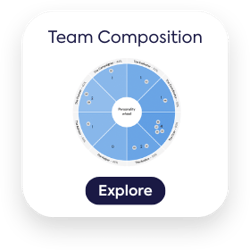
- A team-level read: how the mix covers the eight ways work gets done, not one person's style in isolation
- Assessment connected to hiring, culture and development decisions in one platform
Choose a DISC assessment if you want
- A cheap, fast, familiar shared language for communication-style workshops
- A mature facilitator ecosystem, with certification and ready-made training kits
- A tool most of your team has probably met before
Side by side
| Compono | DISC | |
|---|---|---|
| What it is | ✓One validated work-personality assessment inside a talent intelligence platform | A public-domain framework with many competing publishers; quality varies widely from BPS-registered instruments to free clones |
| What's measured | ✓Work personality: 8 validated types (Doer, Auditor, Helper, Advisor, Pioneer, Campaigner, Evaluator, Coordinator) plus organisation and culture fit | Self-reported behavioural style across four factors (Dominance, Influence, Steadiness, Conscientiousness) |
| Team view | ✓Team work-personality mix read against what the role and culture need | Individual dots overlaid on a quadrant map; no team-level construct |
| Use in hiring | ✓Built for hiring from the start: every candidate matched to the role and your measured culture, with instruments validated for selection decisions | ✗Wiley's flagship reseller states DiSC is "not recommended for pre-employment screening"; Thomas is the exception that markets its PPA for recruitment |
| Validation | ✓Validated instruments with Compono's own normative data and a consistent, repeatable measurement process | Publisher-funded research; independent studies question predictive validity for job outcomes |
| Delivery model | ✓Software-first; no certification course required to act on the results | Per-head profiles (roughly US$74-100+ retail) plus facilitator certification (~US$3,000) plus workshop time |
| What the data feeds | ✓Hiring decisions, culture measurement and development planning on one dataset | A workshop and a PDF profile |
| Best fit | Mid-market organisations (roughly 60-1,000 staff) that want people data driving decisions | Facilitated communication and self-awareness training |
Facts checked July 2026 against publisher pages and reseller pricing. Tell us if something's out of date and we'll fix it.
What DISC genuinely does well
- A shared language, fast. Four styles, learnable in an hour and memorable for years. For giving a team a common vocabulary about communication, it works, and even critics concede that use case.
- Low friction and low cost per person. Profiles take 8 to 20 minutes, cost tens of dollars and need no psychologist to administer.
- An enormous installed base. Wiley claims more than a million people take its DiSC assessment every year, and the AU/NZ facilitator and distributor channel is mature. Familiarity is real.
- The premium versions are well made. Everything DiSC uses adaptive testing on its Catalyst platform, and Thomas International's PPA is registered with the British Psychological Society, which most DISC clones are not.
Where Compono differs
The framework was never built for the decisions HR actually has to defend. Every mainstream DISC product profiles one person's self-reported style, out of team context, against a model published in 1928. The publishers know its limits better than anyone: Wiley's own reseller materials say DiSC isn't recommended for pre-employment screening, and Wiley sells a different product entirely for selection. When the tool's own maker routes hiring decisions elsewhere, that's worth listening to.
Compono's work personality keeps what makes DISC likeable, an accessible model people actually remember, and rebuilds the measurement for work: validated instruments, Compono's own normative data, and a team-level read of how the mix covers the eight ways work gets done. Then the data does its real job: candidates matched to role and culture before you hire, team composition read alongside culture and climate, development pointed at measured gaps.
More than an assessment
Everything above compares assessment capability. Compono's work-personality data doesn't stop at a profile: Hire matches candidates against the role and your measured culture, Engage reads team work-personality mix alongside culture and climate, and Develop points development at what the measurement actually found. The profile is the start of the dataset, not the deliverable.
Comparing the two for your team?
Tell us what the decision hangs on. We'll give you a straight answer on fit, including when a DISC workshop is genuinely all you need.
Talk to usFrequently asked questions
Can I use DISC for hiring?
Most DISC publishers say no. Wiley's flagship reseller states DiSC profiles are "not recommended for pre-employment screening" because DiSC doesn't measure the factors critical to a role, and Wiley points hiring buyers to a different product. Thomas International is the exception that markets its DISC-based PPA for recruitment. Compono was built for hiring from the start, matching candidates to role and culture with validated instruments.
Is DISC scientifically valid?
It depends which DISC, and for what. Premium versions publish their own reliability research, but independent studies have questioned DISC's predictive validity for job outcomes, and because the framework is public domain, the letters look identical whether they came from a registered instrument or a free quiz. For workshop conversation that may not matter. For people decisions, it does.
What's the difference between DISC and Compono's work personality?
DISC describes general behavioural style in four categories from one person's self-report. Compono measures work personality: 8 validated types built for the work context, normed on working data, and read at team level, so you can see how a team's mix covers the ways work gets done, and how a candidate would change it.
We already use DISC for team workshops. Do we have to stop?
No. If DISC is working as a workshop language, keep it. The gap appears when style profiles start informing hiring, restructures or development spend. Those decisions need instruments built and validated for them, and that's the job Compono does.