

Skip to the main content.

Work Personalityone of eight types

The Helper

β€œLet's support each other!”

Your personality has been mapped against the types of work crucial for high-performing teams.
Type
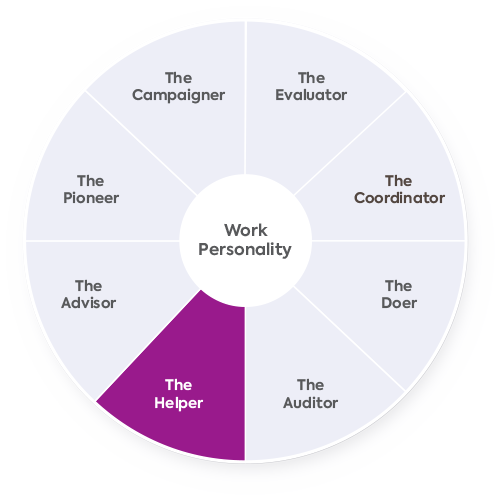
The Helper, one of eight Work Personality types
Natural leadership style
Democratic Leadership
Assessment
Four questions, two minutes, free
Reading time
About 7 minutes
The Work Personality wheel with the Helper segment highlighted

Introduction

Characterised by their genuine altruism, Helpers are empathetic, persuasive, and known for their keen perceptivity of others' feelings. They tend to be reserved and contemplative, often seen in a reflective state of mind.

Driven by their deep-seated personal values and beliefs, Helpers thrive in environments where they can be of assistance to others. As approachable and nurturing individuals, they excel in creating inclusive spaces that allow everyone to feel supported.

The Helper

Major characteristics

  • Empathetic, persuasive, and perceptive of others' feelings.
  • Reserved, reflective, and contemplative
  • Considerate and enjoys helping and supporting others.
  • Driven by personal values and beliefs.
  • Approachable, nurturing, and inclusive.
At work

Main preferences for work

From their intrinsic desire to build supportive and harmonious relationships to their service-oriented tasks focus, this personality type flourishes in a collaborative and socially engaging setting. They find fulfilment and motivation in roles that not only allow active contribution to team well-being but also align with their personal ethics.

  • Values building supportive and harmonious relationships.
  • Service oriented tasks and collaborative group focus.
  • Seeks roles that allow active contribution to team well-being.
  • Enjoys tasks that involve interpersonal communication.
  • Finds motivation in roles that align with personal ethics.
Watch for

Potential blind-spots at work

A Helper can prove to be instrumental in fostering a thriving workplace with their collaborative and empathetic approach. However, while they are adept at interpersonal relationships, this personality type has a few potential blind spots that could impede their progress.

  • May avoid confrontations, even when necessary.
  • Could struggle with tasks requiring aggressive or competitive actions.
  • Might prioritise relationships over task completion.
  • Occasionally overlooks analytical or data-driven decision-making.

Tips for collaborating with this personality type

Imagine a colleague who thrives in a collective setting, someone who values team spirit and harmony above all else. Their strength lies in their empathetic nature and their unique ability to foster relationships within the team. Here are some do's and don'ts to guide you in creating a supportive and conducive work environment for them.

Do's

  • Do involve them in team-building and collaborative projects.
  • Do provide opportunities for them to mentor or support others.
  • Do value their empathetic approach and people-focused skills.
  • Do encourage their input in defining team and organisational values.

Don'ts

  • Don't isolate them or limit their interaction with team members.
  • Don't overlook their need for personal connection in the workplace.
  • Don't undervalue their role in maintaining group morale and support.
  • Don't push them into situations where confrontation is likely without support.

Knowing Me (worksheet)

Jam-packed with insightful questions, this is a worksheet all about you.
Yes, you heard it right, YOU.

This worksheet is intended to help you delve deeper into your work personality and understand how you tick. And once you gain clarity about yourself, you won’t be keeping it a secret.

The "Knowing Me" worksheet is a fantastic way to share your insights with your team. By inviting your colleagues into your world, you are encouraging a more cohesive and understanding work environment.

So, let's get down to business and start filling it out, shall we?

  • Are you known for your supportive nature and the ability to promote team harmony?
  • Do you help others quietly and efficiently, without seeking acknowledgment or praise?
  • Are you skilled at understanding and managing team emotions, thereby improving team cohesion?

Remember, these examples are just a starting point - your worksheet is your canvas to fill with your own unique colors and shades.

Download the Knowing Me worksheet for The Helper
Knowing Me The Helper

PDF, opens in a new tab.

Guess who?

Peer into the minds of the world's most influential leaders πŸ“£

Ever wondered if you share a personality type with Nelson Mandela, Steve Jobs, or perhaps Mother Teresa? Here's your chance to find out, but there's a catch! We aren't revealing them upfront.

Try guessing them first. As you click each mystery card, the leader will be revealed.

These leaders are empathetic, supportive, compassionate, reflective, harmony-seeking, and collaborative. πŸ€”

Revealed
Mahatma Gandhi 🀝

Known for his empathy, compassion, and ability to lead with a focus on harmony and non-violence.

Revealed
Jacinda Ardern 🀝

Former Prime Minister of New Zealand, admired for her empathetic, compassionate leadership style, and focus on inclusivity.

Revealed
Mother Teresa 🀝

A humanitarian leader, exemplifying empathy, selflessness, and a commitment to serving others.

Want to guess more influential leaders? Explore all eight types

Career paths

The Helper thrives on assisting others, displaying immense empathic capabilities and a passion for ensuring the sustainability of processes.

They have an innate preference for interactions with individuals or small group settings, often choosing careers where they can nurture and guide others toward personal and professional growth.

Their empathetic and supportive character makes them excellent Psychologists, Social Workers, and Counsellors.

Their desire to ensure sustainable processes finds them in roles like HR Specialist or Employee Relations Manager.

They thrive in roles such as Occupational Therapist, Nurse, and School Counsellor, where they can directly contribute to individual wellbeing.

Their focus on supporting others also makes them successful Learning & Development Specialists, Employee Wellness Coordinators, and Corporate Social Responsibility Managers.

The full list:
Empathy and support
  • Psychologist
  • Social Worker
  • Counsellor
  • Humanitarian Worker
  • School Counsellor
  • Career Counsellor
  • Learning & Development Specialist
  • Employee Wellness Coordinator
  • Corporate Social Responsibility Manager
  • Customer Service Representative
Sustainable processes
  • HR Specialist
  • Employee Relations Manager
  • Librarian
  • Benefits Coordinator
  • Diversity & Inclusion Specialist
Individual wellbeing
  • Occupational Therapist
  • Nurse
  • Physical Therapist
  • Nutritionist

Leadership style

Individuals have natural or preferred leadership styles that align with their personality types.

For Helpers, they may find aspects of their preferred leadership style easier or more challenging in certain circumstances. But that doesn't mean they can't adapt to specific situations.

Effective leaders are flexible and change their approach based on the situation.

By remaining flexible in their approach, Helpers can harness their strengths while also adapting to the team's needs and the demands of the task.

The Helper's natural leadership style is:

Democratic Leadership

See how Helpers adapt to the other two
What does this mean? πŸ€”

Democratic Leadership focuses on collaboration, shared decision-making, and input from the team. Democratic leaders encourage participation and value the contributions of their team members, guiding them toward a common goal.

This style is best suited to environments where creativity, innovation, and diverse perspectives are valued, as it allows for greater engagement and ownership from team members. Read more.

HOW to ADAPT TO other situations

Any leadership style can be adjusted to fit different situations and team needs.

Click each tab below to discover what's easy and hard when adapting to each leadership style.

Pick a style to compare

Adapting to Democratic Leadership (natural style)

What's easy?

Helpers can take on directive leadership if they are motivated by the well-being of the team, providing clear guidance to avoid confusion or stress for their team members.

Blindspots?

They will struggle with giving orders or being too controlling, as they prefer collaboration and ensuring everyone feels valued.

What's easy?

Helpers naturally thrive in democratic leadership as they prioritise relationships and enjoy engaging others in shared decision-making. They excel in creating an inclusive, supportive environment.

Blindspots?

They may find it hard to enforce deadlines or make tough decisions when team input conflicts, as they aim to keep everyone happy.

What's easy?

Helpers enjoy giving autonomy to trusted team members, allowing them the space to grow and develop independently.

Blindspots?

They may struggle with stepping back completely, especially if they feel team members need emotional support or clearer guidance.

Related tool Β· leadership style assessment

Want to be sure if Directive, Democratic or Non-Directive Leadership is right for the current situation or decision your team faces?

In 10 short questions, find out the most appropriate leadership approach you can use for every team situation.

Assess my situation now

Leadership style dial

Resolving conflict in teams

For leaders, conflict within a team can seem like a daunting challenge.

Yet, when equipped with a deep understanding of each team member's unique personality, leaders can harness these moments to foster growth, spark innovation, and cultivate harmony.

Below is practical advice for leaders to navigate such scenarios effectively, based on the personality types in their team. 

Click each personality type below to see practical advice for a leader to manage conflict with the Helper.

Guide the Advisor to focus on decision-making, e.g., β€œLet’s make sure we find a resolution that works for everyone.”

Encourage the Helper to assert their needs, e.g., β€œPlease share your thoughts on how this decision might impact the team.”

Help the Pioneer consider emotional impacts, e.g., β€œLet’s think about how this approach might affect team morale.”

Encourage the Helper to participate more actively, e.g., β€œHow do you feel about the direction we’re going in?”

Encourage the Campaigner to consider team dynamics, e.g., β€œHow do you think this plan will affect the overall team atmosphere?”

Help the Helper feel safe to express their concerns, e.g., β€œYour input is importantβ€”how do you feel about this idea?”

Help the Evaluator acknowledge the emotional aspects of decisions, e.g., β€œLet’s consider the team’s feelings about this plan.”

Encourage the Helper to voice their concerns, e.g., β€œYour thoughts are valuable hereβ€”how do you feel about this decision?”

Encourage the Coordinator to check in on emotional well-being, e.g., β€œHow do you think this plan impacts the team emotionally?”

Help the Helper voice concerns confidently, e.g., β€œWe value your perspectiveβ€”how do you think this approach will affect team morale?”

Help the Doer check in with the team’s emotional well-being, e.g., β€œHow is this task affecting the team emotionally?”

Encourage the Helper to voice their concerns confidently, e.g., β€œYour insights are valuableβ€”how do you think this approach affects team morale?”

Encourage the Auditor to consider emotional aspects of decisions, e.g., β€œHow might these details impact the team’s morale?”

Guide the Helper to value detailed planning, e.g., β€œThis thorough approach will benefit the team in the long runβ€”how do you feel about it?”

Create a safe space for both Helpers to share concerns, e.g., β€œLet’s make sure both of your perspectives are heardβ€”this discussion is important for the team.”

Reinforce that conflict can be constructive and lead to stronger outcomes.

One result is interesting.
Eight of them is a map.

Send this page to the people you work with and ask for theirs. Most friction at work starts in the gap between how you prefer to work and how they do, and that gap is easier to talk about once it has a name.

Everyone can take the assessment free, in about two minutes.

The eight Work Personality types

Tap a segment to see what each type brings, and where each one gets stuck.

Tap or click a segment

 EvaluatorCoordinatorDoerAuditorHelperAdvisorPioneerCampaignerEightWORK TYPES
This page

The Evaluator

"Let's weigh up our options!"

Tests the thinking and finds the risk before it finds you.

Read the full Evaluator page

Eight types, one of them is yours.


Not sure which one is yours? Take the assessment Four questions. About two minutes.

How you prefer to work
is not how everyone works.

Work Personality maps your preferences against the kinds of work high-performing teams rely on, and gives you one of eight types. It is not a measure of ability. One person thinks out loud and decides fast, another needs quiet first. Neither is wrong, and most friction at work starts in that gap.

For one person it is a conversation starter. For a whole team it is a map: which kinds of work are covered twice over, and which are not covered at all.

The two assessments

This page

The short assessment. Four questions. One of eight types. Free, and a strong indication rather than a diagnosis.

The platform

The validated assessment. Psychometrically validated, measured by degree, and detailed enough to make decisions you can defend.

Designed by corporate psychologist Rudy Crous. Related reading: leadership styles and your personality and what the Helper type means at work.

Common questions about the Helper

Characterised by their genuine altruism, Helpers are empathetic, persuasive, and known for their keen perceptivity of others' feelings. The Helper's catchphrase is β€œLet's support each other!”. It is one of the eight Work Personality types, each matched to a kind of work high-performing teams need covered.

Empathetic, persuasive, and perceptive of others' feelings; Reserved, reflective, and contemplative; Considerate and enjoys helping and supporting others; Driven by personal values and beliefs; Approachable, nurturing, and inclusive.

Their empathetic and supportive character makes them excellent Psychologists , Social Workers , and Counsellors . Their desire to ensure sustainable processes finds them in roles like HR Specialist or Employee Relations Manager .

Democratic Leadership. Democratic Leadership focuses on collaboration, shared decision-making, and input from the team. Democratic leaders encourage participation and value the contributions of their team members, guiding them toward a common goal. Effective leaders are flexible and change their approach based on the situation.

Do involve them in team-building and collaborative projects. Do provide opportunities for them to mentor or support others. Do value their empathetic approach and people-focused skills. Do encourage their input in defining team and organisational values.