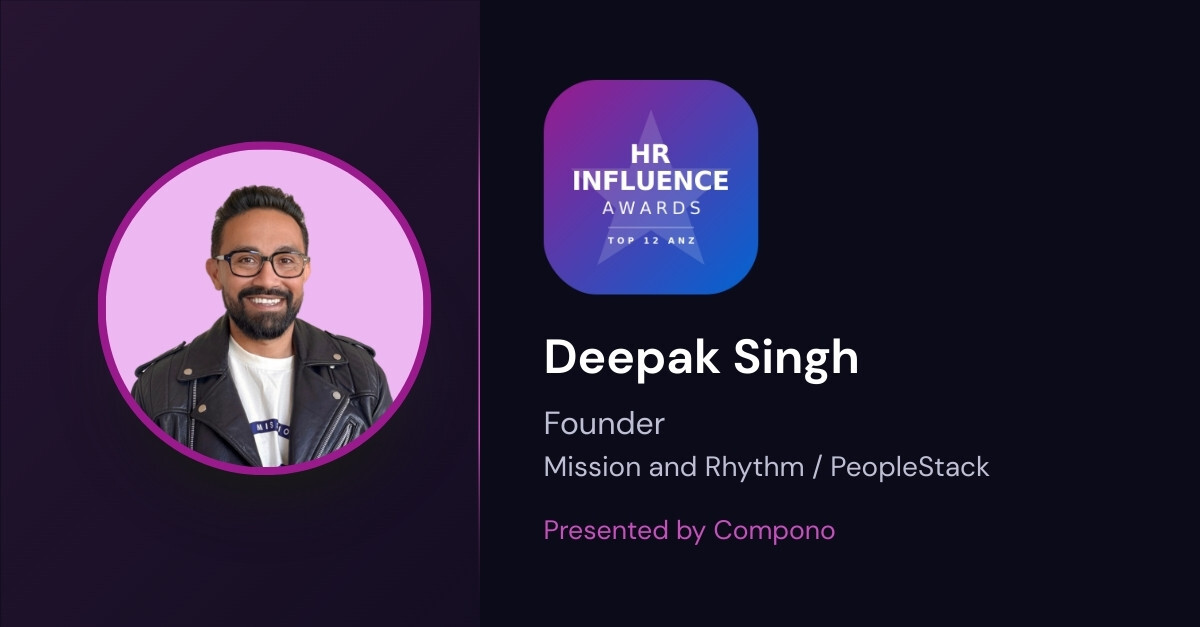
Deepak Singh asked his team a simple question after running an engagement survey: what would actually make a real difference? Some teams came back with ambitious goals. Others asked for whiteboard markers that worked.
That second group taught him more than the first. Singh, founder of Mission & Rhythm, PeopleStack, and Just Sing Out, and a 2026 HR Influence Awards Top 12 member, shifted Gallup engagement from the 25th to the 75th percentile in 18 months at a previous APAC tech role. The starting point was smaller than anyone expected.
In this article:
- Deepak Singh moved Gallup engagement from the 25th to the 75th percentile in 18 months by running six-monthly change sprints with visible ownership and real consequences
- The first round of engagement improvements included requests as simple as working whiteboard markers, proving the system responded before asking teams to aim higher
- Singh rebuilt onboarding for new starters and simplified six compensation plans into one, cutting early-career attrition (first 12 months) by 40%
- His honest approach to hiring includes putting leadership challenges directly into job ads, which filtered out 60% of applicants but produced a hire still in the role three years later
- Singh runs three ventures from the same mission: "Great experiences for our business and community, through great experiences for our people"
Prove the system works first
Most companies run an engagement survey, share a few slides, and move on. Singh did the opposite. Results went back to employees quickly, without spin, without anyone softening the findings. Then he asked two questions: what does this actually mean to you, and what would actually make a real difference?
"We made the results matter," Singh says in our interview. "Most companies run a survey, eventually share a few slides, nothing tangible really happens, and then everyone moves on. So we broke that mould and did the opposite."
The team ran six-monthly change sprints with clear actions and visible ownership. Managers who took action were rewarded. Managers who didn't were held accountable, including through their bonus.
The whiteboard markers were the point. Not because stationery transforms culture, but because responding to something small proved that the system actually listened. Each cycle, teams got better at setting goals and owning what happened next. Singh describes it as building a hurricane, with each circle growing concentrically bigger.
On the structural side, the business had grown through acquisition and had six different compensation plans for six different products. Singh's team simplified it to one. They rebuilt onboarding for new starters, which cut early-career attrition in the first 12 months by 40%.
For HR teams trying to close the gap between survey data and real action, tools like Compono Engage can surface culture and engagement signals in real time. But as Singh's whiteboard markers story shows, the tool only matters if someone acts on what it reveals.
The job ad that scared everyone away
When the conversation turns to hiring, Singh tells a story that captures his entire philosophy.
A client came to him with a role to fill. Great role, real impact, good team. But the CEO was difficult. The client's exact words were stronger than "difficult," though Singh cleans them up slightly: "They came to me and said, hey, this is a great role, really powerful, but to be honest, the CEO's an idiot."
So they put it in the job ad. Not those words exactly, but close. The leadership would be extremely challenging. The environment would be hard. They had a bit of fun with the language and kept it honest.
"That probably got rid of 60% of people who would normally apply," Singh says. "But the people who did apply walked in with eyes wide open."
Three years later, the hire is still in the role. The culture has improved. Singh sees this as the same principle that runs through all his work: the employee journey and the customer journey are the same journey. Design both with the same intentionality, and people know where they stand from day one.
Breakups, bad hires, and holding on too long
Asked whether he's ever made a bad hire, Singh doesn't flinch. "Of course. I think most of us have."
The mistake, he says, wasn't the hire itself. It was how long he held on before addressing the misalignment. "The longer you wait, the more it costs everyone. The team, the team member, yourself, and in the end your customers as well."
He's blunt about what letting someone go actually feels like. "In the end, it's a relationship and sometimes some relationships don't work. Breakups are shit, but they don't have to be bad."
His advice on avoiding bad hires in the first place is practical. Get alignment on what good looks like across the entire hiring team, not just the hiring manager. Define what the person needs to achieve in concrete terms. "It might be three dot points. But if you can start with that and be really clear, it's much easier to look for that versus this laundry list of 17 different things."
Read the full story
This post covers the highlights. The full feature article goes deeper into Singh's career journey from corporate HR to founding three ventures, his approach to getting executive buy-in, the pre-legal coaching model behind Just Sing Out, and the advice he'd give his younger self.
Read or watch the full feature on HR Influence Awards
See how it works
If Singh's approach to closing the gap between engagement data and real action resonates, Compono Engage gives mid-market HR teams the tools to surface culture signals before they become problems.
See how Compono Engage works -- no commitment, just a look at what's possible when engagement goes beyond the annual survey.
FAQ
How did Deepak Singh improve employee engagement so quickly?
Singh shifted Gallup engagement from the 25th to the 75th percentile in 18 months by returning survey results to employees without spin, asking what would make a real difference, and running six-monthly change sprints with clear ownership. Managers who acted were rewarded. Those who didn't were held accountable through their bonus. He also simplified six compensation plans into one and rebuilt onboarding, cutting early-career attrition by 40%.
What is an honest job ad?
An honest job ad includes the real challenges of the role and working environment rather than selling only the positives. Deepak Singh helped a client include genuine warnings about difficult leadership in a job ad. While 60% of typical applicants dropped out, the person who was hired stayed in the role for over three years because they knew what to expect from day one.
What are the HR Influence Awards?
The HR Influence Awards recognise the most influential people and culture leaders across Australia and New Zealand. The 2026 Top 12 winners were selected based on their voice, impact, community contribution, innovation, and influence across the profession. Deepak Singh was selected for his combination of multi-organisation measurable impact and community leadership, including benchmarked Gallup shifts across his career.
Deepak Singh is Founder of Mission & Rhythm, PeopleStack, and Just Sing Out, Melbourne. He is a 2026 HR Influence Awards Top 12 ANZ, HRD Hot List 2024, Culture Amp Top 25 Emerging Culture Creators 2024, and Culture Amp People Geek Community Board member. Connect with him on LinkedIn.
The HR Influence Awards are presented by Compono.

Better hiring decisions, before the interview
Compono Hire helps you predict job-fit and team-fit using behavioural science, so you can shortlist with confidence.
Request a demoBuilt for mid-market hiring teams.

Practise your next tough conversation
Voice-first coaching that adapts to your personality. Get actionable steps you can take this week.
Start freeBuilt by Compono. Not therapy — practical behaviour change.

.png?width=383&height=200&name=team%20(1).png)
Rudy Crous