

.webp)

 Mathan Allington


The 'Brilliant Jerk' problem (and why every winner has a bad hire story)
 Mathan Allington
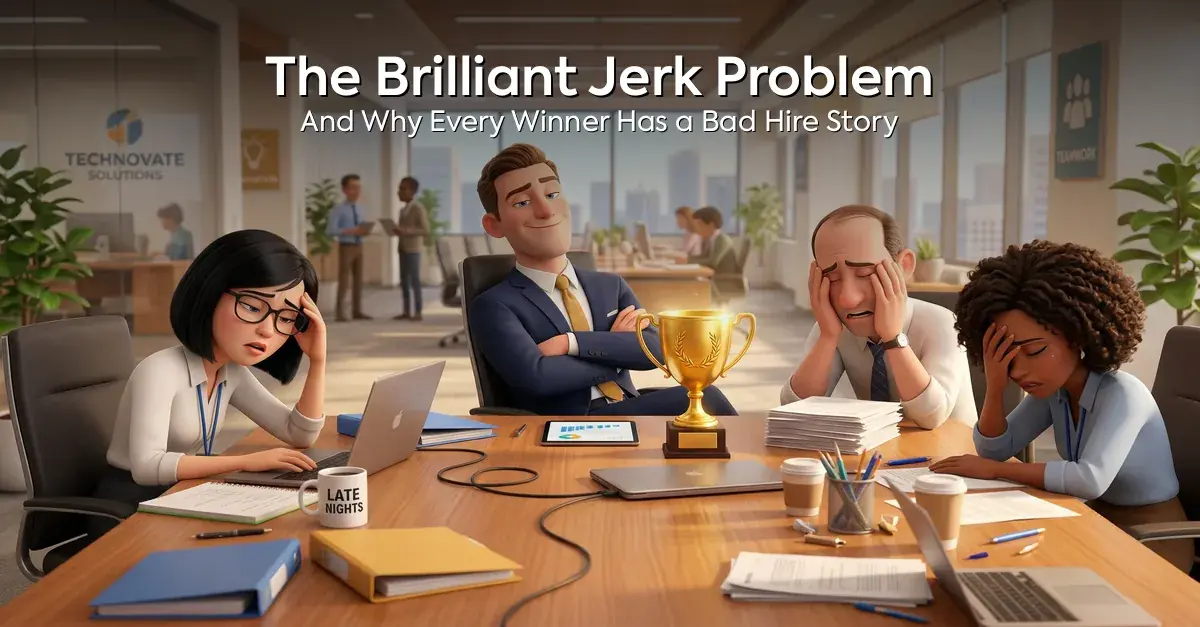
Every HR Influence Awards 2026 winner admitted to making a bad hire. Here's what six of Australia and New Zealand's top people leaders learned about...
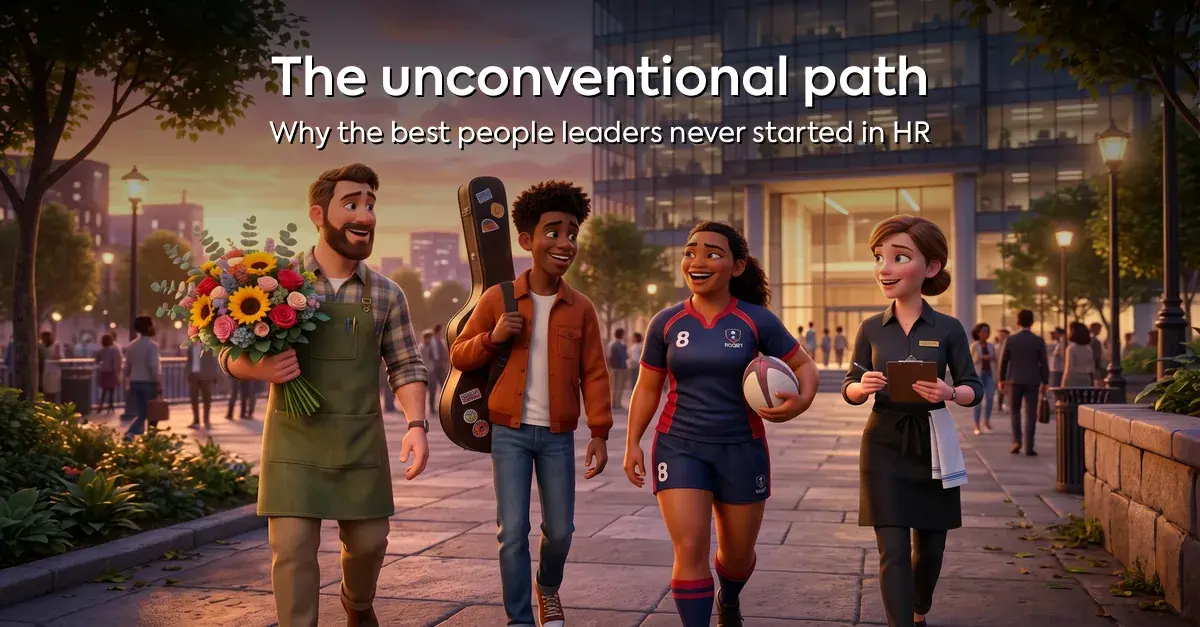
Edan Haddock was arranging wedding bouquets when most HR professionals were writing their first performance review.
He spent the best part of his twenties and early thirties as a professional florist, self-employed, working with his hands. The white-collar world was something that happened to other people. Then at 30, he made a career change that even he didn't fully understand at the time, landing in a call centre directing people to HR support when the Fair Work Act came in.
"I'm a late joiner to the HR industry," says Edan Haddock, Head of Talent and People Experience at Movember and one of twelve winners of the HR Influence Awards 2026. "I was a florist and self-employed until I was 30. Did a career change and moved into the white collar industry basically."
What makes Edan's story interesting isn't the career switch itself. It's what he brought with him. And he's not alone. Across the eight winners we interviewed for this year's awards, not one of them followed a straight line into people leadership. A musician who dropped out of university four times. A French teacher who managed a pub at Harvard. A commerce and law graduate who knew from day one he didn't want to practise law. A rugby development manager. An operations professional. A psychology graduate who couldn't get an entry-level HR job.
As the producer of the awards, having been on the call for all twelve interviews, I noticed this pattern early. When Rudy asked each winner how they ended up in HR, nobody gave a simple answer. Every story had a turn in it. And the more I heard, the more I started to think the turns were the point.
Edan has been reflecting on what floristry gave him. Not in an abstract, nice-story-for-the-bio way, but in practical terms about what the profession actually needs right now.
"I've been reflecting on this quite a bit," he says. "The really big one for me is creativity. I'm in this environment where the skills that I learned as being a professional florist for such a long chunk of my career, it's now the time that I'm really bringing that to the table."
He describes a recent piece of people analytics work with his team member Kiyo, where they used AI to process what would have taken weeks manually. The data crunching was handled. What was left was the part that mattered.
"Kiyo and I could really focus on how do we bring this to life and how do we creatively tell these stories to the people that matter. I think that creativity and that storytelling and being able to tap into that mind is where we all need to be focused. The people that haven't been able to do that or perhaps don't have that skill are going to find it harder to adjust in this kind of automated world that we're moving into."
There's something worth sitting with there. In a profession that has historically been defined by compliance and process, the person making the strongest case for creativity learned it arranging flowers, not studying organisational behaviour.

Drew Mayhills, Chief Learning and Innovation Officer at AIM WA, didn't find HR through a careers counsellor or a graduate program. He found it the way musicians find most things: by following what was interesting and figuring out the rest later.
"I started as a musician. I dropped out of uni four times to go and play on tour in bands," he says. "A lot of that has come about by being open to opportunities, saying yes, trying things and committing to things sometimes without necessarily having completely the plan all worked out."
Drew calls it a "squiggly line career." From music, he moved into education, then technology, then worked as an art director for a period, then coaching. Each chapter fed a different part of what he was looking for, though he didn't always know what that was while he was in it.
"When you're looking forward it doesn't seem to make a lot of sense but it's much easier to connect the dots looking backward."
What music gave Drew was a foundation in creative thinking that now drives his innovation agenda. His Churchill Fellowship in 2023, focused on AI for teacher effectiveness, sits at the intersection of education, technology and people. Three threads that only make sense when you trace them back through the touring vans and the four university attempts.
"I have my dream job for that reason," he says. "It was always the case prior to this role that I was feeding one part of what I loved. Maybe I was creative, but I didn't necessarily have the technology acumen. Or I was really engaged in the learning, but I wasn't allowed to play in the creative space."

Teresa Lilly, Founder of Culture Pilot Co, has what she cheerfully describes as "a very eclectic career." She studied French at university, taught languages, managed a pub at Harvard where she ran events, and played classical piano. The HR thing, as she puts it, found her.
"I kind of fell into HR. It wasn't something that I sought out. It found me."
But when she talks about what those earlier careers actually gave her, the connections are surprisingly direct.
"By learning another language, it changes your worldview and the things that you kind of assume are standard or everyone thinks the same way. You actually can go into another culture in another language and it's totally different."
That cultural sensitivity now runs through everything she does with startup clients at Culture Pilot Co, helping founders see that the way they've always done things isn't the only way. The pub management at Harvard? That was about bringing people together.
"I was a pub manager and we did karaoke every Friday night. So I had to get over it and get myself on stage," she laughs. "How do you build those connections with people and create those moments and opportunities?"
Teresa sees the through line clearly. "I think you look at HR professionals and a lot of people come from quite different backgrounds and that does influence the flavour of HR that you bring and how you approach the space."
For organisations trying to understand what actually shapes great people and culture leadership, Teresa's career is a useful case study. The diversity of experience isn't a detour. It's the qualification.
Alex Pusenjak, Global VP of People and Culture at Fluent Commerce, took a more structured route into the profession. He studied commerce and commercial law, started in a different industry entirely, and then made a deliberate jump into HR.
"My path wasn't a straight line," he says. "That foundation in law and commerce did give me a very clear internal compass. I always knew exactly what I didn't want to do. I didn't want to be a cog in a machine or manage spreadsheets that lacked pulse."
What the commerce and law background gave Alex was something that shows up every day in how he operates: the ability to speak the language of the business. He talks about understanding revenue direction, partnering with CFOs, bringing data-driven insights to leadership.
"You need to be able to speak the same language as your CFO. You need to understand the business more than ever and understand where the direction from a revenue perspective is."
It's a point that came up across several interviews. The winners who could translate between people priorities and commercial language were the ones getting invited into strategic conversations. Alex didn't learn that in an HR textbook. She learned it studying law and commerce.
Anna Liumaihetau Darling, GM of People Experience at Sharesies, spent five years at New Zealand Rugby growing the women's game. It wasn't a traditional HR role. It was product development, in the truest sense.
"We were basically developing a new product, which is girls and women playing rugby," she says. "Even though they had been doing it for a long, long time, there was nothing really in structure in place. So we had the ability and the freedom to try things differently."
That experience of building something from scratch, challenging the way it had always been done for the men's game, and creating new systems for a different audience transferred directly to Sharesies.
"How do we then at Sharesies as a new startup company, build and create the systems, policies, processes that work for us? So how can I translate some of that stuff we did differently in the women's game, crossover to Sharesies?"
Anna joined when there were fewer than 50 people. The company now has around 230. The parallels between building women's rugby infrastructure and building a fintech people function aren't obvious until you hear her describe both. Then they're impossible to miss.

The pattern holds across the rest of the group too.
Sharon Gray, Chief People Officer at OzHarvest, came through operations before moving into people management. She sees it as a clear advantage. "I think it helps me work within organisations with stakeholders to understand that they have things on their plate as well that are not necessarily HR focused. Understanding that and being able to navigate that in a realistic and practical way has helped me do my job well."
Matt McFarlane, Founder and Director of FNDN, studied psychology at university "quite literally just because I enjoyed it as a subject in high school." He had no plan. When someone eventually mentioned that psychologists often end up in HR, he looked into it, liked what he heard, and tried to get an entry-level role. He couldn't. So he took a job as an office administrator for twelve months, doing filing and phones, until he could get his foot in the door.
And Deepak Singh, Founder of Mission and Rhythm, PeopleStack and Just Sing Out, built three ventures out of frustration with the profession's limitations. His move out of corporate roles at Uber Car Share and REA Group wasn't a grand plan. "It actually started out of frustration. I'd finished a great contract. I stepped into what was a non-existent job market." Someone asked him to help with a project. He registered an ABN to get paid. And that was the beginning of everything.
What connects all three is a refusal to wait for the profession to hand them a path. They made their own.
There's something worth paying attention to here. Eight winners. Eight completely different entry points into people leadership. Not one of them followed the conventional route of studying HR, getting a graduate role, and working their way up through the function.
A people and culture platform can help organisations identify the skills and values that matter most. But the insight from these eight leaders is that the most valuable skills in people leadership often come from somewhere else entirely. Creativity from floristry. Commercial thinking from law. Cultural sensitivity from learning French. Product thinking from women's rugby. Stakeholder empathy from operations.
The profession benefits from people who didn't grow up inside it. Not despite their unconventional backgrounds, but because of them.
As Edan puts it, reflecting on his own path: "I was raised in an era where creative people do creative work and mathematical people do like-collar work. I think the first thing I would say would be your creativity is going to be your greatest asset."
He was talking to his younger self. But it's advice the entire profession could stand to hear.
Read the full feature articles for each winner mentioned in this piece:
About the HR Influence Awards
The HR Influence Awards recognise the top 12 HR and people leaders across Australia and New Zealand who are shaping the future of work. Presented by Compono, the awards celebrate leaders who go beyond policy to drive real business and cultural outcomes.
#HRInfluenceAwards
Every HR Influence Awards 2026 winner admitted to making a bad hire. Here's what six of Australia and New Zealand's top people leaders learned about...
Seven HR Influence Awards 2026 winners on how to lead diverse personalities, from the platinum rule and whole-brain thinking tools to why the leader...
Five HR Influence Awards 2026 winners on what AI has changed in their teams, where it falls short, and the disclosure gap worrying them.