
.webp?width=559&height=292&name=2026.07.21%20Fireside%20KV%20-%201200x627%20(event%20featured).webp)
.png?width=383&height=200&name=team%20(1).png)
 Mathan Allington


1 min read
Best Greenhouse alternatives for modern hiring teams
 Mathan Allington
The best Greenhouse alternatives depend on why you're switching: Compono Hire for culture-fit hiring in the mid-market, Lever for a combined ATS and...

To defend a hiring decision, replace gut feel with a multi-dimensional assessment framework that scores every candidate on organisation fit, technical skills and work personality against criteria set before recruitment starts. Objective data creates a transparent audit trail that justifies your choice to stakeholders, and it protects you months later if the hire is questioned.
Last reviewed July 2026.
Everyone has sat in a post-interview debrief where the feedback was "they just didn't feel like a good fit" or "I'm not sure about the vibe". Intuition has its place in human interaction, but it is a shaky foundation when you need to justify a hire to a board or a department head. Subjectivity is the gateway for unconscious bias, producing teams that look and think exactly like their managers, which quietly caps performance.
When a hire does not work out, the finger points at the recruitment process. Without clear data points to review, you cannot analyse what went wrong or justify why that person was chosen over another. Protecting your reputation as a talent leader means shifting the conversation from feelings to facts, and that starts with defining success before the first CV lands.

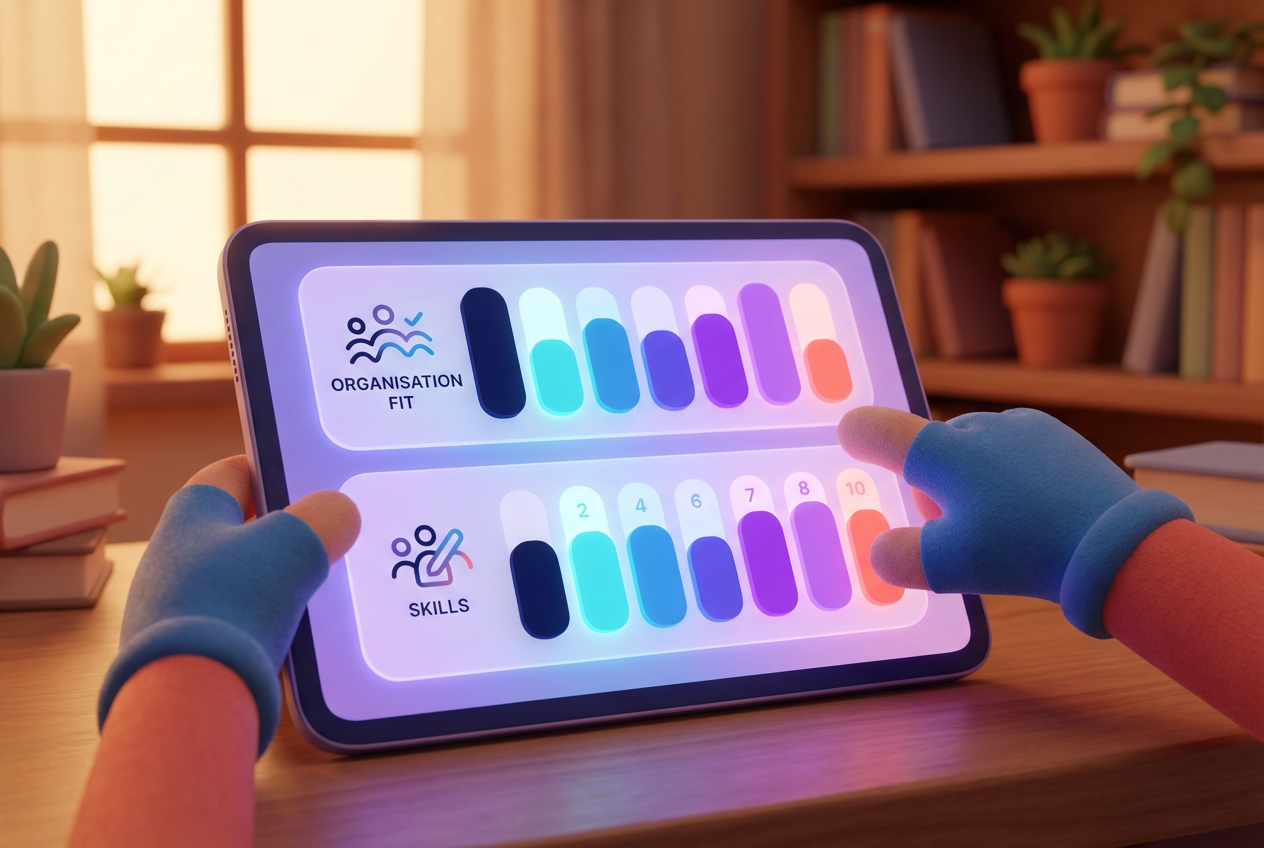
Defensible hiring needs standardised criteria applied to every candidate, which means going beyond the resume review. Experience tells only part of the story. Compono evaluates candidates across three dimensions: organisation fit, skills and qualifications. Measuring each independently gives you a rounded view that is hard to argue with.
Organisation fit is where the most bias creeps in, so structure it. A measured assessment of candidate fit shows exactly how a person aligns with your values and team dynamics. If a stakeholder questions the hire, you point to specific scores in collaboration or adaptability. The discussion moves from personality clashes to business objectives.
Every team has a unique DNA, and adding a member changes the chemistry. If you can prove a candidate brings the traits the team currently lacks, your decision becomes a strategic move rather than a shot in the dark. A team full of Pioneers generates ideas but struggles with execution, so hiring a Doer or Coordinator is a logical, defensible choice to balance it.
Compono Hire automates that ranking, scoring candidates on these exact dimensions and predicting culture fit with 92% accuracy. A data-driven shortlist lets you show stakeholders that your selection is not just a good person but the right person, backed by a decade of research into high-performing teams.
Even with strong pre-employment assessments, the interview still matters, and a defensible interview is a structured one: the same behavioural questions for every candidate, scored against a pre-defined rubric. When everyone plays on the same field, results become comparable and objective.
If a decision is challenged months later, those scores are your best defence. You can demonstrate the candidate gave specific examples of past behaviour matching the role's core competencies, and that the process was consistent and fair. That transparency keeps recruitment positioned as a strategic partner rather than a cost centre.
The reason defensibility matters is the price of getting it wrong. Beyond the cost of re-recruiting, a bad hire drags team morale and slows project timelines. A data-backed selection process de-risks the investment: you are not filling a seat, you are building a high-performing culture.
The Compono Culture, Engagement and Performance Model maps the link between how people are hired and how they perform long term. When your hiring process connects directly to performance outcomes, defending your decisions stops being an argument and becomes a report.
Compono Hire scores every candidate on fit, skills and work personality, giving you an audit trail stakeholders cannot argue with.
Talk to usFocus on the data. Share the candidate's scores across organisation fit, technical skills and work personality, and explain how their profile matched the pre-defined role requirements better than other applicants. It keeps the conversation objective and professional.
Culture fit is often a catch-all for subjective feelings, which makes it legally and professionally difficult to justify. Organisation fit, which measures alignment with specific values and behaviours, gives you a concrete framework you can measure and defend.
No tool is a crystal ball, but assessments grounded in psychological research reliably predict how someone will handle conflict, collaboration and task execution in a team setting, which is exactly what most hiring disputes turn on.
Keep the original job description, the interview scoring rubric, the results of all pre-employment assessments, and a summary of why the successful candidate was chosen against the criteria. Together they form a clear audit trail.

1 min read
The best Greenhouse alternatives depend on why you're switching: Compono Hire for culture-fit hiring in the mid-market, Lever for a combined ATS and...

1 min read
Hiring across locations requires a unified digital infrastructure that balances centralised control with local flexibility to ensure every new...

1 min read
An applicant tracking system (ATS) for a mid-market business has to bridge the gap between basic job posting and heavy enterprise recruitment...
 Compono